There are what we might call birthing pains switching over to Mountain Lion. So far they have fallen more into the curiosity category than the I want to slash my wrists category.
First of all, one of the big reasons I did it was to get all clouded up. I turned on everything and, well, nothing happened. Which was sort of disappointing, having that little notification icon on the top right over there with no notifications to keep it happy. Then, all of sudden, it looks as if I'm being notified of every email I've ever received. I've never actually used the Mac mail client, primarily because in the past, because my Yahoo mail isn't a POP account, for which I refused to pay the two dollars, it wasn't supposed to work. So much for that.
Sigh. It will sort itself out, I'm sure. I guess it behooves me to keep the Mail app in the dock...
(The local theater just wished me a Merry Christmas!)
As for programs, the one I was worried about most was VMWare Fusion, through which I run Windows and TRPC. At first blush, it told me it wouldn't work, even though I had already researched that it would. Turns out that Mt Lion sees an old version somewhere in the guts and doesn't recognize the new version. No big deal. I downloaded the new version again (VMWare remembered me—never underestimate the value of registering software) and before long I was back in business.
I've declined the idea of clouding my photos. It would require a new version of iPhoto and, honestly, I don't want my recent photos like that. I want all my photos on my iPad and Mac, and that's easy enough to do manually, especially since I use my SLR as often as not, and am not dependent on the iPhone as my main camera.
The biggest issue, having nothing to do with Apple, is that Amazon, which had told me I was grandfathered in to having all my music on their cloud for free because I was such a wonderful customer, just buried grandpa. However, for twenty-five smackers a year I can keep their cloud. Then again, also for twenty-five smackers a year I can use iTunes and their cloud. When you've sold your soul to both Apple and Amazon, this is a tough choice, but I think I'm going to go with Apple.
Life is sooooo tough.

Saturday, August 04, 2012


Friday, August 03, 2012
Riding off into the weekend

This looks like a dream of Tomorrowland juxtaposed against Cinderella's castle, if you had too many pickles right before going to sleep. The io9 headline says it all: An abandoned Russian theme park (with a woolly mammoth) in Japan.
Have a nice weekend. Don't eat too many pickles.
Hope springs eternal in the Menickean breast
I'll bet anything I've used that headline before. More than once. I am so much the eternal optimist! When a glass is filled to the brim I see a glass that isn't half empty. What can I say? I'm a Pollyanna.
[Translation: I upgraded to Mountain Lion overnight and haven't checked yet to see how everything is working. I'm writing this on a different machine.]
And did I mention that I have a couple of Sailors lined up to Pfffft at Yale? Of course, when you think about it, there's only one shot at one topic for Septembrists, which seems like a squandering of mental resources, but then there's literally something every weekend in October, given that these two are young 'uns who can debate at the MHL and CFL. So I'm really rooting for October to be a good topic. That's where the money is.
I keep getting bulletins from the front, i.e., Vegas, from O'C, who's never met a physical space he didn't immediately check into. I do not find it ironic in the least that he went to see a ventriloquist act in the middle of NFL, but that's just me. He's also eaten every few minutes, often with people I would have liked to be eating with myself. Ten to one, however, that someone else is now mayor of Japonica. Or let's put it this way, I'm hoping that someone else is now mayor of Japonica...
And I do admit some curiosity over what the NFL was up to. Their website is wonderfully informative, if you don't want any information. Your annual dues at work! Rumor has it that they're changing the name of the organization to "The People Who Talk A Lot About One Thing or Another in Front of Other People," or something similarly mellifluous, but I could be wrong about that. Maybe, seriously, they'll start understanding someday that they are not a national organization if they ignore the needs of areas like the northeast. But probably not. Greater minds than mine have made the case.
[Translation: I upgraded to Mountain Lion overnight and haven't checked yet to see how everything is working. I'm writing this on a different machine.]
And did I mention that I have a couple of Sailors lined up to Pfffft at Yale? Of course, when you think about it, there's only one shot at one topic for Septembrists, which seems like a squandering of mental resources, but then there's literally something every weekend in October, given that these two are young 'uns who can debate at the MHL and CFL. So I'm really rooting for October to be a good topic. That's where the money is.
I keep getting bulletins from the front, i.e., Vegas, from O'C, who's never met a physical space he didn't immediately check into. I do not find it ironic in the least that he went to see a ventriloquist act in the middle of NFL, but that's just me. He's also eaten every few minutes, often with people I would have liked to be eating with myself. Ten to one, however, that someone else is now mayor of Japonica. Or let's put it this way, I'm hoping that someone else is now mayor of Japonica...
And I do admit some curiosity over what the NFL was up to. Their website is wonderfully informative, if you don't want any information. Your annual dues at work! Rumor has it that they're changing the name of the organization to "The People Who Talk A Lot About One Thing or Another in Front of Other People," or something similarly mellifluous, but I could be wrong about that. Maybe, seriously, they'll start understanding someday that they are not a national organization if they ignore the needs of areas like the northeast. But probably not. Greater minds than mine have made the case.
Loose links sink geese, or something like that
More good stuff that speaks for itself:

- Like comics? Then how about Comics For Feminists?
- Frank Oz is one interesting fellow. A nice little bio: Frank Oz to ‘Star Wars’ fans: Do the Yoda impression I won’t
- You've always wanted to know the history of "Yes, We Have no Bananas," and now you can. I love the animation. If you look back and think that the early Disney animation from Steamboat Willie is clunky, compare it to this. Disney comes across as a virtual Monet.
- Who Ensures That “No Animals Were Harmed in the Making of This Film”? Somebody has got to protect what are referred to as the "animal actors."
- I know that high school students mostly think of Dickens as death on a two-wheeler, but there remains in me some hope that one or two of them every now and then will read some Dickens on their own time, and suddenly realize, Wow, Menick was right. Joyce Carol Oates writes a combination essay/review, The Mystery of Charles Dickens.
Coachean Feed: Articles of interest to debaters

- This may not be terrifically debate-ish, but it bothers me nonetheless. As Many As 100 Million Sharks Killed Every Year for Soup. You should be aware of it, at least.
- There's never enough good articles on retributory justice. The Retribution Argument Against Capital Punishment, from the PAP blog.
- At the Florida Republican convention, it will be illegal to carry a water pistol. It will not be illegal to carry a real gun, however. America: the dumbest country ever? Find out about this and more in Don’t Even Consider Talking About the Olympics. Prepare to weep.
Tony Bennett is 86 Years Old Today
Not long ago we went to the Museum of the Moving Image, which is way the hell out in No Man's Land, AKA Astoria. Walking back to the subway, we walked past The Frank Sinatra School of the Arts, a very successful high school founded by Tony Bennett in honor of the other great crooner of the 20th Century. Cool or what?
And Bennett still survives. His most recent new album was Duets II from last year. I'm partial to the the earlier Duets album from 2006, which is where all these videos come from. What can I say? Try them out for size.
First, there’s Bennett and k.d. lang singing and talking about Because of You. If you thought lang was, I don’t know, a country singer, this will be a revalation. (I think she has one of the best voices out there these days. She and Bennett recorded an entire album, “A Wonderful World,” in 2002, which seems to be playing in my house every time I turn around. If you had it in your house, you’d be playing it too.)
Next, this clip looks like something from a ’60s variety show until Diana Krall shows up to join Bennett in The Best is Yet to Come.
And meanwhile, if you thought k.d. lang was a country singer, maybe you thought that guy Bono was some sort of rocker? Try him out on I Wanna Be Around.
Tony Bennett is 86 years old? Happy Birthday, guy. And thanks.
And Bennett still survives. His most recent new album was Duets II from last year. I'm partial to the the earlier Duets album from 2006, which is where all these videos come from. What can I say? Try them out for size.
First, there’s Bennett and k.d. lang singing and talking about Because of You. If you thought lang was, I don’t know, a country singer, this will be a revalation. (I think she has one of the best voices out there these days. She and Bennett recorded an entire album, “A Wonderful World,” in 2002, which seems to be playing in my house every time I turn around. If you had it in your house, you’d be playing it too.)
Next, this clip looks like something from a ’60s variety show until Diana Krall shows up to join Bennett in The Best is Yet to Come.
And meanwhile, if you thought k.d. lang was a country singer, maybe you thought that guy Bono was some sort of rocker? Try him out on I Wanna Be Around.
Tony Bennett is 86 years old? Happy Birthday, guy. And thanks.
Thursday, August 02, 2012
Les Temps Perdu: My career in landscape management
I seem to be on a jobs kick.
Probably the first job I had was mowing the lawn of the woman who gave me piano lessons. This was in exchange for the lessons. I’d sit at the piano for half an hour, going through very elementary instructional books—the playing of actual music didn’t fit into her pedagogic theory—and then go outside and push the mower around her small lawn. I began to dread the lessons because I associated them with lawn-mowing, which is one of those remarkably boring activities with no redeeming value unless you happen to like shorter grass than when you started. I tended to be a grass agnostic.
As I said, my piano teacher had been my third grade teacher. She was also the church organist, a vast round presence banging away up in the loft, a fixture in the place. She was one of the series of teachers that I shared with my mother. That is, my mother also attended that same grammar school, Our Lady of Mercy, back when she was a kid. My first grade teacher, Sister Agnes Mercedes, had been the principal in my mother’s day. Sister Mercedes was the epitome of old age to us first graders; we were relieved the second year to move up to a nun fresh out of the nunnery, who even we recognized not merely as the breath of youth in comparison to Sister Mercedes, but as being genuinely and intrinsically young. We literally sent her into a nervous breakdown about halfway into the school year, and spent the rest of second grade in a mixed class with the first graders under the watchful albeit ancient eye of Sister Mercedes. Then, in third grade, we moved up to Miss Marino, my future piano teacher. Sister Mercedes, at this point, retired, becoming a presence on the convent porch across the street from the school, waving at the children year after year as she got older and older, and then older still. Old nuns just fade away, was the lesson we learned from this.
Miss Marino was one of two lay teachers in the school, which spanned kindergarten to eighth grade, with the exception of a steady flow of kindergarten teachers. There was Miss Marino, who had been my mother’s third grade teacher as well as mine, and there was Miss Doyle, who had been my mother’s fifth grade teacher as well as mine. These women had staying power. My mother would complain that the prodigiously large Miss Marino spent half her time in my mother’s day sleeping on the job. As third graders, this didn’t bother my generation much. Then my mother would complain about the imperious Miss Doyle, who was legendary as the meanest teacher ever to walk the earth. As fifth graders, we were able to gainsay this, as halfway through the year, Miss Doyle disappeared for two weeks, reappearing reborn as Mrs. Peterson, the sweetest little old lady you ever met. That is, she appeared to be a little old lady to us, and let’s face it, she had been teaching in my mother’s day so she was no spring chicken. But then again, all newlyweds, however long in the tooth, are spring chickens to some extent.
When my piano lessons ended, roughly around the time Mrs. Peterson was our teacher, my lawn mowing career also went on hiatus. Unfortunately, our local newspaper had an annual event for a week or two when children were able to place free want ads. Being an industrious lad (for which read, being made to do it by my parents), I put in an ad as a lawn mowing professional, and sure enough, I got a job mowing a lawn just down the street. I want to say that my employer was named Mr. MacGregor, but that may have been the name of his dog. Both were Scots. The human MacGregor was a dandy, dressed to the nines for no apparent reason, with bright white hair and mustache, quite the neighborhood character, always walking his little white Scottie. I vaguely recall a Mrs. MacGregor, but I could be wrong about this. And as I said, Mr. MacGregor very well could have been the dog. In any case, he (the man) hired me, but was not satisfied with the quality of my work. This shocked me because, well, it was just lawn mowing, and you pushed the (manual) mower around for a while, and eventually you had covered the entire territory, and there you were. But Mr. MacGregor, who I also recollect as a drinking man, felt otherwise, and even went so far as to complain to the managers (i.e., my parents) about my performance. Since my parents were well aware of the crappy job I did mowing our own lawn, they sided with him rather than me. So much for defending the family honor. My lawn mowing career ended for a second time, never to be revived, at least for profit.
When as an adult I owned my first house, I proudly purchased my own manual lawn mower, and occasionally pushed it around the villa, an older version of my young landscaping self. The only excitement I derived from this was one time using the mower to chase a big green snake into the neighbor’s yard. When we moved into our present house, we had been there barely a day when a large sweaty fellow bearing gas-powered equipment on his back like Atlas supporting the earth appeared in our driveway claiming to be named Pete, and also claiming that he had been the lawn guy for the previous owners. I embraced him warmly, welcoming him into the family and telling him to carry on as before.
There is, in my garage, a barely used lawn mower, if anyone is interested. Best offer, and it’s yours.
.
Probably the first job I had was mowing the lawn of the woman who gave me piano lessons. This was in exchange for the lessons. I’d sit at the piano for half an hour, going through very elementary instructional books—the playing of actual music didn’t fit into her pedagogic theory—and then go outside and push the mower around her small lawn. I began to dread the lessons because I associated them with lawn-mowing, which is one of those remarkably boring activities with no redeeming value unless you happen to like shorter grass than when you started. I tended to be a grass agnostic.
As I said, my piano teacher had been my third grade teacher. She was also the church organist, a vast round presence banging away up in the loft, a fixture in the place. She was one of the series of teachers that I shared with my mother. That is, my mother also attended that same grammar school, Our Lady of Mercy, back when she was a kid. My first grade teacher, Sister Agnes Mercedes, had been the principal in my mother’s day. Sister Mercedes was the epitome of old age to us first graders; we were relieved the second year to move up to a nun fresh out of the nunnery, who even we recognized not merely as the breath of youth in comparison to Sister Mercedes, but as being genuinely and intrinsically young. We literally sent her into a nervous breakdown about halfway into the school year, and spent the rest of second grade in a mixed class with the first graders under the watchful albeit ancient eye of Sister Mercedes. Then, in third grade, we moved up to Miss Marino, my future piano teacher. Sister Mercedes, at this point, retired, becoming a presence on the convent porch across the street from the school, waving at the children year after year as she got older and older, and then older still. Old nuns just fade away, was the lesson we learned from this.
Miss Marino was one of two lay teachers in the school, which spanned kindergarten to eighth grade, with the exception of a steady flow of kindergarten teachers. There was Miss Marino, who had been my mother’s third grade teacher as well as mine, and there was Miss Doyle, who had been my mother’s fifth grade teacher as well as mine. These women had staying power. My mother would complain that the prodigiously large Miss Marino spent half her time in my mother’s day sleeping on the job. As third graders, this didn’t bother my generation much. Then my mother would complain about the imperious Miss Doyle, who was legendary as the meanest teacher ever to walk the earth. As fifth graders, we were able to gainsay this, as halfway through the year, Miss Doyle disappeared for two weeks, reappearing reborn as Mrs. Peterson, the sweetest little old lady you ever met. That is, she appeared to be a little old lady to us, and let’s face it, she had been teaching in my mother’s day so she was no spring chicken. But then again, all newlyweds, however long in the tooth, are spring chickens to some extent.
When my piano lessons ended, roughly around the time Mrs. Peterson was our teacher, my lawn mowing career also went on hiatus. Unfortunately, our local newspaper had an annual event for a week or two when children were able to place free want ads. Being an industrious lad (for which read, being made to do it by my parents), I put in an ad as a lawn mowing professional, and sure enough, I got a job mowing a lawn just down the street. I want to say that my employer was named Mr. MacGregor, but that may have been the name of his dog. Both were Scots. The human MacGregor was a dandy, dressed to the nines for no apparent reason, with bright white hair and mustache, quite the neighborhood character, always walking his little white Scottie. I vaguely recall a Mrs. MacGregor, but I could be wrong about this. And as I said, Mr. MacGregor very well could have been the dog. In any case, he (the man) hired me, but was not satisfied with the quality of my work. This shocked me because, well, it was just lawn mowing, and you pushed the (manual) mower around for a while, and eventually you had covered the entire territory, and there you were. But Mr. MacGregor, who I also recollect as a drinking man, felt otherwise, and even went so far as to complain to the managers (i.e., my parents) about my performance. Since my parents were well aware of the crappy job I did mowing our own lawn, they sided with him rather than me. So much for defending the family honor. My lawn mowing career ended for a second time, never to be revived, at least for profit.
When as an adult I owned my first house, I proudly purchased my own manual lawn mower, and occasionally pushed it around the villa, an older version of my young landscaping self. The only excitement I derived from this was one time using the mower to chase a big green snake into the neighbor’s yard. When we moved into our present house, we had been there barely a day when a large sweaty fellow bearing gas-powered equipment on his back like Atlas supporting the earth appeared in our driveway claiming to be named Pete, and also claiming that he had been the lawn guy for the previous owners. I embraced him warmly, welcoming him into the family and telling him to carry on as before.
There is, in my garage, a barely used lawn mower, if anyone is interested. Best offer, and it’s yours.
.
More articles we didn't bother reading
These headlines are all real, directly copied from our RSS feed to here without editing. When we say we didn't read them, we mean it. They didn't exactly pull us in, for some reason...
- Sarah and Todd Palin attend NBC’s press tour party, compete for attention with a monkey
- What We Learned From Swimming With Leeches
- Kirk Douglas to give more money to Kirk Douglas Theatre
- Museum of HP Calculators
- Why Justin Bieber and Selena Gomez May Be the Same Person
- Make Your Own Chick-Fil-A Sandwiches at Home [Food]
Capitalism is safe! Ayn Rand on the Johnny Carson show.
If we're going to debate capitalism, we're going to have to avoid quoting Ayn Rand. Memorize the following, then subtract all the words from your mind.
Via Dangerous Minds.
Via Dangerous Minds.
Wednesday, August 01, 2012
Debate is dead in America
Oh, wait a minute. Maybe not. Registration opened today for Big Bronx and Yale and it must have taken almost twenty minutes before both of them filled up. Incroyable!
I was worried that the new improved tabroom.com wouldn’t be up to the job, but it performed admirably. My understanding is that things went so well that O’C never moved away from the slot machines all night (he’s out in Vegas for a big NFL meeting that they didn’t invite me to, but, uh, well, uh...). The hiccups I saw tended to be mostly because of the way things had been set up by the tournaments, not by CP. Which means, of course, that he’s just sitting around and gloating. Feh!
I do have to admit that it’s taking me a while to navigate the new tabroom. It’s much more attractive that the previous iteration, but things aren’t necessarily where I left them. But I’ll get used to it after around the twentieth tournament. Meanwhile, things are now on the move, it is August 1, and the season has begun. Let the games begin!
Next up: remind people of the MHL Workshop. Brother Kevin is joining the MHL this year, which is nice for warm bodies, and also means that he’ll help at the workshop. CP is also tentatively signed up. Very nice again. There has also been a flurry of new programs popping up in the region over the summer, which is also very nice, provided they aren’t replacing programs that have gone toes up on us. I haven’t heard of any big changes, though. We usually have to wait until the Pups when we can collect all the gossip on who’s back, who’s new, who joined the Foreign Legion, who had a sex change operation, etc. As far as the schedule is concerned, every weekend looks about the same, except for the traffic jams in October and January, but they affect local rather than circuit tournaments.
I have yet to hear from my PFers that they are going to do Yale. I’ll give ‘em till the resolution comes out, because if they don’t start working right away, they’ll be lost. We’ve got Speecho-Americans up the wazoo, though, a very strong looking contingent. I’m thinking a big year for Sailors in the IE business.
I was worried that the new improved tabroom.com wouldn’t be up to the job, but it performed admirably. My understanding is that things went so well that O’C never moved away from the slot machines all night (he’s out in Vegas for a big NFL meeting that they didn’t invite me to, but, uh, well, uh...). The hiccups I saw tended to be mostly because of the way things had been set up by the tournaments, not by CP. Which means, of course, that he’s just sitting around and gloating. Feh!
I do have to admit that it’s taking me a while to navigate the new tabroom. It’s much more attractive that the previous iteration, but things aren’t necessarily where I left them. But I’ll get used to it after around the twentieth tournament. Meanwhile, things are now on the move, it is August 1, and the season has begun. Let the games begin!
Next up: remind people of the MHL Workshop. Brother Kevin is joining the MHL this year, which is nice for warm bodies, and also means that he’ll help at the workshop. CP is also tentatively signed up. Very nice again. There has also been a flurry of new programs popping up in the region over the summer, which is also very nice, provided they aren’t replacing programs that have gone toes up on us. I haven’t heard of any big changes, though. We usually have to wait until the Pups when we can collect all the gossip on who’s back, who’s new, who joined the Foreign Legion, who had a sex change operation, etc. As far as the schedule is concerned, every weekend looks about the same, except for the traffic jams in October and January, but they affect local rather than circuit tournaments.
I have yet to hear from my PFers that they are going to do Yale. I’ll give ‘em till the resolution comes out, because if they don’t start working right away, they’ll be lost. We’ve got Speecho-Americans up the wazoo, though, a very strong looking contingent. I’m thinking a big year for Sailors in the IE business.
Celebrating the birthday of a tie designer (and occasional guitar player)
Among those iconic rock guitarists whose sound is identifiable a mile away, one must include Jerry Garcia, who would have been 70 years old today. (He died of a heart attack in 1995.)
Here he is with the original Dead, one of the groups that personified the 60s in ways both good and bad.
Going to a Grateful Dead concert was a risky proposition. I saw them in 1971. They were sort of boring. On the other hand, at times they were transcendent. You can hear just about all their music online, because they encouraged their fans to record, and even set aside recording seats for the true enthusiasts. You can draw your own conclusions.
Here's a couple of straightforward Jerry just playing and singing and being really good at it.
No one pretends that drug abuse wasn't a factor in Garcia's early death. At least he outlived some of the others of his generation, like Joplin and Hendrix, who burned out before they barely got started.
Why Garcia designed a line of neckties, having obviously never worn one, is beyond my understanding. Gaiters and spats would have been as likely, if you ask me. Then again, they were really popular with Deadheads who wear neckties, which one assumes must be a rather small Venn intersection. Oh, well. The music lives on. (And so do the ties. Go figure.)
Here he is with the original Dead, one of the groups that personified the 60s in ways both good and bad.
Going to a Grateful Dead concert was a risky proposition. I saw them in 1971. They were sort of boring. On the other hand, at times they were transcendent. You can hear just about all their music online, because they encouraged their fans to record, and even set aside recording seats for the true enthusiasts. You can draw your own conclusions.
Here's a couple of straightforward Jerry just playing and singing and being really good at it.
No one pretends that drug abuse wasn't a factor in Garcia's early death. At least he outlived some of the others of his generation, like Joplin and Hendrix, who burned out before they barely got started.
Why Garcia designed a line of neckties, having obviously never worn one, is beyond my understanding. Gaiters and spats would have been as likely, if you ask me. Then again, they were really popular with Deadheads who wear neckties, which one assumes must be a rather small Venn intersection. Oh, well. The music lives on. (And so do the ties. Go figure.)
Tuesday, July 31, 2012
Debate/Art: On Jake, MOMA and abstraction
Oh, no! I’ve got to stay up late tonight to register for Big Jake? I’ve got to wait on line dressed up as Boba Fett? I remember when you used to register for tournaments by fax. Hell, I remember when you used to register for tournaments by mail. Now you have to like them on Facebook, tweet them to all your followers, drink their special Kool-Aid, and still you have to stay up until midnight.
Some things don’t excite me like they used to. I just wasn’t made for these times.
Meanwhile, as I mentioned yesterday, on Saturday we trundled over to the Museum of Modern Art, which was CP’s choice of cultural venue for the trip. Fine by me. For all practical purposes MOMA was the place where I first discovered art, back when I was in high school. I didn’t know anything, and I had it in my head that if I was going to go look at art, it ought to be modern, me being a modern sort of guy at heart. So, MOMA it was. Walking through it now, I can still recall the effect things like “Starry Night” and the Monet water lilies had on me originally. Imagine never having seen them before. When you do see them, they immediately punch you in the stomach. The combination of beauty and inherent meaning and life and depth are overwhelming.
All of which is hard to appreciate when the place is packed to the gills. Your hit parade of modern artists, the Van Goghs and Rousseaus and Monets and Cezannes—the galleries with these guys were fairly wall to wall with people. Which wouldn’t bother me too much but I can’t for the life of me figure out why half of them are taking photographs of the paintings. A photograph of a painting is like a sculpture of a novel. It doesn’t make any sense. It’s certainly not anything but a capturing of the image in your camera, with terrible lighting. What in God’s name is the point? For twenty bucks you can buy a catalog, with good printing, or for fifty bucks, an art book with superb printing, if you want a record of what you saw. But there are people walking through photographing literally every picture they pass. It’s hard enough to appreciate art in a crowded environment. So instead you take a picture of it and go look at it on your iPhone later? What am I missing here? Is that the definition of a modern-day visit to the art museum?
As one progresses through time at the MOMA, getting away from the early 20th Century, one finds fewer people and more opportunity to look at things. And it is extremely important, if you have any interest in art whatsoever, which as far as I am concerned is roughly equivalent to having an interest in breathing, to put yourself in a position to see art in person. One can talk all day about understanding art, and there is no question that there are certain facts about a given work that might enhance your appreciation, but at some level, just looking at it (or in the case of music, listening to it, or in the case of writing, reading it) is the primary action. Take the Monet water lilies. You don’t have to know squat to appreciate the colors and composition. You barely even have to know they’re water lilies. They’re pretty, and everything flows from that. As a matter of fact, an awful lot of art is pretty, i.e., an attempt to capture some sort of beauty, and you don’t need someone to tell you whether you find something beautiful. As art moves away from that, however, there is an intellectual aspect to it, but still, if the art doesn’t affect you on its own level, absent the intellectual aspect, it’s pretty jejune. A work of art could be trying to impress upon you the horrors of war, for instance; that work is unlikely to be pretty in the normal sense of the word, but it can still affect you, and therefore still be art. Come to think of it, the only thing that can’t be art is something that doesn’t affect you, or at least if something doesn’t affect you, it fails as art.
Every visit to a museum reaps new benefits. I have to admit that this time, for no reason I can explain, I was very much drawn to an awful lot of abstract works. I’ve noticed this lately, that the more abstract work I see, the more I start to appreciate it. And not because of any intellectual improvement of my appreciation mechanism. I have just started to like looking at non-representational, even minimalist works. Go figure. It’s not that I can’t explain it, but I don’t have to. The works appeal to me at a non-intellectual level. That’s art.
Then again, there is some art that only has an intellectual function, like Duchamp’s bicycle wheel. As far as I’m concerned, this may be the most important piece in the whole museum, because it redefines art as what artists call art. (And it predates his “Fountain” by a few years.) It’s more than about ready-mades. It’s about what art can and can't be. The Impressionists had been saying for years that just because their art didn’t fit what the art world insisted art must be didn’t make their work not art, but at the same time, their art, however much it wasn’t the art of the time, had most of the trappings of what was expected of art, i.e., representation, clarity, attempts at beauty (even if the first viewers felt that the beauty was not achieved). But when you throw down a bicycle wheel and call it art because you’re an artist, and the only reason it is art is because you say it is, that’s huge. It clarifies abstraction (which it didn’t completely predate; plenty of pre-20th century art is bordering on, or past, abstraction). Once you know that the rules are what artists claim the rules to be, you can appreciate, or not, literally anything.
So, now I can look at abstract expressionists and wish I had that on my wall, without thinking oh, I could do that. I couldn’t. I couldn’t paint an all-white canvas, at least not well. More to the point, I didn’t. Some artist did. That’s what makes it art.
In our group Saturday, JV was probably the biggest abstraction fan. It probably goes with his essential inner scientist. As I say, I find myself changing in that direction. Not any inner scientist, of course, but just my inner appreciator. It’s getting more appreciative. I like that.
Some things don’t excite me like they used to. I just wasn’t made for these times.
Meanwhile, as I mentioned yesterday, on Saturday we trundled over to the Museum of Modern Art, which was CP’s choice of cultural venue for the trip. Fine by me. For all practical purposes MOMA was the place where I first discovered art, back when I was in high school. I didn’t know anything, and I had it in my head that if I was going to go look at art, it ought to be modern, me being a modern sort of guy at heart. So, MOMA it was. Walking through it now, I can still recall the effect things like “Starry Night” and the Monet water lilies had on me originally. Imagine never having seen them before. When you do see them, they immediately punch you in the stomach. The combination of beauty and inherent meaning and life and depth are overwhelming.
All of which is hard to appreciate when the place is packed to the gills. Your hit parade of modern artists, the Van Goghs and Rousseaus and Monets and Cezannes—the galleries with these guys were fairly wall to wall with people. Which wouldn’t bother me too much but I can’t for the life of me figure out why half of them are taking photographs of the paintings. A photograph of a painting is like a sculpture of a novel. It doesn’t make any sense. It’s certainly not anything but a capturing of the image in your camera, with terrible lighting. What in God’s name is the point? For twenty bucks you can buy a catalog, with good printing, or for fifty bucks, an art book with superb printing, if you want a record of what you saw. But there are people walking through photographing literally every picture they pass. It’s hard enough to appreciate art in a crowded environment. So instead you take a picture of it and go look at it on your iPhone later? What am I missing here? Is that the definition of a modern-day visit to the art museum?
As one progresses through time at the MOMA, getting away from the early 20th Century, one finds fewer people and more opportunity to look at things. And it is extremely important, if you have any interest in art whatsoever, which as far as I am concerned is roughly equivalent to having an interest in breathing, to put yourself in a position to see art in person. One can talk all day about understanding art, and there is no question that there are certain facts about a given work that might enhance your appreciation, but at some level, just looking at it (or in the case of music, listening to it, or in the case of writing, reading it) is the primary action. Take the Monet water lilies. You don’t have to know squat to appreciate the colors and composition. You barely even have to know they’re water lilies. They’re pretty, and everything flows from that. As a matter of fact, an awful lot of art is pretty, i.e., an attempt to capture some sort of beauty, and you don’t need someone to tell you whether you find something beautiful. As art moves away from that, however, there is an intellectual aspect to it, but still, if the art doesn’t affect you on its own level, absent the intellectual aspect, it’s pretty jejune. A work of art could be trying to impress upon you the horrors of war, for instance; that work is unlikely to be pretty in the normal sense of the word, but it can still affect you, and therefore still be art. Come to think of it, the only thing that can’t be art is something that doesn’t affect you, or at least if something doesn’t affect you, it fails as art.
Every visit to a museum reaps new benefits. I have to admit that this time, for no reason I can explain, I was very much drawn to an awful lot of abstract works. I’ve noticed this lately, that the more abstract work I see, the more I start to appreciate it. And not because of any intellectual improvement of my appreciation mechanism. I have just started to like looking at non-representational, even minimalist works. Go figure. It’s not that I can’t explain it, but I don’t have to. The works appeal to me at a non-intellectual level. That’s art.
Then again, there is some art that only has an intellectual function, like Duchamp’s bicycle wheel. As far as I’m concerned, this may be the most important piece in the whole museum, because it redefines art as what artists call art. (And it predates his “Fountain” by a few years.) It’s more than about ready-mades. It’s about what art can and can't be. The Impressionists had been saying for years that just because their art didn’t fit what the art world insisted art must be didn’t make their work not art, but at the same time, their art, however much it wasn’t the art of the time, had most of the trappings of what was expected of art, i.e., representation, clarity, attempts at beauty (even if the first viewers felt that the beauty was not achieved). But when you throw down a bicycle wheel and call it art because you’re an artist, and the only reason it is art is because you say it is, that’s huge. It clarifies abstraction (which it didn’t completely predate; plenty of pre-20th century art is bordering on, or past, abstraction). Once you know that the rules are what artists claim the rules to be, you can appreciate, or not, literally anything.
So, now I can look at abstract expressionists and wish I had that on my wall, without thinking oh, I could do that. I couldn’t. I couldn’t paint an all-white canvas, at least not well. More to the point, I didn’t. Some artist did. That’s what makes it art.
In our group Saturday, JV was probably the biggest abstraction fan. It probably goes with his essential inner scientist. As I say, I find myself changing in that direction. Not any inner scientist, of course, but just my inner appreciator. It’s getting more appreciative. I like that.
Movies: Indiana Jones and the Unmade Movies
There's a certain sense of loss when one considers Indiana Jones. The good news is that there is one really really good movie, and two okay movies, and only one stinker, although which is which can be a little fluid, except for the real stinker. If you settle back and watch movies 1, 2 and 3, knowing that you like them in some particular order, you may find yourself coming away liking them in a different order. They're all good, in other words, and you can even find one or two of them growing on you more than you expected. As for Indy 4, if you find yourself watching it again, then civilization has crumbled and it is the only DVD left after the nuclear holocaust, so you have no choice, and you have my sympathies. Then again, it could have been Howard the Duck...
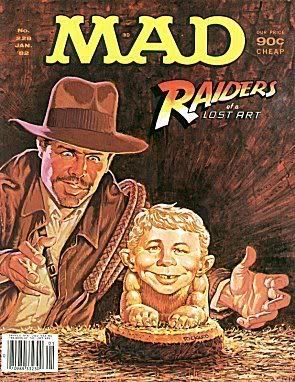 The folks at Mental Floss, obviously fans of the canon, have done us a great service by unearthing not one, not two, but three Indy screenplays that were never produced, with the full stories surrounding them.
The Lost Scripts, Part I: Indiana Jones and the Monkey King
The Lost Scripts, Part II: Indiana Jones and the Saucermen from Mars
The Lost Scripts, Part III: Indiana Jones and the City of the Gods
Oh, what might have been.
The Lost Scripts, Part I: Indiana Jones and the Monkey King
The Lost Scripts, Part II: Indiana Jones and the Saucermen from Mars
The Lost Scripts, Part III: Indiana Jones and the City of the Gods
Oh, what might have been.
Arts: The proverbial "really good" science fiction movie
You've got to understand that, with only a couple of exceptions like Forbidden Planet and The Day the Earth Stood Still, for the longest time there was no such thing as a major Hollywood science fiction movie. For that matter, aside from such pictures as Metropolis and Things to Come, there never had been any major science fiction movies period. The Golden Age of science fiction, as far as writers were concerned, was a penny dreadful, cheap book genre phenomenon, far removed from real writing. In the movie world, it was cheap serials and B pictures mostly aimed at the most non-discriminating audiences, like Saturday afternoon double features, and these were mostly populated by Bug-Eyed Monsters.
 Still, there were some good movies among all of these. Scratch any buff, and you'll come up with things like the Quatermass films, for instance. But in the 1960s, major studios producing major pictures with major talent was not happening. 2001: A Space Odyssey changed all that.
Arthur C. Clarke was a soft-spoken gentleman whom I brought to Syracuse as part of a big annual event with various speakers and whatnot, which is a good story that I'll get to eventually. We picked him up at the airport and, not being terribly versed in SF, did our best work when we brought him into contact with some local writers with whom he could speak the same language. Clarke was very excited at the time about the possibility of a film of Childhood's End, which he claimed had paid a lot of bills for him because it had been optioned since day one, but now, finally, it looked as if it might really happen. It never did, of course. Anyhow, mostly we brought in Clarke because of 2001. This wasn't just a movie we liked. It was the experience of going into space. It was filmed in Cinerama, a really really wide widescreen process, sort of the IMAX of its day. It was the apotheosis of the space traveling future the baby boomers had all been promised, a year before Apollo 11 landed on the moon. Heady times.
When Clarke talked about 2001, he actually did use the expression "the proverbial 'really good' science fiction movie." That's what he and Kubrick set out to make, not just a humongous budget, special effects juggernaut, but a movie with some real thought in it. So much thought, as it turned out, that it may be one of the most misunderstood or least understood movies of all time. Letters of Note manages to track down the original correspondence between Kubrick and Clarke, initiating their collaboration.
Open the pod door, Hal.
.
Arthur C. Clarke was a soft-spoken gentleman whom I brought to Syracuse as part of a big annual event with various speakers and whatnot, which is a good story that I'll get to eventually. We picked him up at the airport and, not being terribly versed in SF, did our best work when we brought him into contact with some local writers with whom he could speak the same language. Clarke was very excited at the time about the possibility of a film of Childhood's End, which he claimed had paid a lot of bills for him because it had been optioned since day one, but now, finally, it looked as if it might really happen. It never did, of course. Anyhow, mostly we brought in Clarke because of 2001. This wasn't just a movie we liked. It was the experience of going into space. It was filmed in Cinerama, a really really wide widescreen process, sort of the IMAX of its day. It was the apotheosis of the space traveling future the baby boomers had all been promised, a year before Apollo 11 landed on the moon. Heady times.
When Clarke talked about 2001, he actually did use the expression "the proverbial 'really good' science fiction movie." That's what he and Kubrick set out to make, not just a humongous budget, special effects juggernaut, but a movie with some real thought in it. So much thought, as it turned out, that it may be one of the most misunderstood or least understood movies of all time. Letters of Note manages to track down the original correspondence between Kubrick and Clarke, initiating their collaboration.
Open the pod door, Hal.
.
Monday, July 30, 2012
Debate: Country mouse in the big city
I guess I’m sort of obliged to report on the activities of the previous weekend, seeing how it was the greatest collection of debate coaches in one place since the construction of the pyramids. Or since O'C ate dinner alone at Japonica...
I collected CP from his train on Friday. Amtrak was running roughly five levels of Word Welder late, because they lost an engine, but as we agreed, better to lose an engine on a train than on a flight in from Logan. CP put the time to good use, propping up tabroom.com with string and Dixie Cup tops in preparation for having it look like it’s running on August 1, when the first registrations open. As he reported on Facebook, by the way, what I was seeing before, which was bizarrely disturbing, was not what he was working on. I must have gotten cached into No Man’s Land somehow. When he was sitting on the chair next to me in the living room, I got what looked liked the comfortingly disturbing screens of old; actually, they looked a little nicer, although I hate to admit it. I’m trusting that CP will be too busy these next few days to be reading any blogs, so I should be safe.
We popped down to Manhattan on Saturday, and JV arrived when we did to meet up with us. The goal was to give our poor unfortunate Bostoner a taste of a real city. We poked around GCT a bit, then headed up to St. Pat’s, and then MOMA, where we ate lunch. I’ll write about the museum separately, but suffice it to say that we had a lot of fun pointing out our various favorites. We also ate lunch there, consisting primarily of a watermelon gazpacho with pansies floating on the top. There’s a picture on my iPhone, if you happen to steal it at the next tournament and want to see what lunch looked like.
O’C promised to me us at 3ish at the museum, and we were forced to take both JV and CP to the emergency room to revive them from the brain hemorrhages they suffered when O’C actually met us at 3ish at the museum. He’s got the Foursquare check-ins to prove it (but then again, he checked in at 27 other places that day, including the men’s room at the Hilton, and you may not want to sort through them all). With our group now complete, we moseyed, specifically up to see the patented stairs at the Apple Store (beats me why they’re patented: they just look like stairs), the St. Gaudens Sherman statue, Rizzoli’s bookstore (where O’C discovered a book of Star Wars blueprints that was selling for a mere $500 which he just has to have, despite the fact that nothing in Star Wars was real, meaning that the blueprints are also not real, but then again, he’s the guy who gets in line for Cinderella’s autograph at WDW, and as I’ve pointed out repeatedly, not only is Cinderella not real, but the person whose autograph he’s getting isn’t her), and then, after fighting the crowds at Times Square and waiting out a short shower, we walked down the High Line to the Village, and ultimately to our dinner destination. CP, who started the day at about six foot four, was now about five foot ten, having worn his feet out to the ankles. But this is the loveliest part of G Village, all the old winding streets and little houses, and even he was impressed. Dinner, at a Brazilian restaurant, was good, but way too loud. The conversation, almost entirely debate-oriented (and, yes, a lot of it was about you, and none of it was complimentary, as you would expect), was rather hard to follow, unfortunately. I would say that when you get a couple or four debate people together, talk is ripe. I hated to miss a word, but there were a couple of times when they were reaming someone out at the other end of the table and I had to interrupt and get the name, just so I could file it away for future reference. After that, we moseyed some more for gelato, and then headed back home. A splendid time was had by all.
And then Sunday we poured CP back on the train for the hinterlands. Somehow through the weekend I got him signed up to work with me on LD at the Pups, and tentatively to help us with the MHL workshop. Plus he introduced us to aged gouda. What more could you ask?
I collected CP from his train on Friday. Amtrak was running roughly five levels of Word Welder late, because they lost an engine, but as we agreed, better to lose an engine on a train than on a flight in from Logan. CP put the time to good use, propping up tabroom.com with string and Dixie Cup tops in preparation for having it look like it’s running on August 1, when the first registrations open. As he reported on Facebook, by the way, what I was seeing before, which was bizarrely disturbing, was not what he was working on. I must have gotten cached into No Man’s Land somehow. When he was sitting on the chair next to me in the living room, I got what looked liked the comfortingly disturbing screens of old; actually, they looked a little nicer, although I hate to admit it. I’m trusting that CP will be too busy these next few days to be reading any blogs, so I should be safe.
We popped down to Manhattan on Saturday, and JV arrived when we did to meet up with us. The goal was to give our poor unfortunate Bostoner a taste of a real city. We poked around GCT a bit, then headed up to St. Pat’s, and then MOMA, where we ate lunch. I’ll write about the museum separately, but suffice it to say that we had a lot of fun pointing out our various favorites. We also ate lunch there, consisting primarily of a watermelon gazpacho with pansies floating on the top. There’s a picture on my iPhone, if you happen to steal it at the next tournament and want to see what lunch looked like.
O’C promised to me us at 3ish at the museum, and we were forced to take both JV and CP to the emergency room to revive them from the brain hemorrhages they suffered when O’C actually met us at 3ish at the museum. He’s got the Foursquare check-ins to prove it (but then again, he checked in at 27 other places that day, including the men’s room at the Hilton, and you may not want to sort through them all). With our group now complete, we moseyed, specifically up to see the patented stairs at the Apple Store (beats me why they’re patented: they just look like stairs), the St. Gaudens Sherman statue, Rizzoli’s bookstore (where O’C discovered a book of Star Wars blueprints that was selling for a mere $500 which he just has to have, despite the fact that nothing in Star Wars was real, meaning that the blueprints are also not real, but then again, he’s the guy who gets in line for Cinderella’s autograph at WDW, and as I’ve pointed out repeatedly, not only is Cinderella not real, but the person whose autograph he’s getting isn’t her), and then, after fighting the crowds at Times Square and waiting out a short shower, we walked down the High Line to the Village, and ultimately to our dinner destination. CP, who started the day at about six foot four, was now about five foot ten, having worn his feet out to the ankles. But this is the loveliest part of G Village, all the old winding streets and little houses, and even he was impressed. Dinner, at a Brazilian restaurant, was good, but way too loud. The conversation, almost entirely debate-oriented (and, yes, a lot of it was about you, and none of it was complimentary, as you would expect), was rather hard to follow, unfortunately. I would say that when you get a couple or four debate people together, talk is ripe. I hated to miss a word, but there were a couple of times when they were reaming someone out at the other end of the table and I had to interrupt and get the name, just so I could file it away for future reference. After that, we moseyed some more for gelato, and then headed back home. A splendid time was had by all.
And then Sunday we poured CP back on the train for the hinterlands. Somehow through the weekend I got him signed up to work with me on LD at the Pups, and tentatively to help us with the MHL workshop. Plus he introduced us to aged gouda. What more could you ask?
Arts: The life of music
I’m in Starbucks and they’re playing “Sit Down I Think I Love You” by Buffalo Springfield, from a California groups of the 60s compilation album. That song was released in 1966. If I had been in Starbucks in 1966 listening to a song similarly old, that song would have been released in 1922. Possibilities? “Toot Toot Tootsie,” “Sheik of Araby” and “Give Me My Mammy.” Would the Starbucks of 1966 have been selling a record of hits of the 20s?
Just wondering.
And this isn't "Sit Down," but all these years later, who's counting? Remarkably good video, and not lip-synched! You can tell why Steve Stills might have been a Monkee, and Neil Young doesn't look a tenth as cranky as he does nowadays.
And here's Al Jolson, a few years after 1922 (he had to wait until the talkies, in order to capture that incredible whistle solo).
Just wondering.
And this isn't "Sit Down," but all these years later, who's counting? Remarkably good video, and not lip-synched! You can tell why Steve Stills might have been a Monkee, and Neil Young doesn't look a tenth as cranky as he does nowadays.
And here's Al Jolson, a few years after 1922 (he had to wait until the talkies, in order to capture that incredible whistle solo).
Debate: Regarding "The Six Truths Judges Will Never Admit"
One interesting thing about the world today is that if someone writes something about debate, there is not only an audience, but there is resonance. Take this article from Victory Briefs: The Six Truths Judges Will Never Admit. It is smart and true, and it makes me want to add on to it.
1. They can’t actually take your speed
My favorite example of this is when very experienced policy judges have gone into LD rounds and come out with their heads pounding. They went in with an expectation of something a little less than supersonic, but the debaters, seeing the policy label, figured that the gloves were off. A swell time was not had by all.
As Arijanto and Wynn point out, by the time the judge yells "Clear," stuff has already been missed. It behooves the debaters to actually keep an eye on the judges. You can tell if they're following you or not. If they're not, most likely speed is the culprit, in which case, if you don't slow down, you deserve the crappy speaker points.
My favorite complaint, and one that is remarkably common, is the opposite of this one. That is, judges go into the round, the debaters ask if they can handle speed, the judges say no, and then the SST takes off. If you don't care, why do you ask? Debaters do drills for speed. How about a drill for less speed?
2. They haven’t been judging in a while
This is so true, to wit, that debaters assume that the judges know stuff the judges don't necessarily know. The article says you'll use acronyms and shortcuts on citations and the like, but I would go even further and say that some debaters will presume an argument is a given. Everyone under the sun has argued X so many times in exactly the same way that everyone under the sun accepts the argumentation so that's your starting point, but the judge who has never been under the sun and never actually heard that argument is at a total loss. Know thy judge.
Of course, this leads me to something else, where arguments are not made but alluded to. You don't explain why X is wrong; you cite evidence, "Joe Blow 3" and that is enough. That's enough? That's not debate. That's sorting a database. Debates require arguments. Please.
3. They have an idea of who they’re voting for before the end of the round
I'm not quite sure what the point of this is, really, because it's way more unlikely that you wouldn't know. There are more obvious rounds than close ones, and rounds seldom play out to the end, although maintaining the win does require certain ritual steps (much like you have to take classes in your senior year of high school after you're already accepted to college). I think the point might have been that judges know before the start of the round, but I wonder about that. The real problem, strategically, is that debaters know before the start of the round. The number one reason for losses against a debater you think is stronger than you is your belief that the debater is stronger than you. There's always a new dog rising. Why shouldn't it be you?
I would point out that while many debaters develop steadily through their careers, many peak as juniors, for a variety of reasons. Giants fall. Each round stands alone. Always.
4. They have their own opinions
I don't think it's so much that judges lean to the truth of one side or the other, but that they buy the arguments more of one side or another, especially if these are arguments that they've developed themselves. This is really bad judging, of course, and is rife when upperclassmen judge underclassmen: the upperclassmen are pretty limited in their knowledge of possible arguments, and respond best to arguments similar to their own. They are way unlikely to accept arguments that are counter to their own; they've bought into them too much. Unfortunately this is true of some others as well, an inability to sever one's marriage to one's own arguments for an hour or so.
Anyhow, the advice the writers provide is good, but I think this may be the least relevant among strong judges.
5. Their paradigms are outdated and obtuse.
The whole paradigm system is ridiculous. Yes, you can provide some general analysis of your understanding of debate, but most paradigms are patently false. The ones that aren't false are too specific for relevance. The number of judges who actually judge according to what their paradigm says is probably a lot smaller than the ones whose paradigms are predictive. And as the writers say, most paradigms are old, which adds to the problem.
This is, of course, why I'm moving away from paradigms in MJP situations, not so much to eliminate them, but to provide a better barometer off the top.
6. They aren’t in the right mind
The underlying truth of judging, especially in later rounds, is that the judges get progressively more tired and more bored by the same thing over and over again (which is why we try to keep judges from judging the same people more than once, but that's usually close to impossible). Debaters who don't make it easy for the judges are, by default, making it hard. Why would you do that?
Here's a simple fact. In six rounds of debate, debaters debate six times. In six rounds of debate, judges judge up to twelve times because of flighting. Depending on the tournament, some judges are lucky to get one round off in prelims and none in elims, especially if they're highly preffed and/or the pool is small. Judges are way more tired than debaters because judges must draw on reserves of strength unalloyed with the adrenalin that drives debaters.
1. They can’t actually take your speed
My favorite example of this is when very experienced policy judges have gone into LD rounds and come out with their heads pounding. They went in with an expectation of something a little less than supersonic, but the debaters, seeing the policy label, figured that the gloves were off. A swell time was not had by all.
As Arijanto and Wynn point out, by the time the judge yells "Clear," stuff has already been missed. It behooves the debaters to actually keep an eye on the judges. You can tell if they're following you or not. If they're not, most likely speed is the culprit, in which case, if you don't slow down, you deserve the crappy speaker points.
My favorite complaint, and one that is remarkably common, is the opposite of this one. That is, judges go into the round, the debaters ask if they can handle speed, the judges say no, and then the SST takes off. If you don't care, why do you ask? Debaters do drills for speed. How about a drill for less speed?
2. They haven’t been judging in a while
This is so true, to wit, that debaters assume that the judges know stuff the judges don't necessarily know. The article says you'll use acronyms and shortcuts on citations and the like, but I would go even further and say that some debaters will presume an argument is a given. Everyone under the sun has argued X so many times in exactly the same way that everyone under the sun accepts the argumentation so that's your starting point, but the judge who has never been under the sun and never actually heard that argument is at a total loss. Know thy judge.
Of course, this leads me to something else, where arguments are not made but alluded to. You don't explain why X is wrong; you cite evidence, "Joe Blow 3" and that is enough. That's enough? That's not debate. That's sorting a database. Debates require arguments. Please.
3. They have an idea of who they’re voting for before the end of the round
I'm not quite sure what the point of this is, really, because it's way more unlikely that you wouldn't know. There are more obvious rounds than close ones, and rounds seldom play out to the end, although maintaining the win does require certain ritual steps (much like you have to take classes in your senior year of high school after you're already accepted to college). I think the point might have been that judges know before the start of the round, but I wonder about that. The real problem, strategically, is that debaters know before the start of the round. The number one reason for losses against a debater you think is stronger than you is your belief that the debater is stronger than you. There's always a new dog rising. Why shouldn't it be you?
I would point out that while many debaters develop steadily through their careers, many peak as juniors, for a variety of reasons. Giants fall. Each round stands alone. Always.
4. They have their own opinions
I don't think it's so much that judges lean to the truth of one side or the other, but that they buy the arguments more of one side or another, especially if these are arguments that they've developed themselves. This is really bad judging, of course, and is rife when upperclassmen judge underclassmen: the upperclassmen are pretty limited in their knowledge of possible arguments, and respond best to arguments similar to their own. They are way unlikely to accept arguments that are counter to their own; they've bought into them too much. Unfortunately this is true of some others as well, an inability to sever one's marriage to one's own arguments for an hour or so.
Anyhow, the advice the writers provide is good, but I think this may be the least relevant among strong judges.
5. Their paradigms are outdated and obtuse.
The whole paradigm system is ridiculous. Yes, you can provide some general analysis of your understanding of debate, but most paradigms are patently false. The ones that aren't false are too specific for relevance. The number of judges who actually judge according to what their paradigm says is probably a lot smaller than the ones whose paradigms are predictive. And as the writers say, most paradigms are old, which adds to the problem.
This is, of course, why I'm moving away from paradigms in MJP situations, not so much to eliminate them, but to provide a better barometer off the top.
6. They aren’t in the right mind
The underlying truth of judging, especially in later rounds, is that the judges get progressively more tired and more bored by the same thing over and over again (which is why we try to keep judges from judging the same people more than once, but that's usually close to impossible). Debaters who don't make it easy for the judges are, by default, making it hard. Why would you do that?
Here's a simple fact. In six rounds of debate, debaters debate six times. In six rounds of debate, judges judge up to twelve times because of flighting. Depending on the tournament, some judges are lucky to get one round off in prelims and none in elims, especially if they're highly preffed and/or the pool is small. Judges are way more tired than debaters because judges must draw on reserves of strength unalloyed with the adrenalin that drives debaters.
Friday, July 27, 2012
Riding off into the weekend
We haven't been on a coaster in a while. This one is from Dollywood.
Below is what the ride actually looks like. You're hanging out in space, as you can see. I do sort of wish the landscape was more interesting, though. There's a virtual version of the ride on the Dollywood site that makes it look like you're soaring through gorgeous mountains; the reality looks more like a park that hasn't done any landscaping yet.

Below is what the ride actually looks like. You're hanging out in space, as you can see. I do sort of wish the landscape was more interesting, though. There's a virtual version of the ride on the Dollywood site that makes it look like you're soaring through gorgeous mountains; the reality looks more like a park that hasn't done any landscaping yet.
Coachean Feed: Debaters' links

- Derrida Speaks About Animals "Violence against animals" begins with categorizing all animals as one big thing called "animals."
- There are four states that don't recognize an insanity plea? Then again, in debating morality, the line between culpability and crazy is sometimes hard to draw, especially if you believe that crazy isn't necessarily all that crazy, or perhaps the opposite, that sane isn't all that sane. Anyhow, Is an insanity defense a constitutional right?
- I love a good morality quiz. Peter Singer & The Drowning Child. The recommendation is to read the literature (there's links) after taking the quiz.
- Thoughts on the process of democratization, from the Rand Corp: Arab Spring Revolutions Have Not Yet Created Democracies, but Democratization Is Possible. There's a link to the study, if you want depth.
Subscribe to:
Posts (Atom)