From the comments: So the debaters are pre ranked and seeded in prelims? If so what is this based on?
You need to apply to qualify for NDCA; you get in by accumulating certain points during the year. It's complicated, but it's on their website. This provides a presumably neutral ranking of debaters across the country, despite where they debated (it doesn't necessarily have to be big bid tournaments). The resulting rankings are numerical, and we can list the entrants to the tournament in order as a result. Then you break them into 4 equal packages. And there you are.

Saturday, April 14, 2012


More than 140 words
I'll try to keep up the tweets, as appropriate, but for those, follow the #NDCA2012 hashtag (and I"ll keep the widget with the tweets here for another couple of days, over on the right). It’s back to business here.
Anyhow, I’d forgotten the complications of pairing NDCA.
The original plan for Friday night had been to get together with O’C and The People’s Champion and the Emperor of Hamiltonia and go watch jousting, but at some point it occurred to me that I had a job to do and I probably should do it. Jousting with O’C would have to wait.
I got into the hotel in the afternoon and started playing with the data and setting up TRPC. The first thing one remembers is that we rank all the debaters and put them into cells. We create four levels, one through four descending, and we set it up so that none of the ones hit in random rounds. CP had the rankings and emailed them to me, and then I entered them, and Bietz showed me how to do the pairings, since I’ve only done it the once before, at last year’s NDCA. It does the presets for both the random rounds at the same time. This does make sense to me, and it also doesn’t. While not knocking out your top debaters by the top seeds hitting each other in the random pairings, it does sort of insure that the lower seeds will have rough draws. But then again, it is a championship. It’s supposed to be hard, and the competition is supposed to be designed so that the best competitors fight it out to the end. Sometimes I have trouble getting used to that.
Next, there’s the whole thing about judges not being in every round. Each judge has a certain number of rounds committed, and that’s it (although, apparently, we have a small purse of bribe money if things get a little too dicey). I went through and allocated to get enough judges for each round, so that we don’t use up people early on. Which meant that when we assigned the judges, if someone was available for round one but didn’t get placed, I removed their availability and put them in round two instead (I had set up that you were either one or the other). Of course, I had to move some twos into round one to get prefs. Then the couple of people who got nuttin’ got moved to three. It’s a pain in the butt, but if you don’t do it, the pain later is even stronger. I remember it from last year, when people would tell us they were no longer obligated, and they were right. I’m just not used to that. Normally you’re obligated for the whole shooting match. There’s some of this at Big Bronx, but the pool is so large it hardly matters, as long as you have a wealth of judges for round 3, where you have your first bubble at the down twos.
There’s four rounds today, with the longest lunch break known to man, so things should go swimmingly. We set up the Warm Room on my computer, so we’ll be doing that again. It looks like it’s working; I’ll post the first info as soon as I arrive on the UNLV campus.
Anyhow, I’d forgotten the complications of pairing NDCA.
The original plan for Friday night had been to get together with O’C and The People’s Champion and the Emperor of Hamiltonia and go watch jousting, but at some point it occurred to me that I had a job to do and I probably should do it. Jousting with O’C would have to wait.
I got into the hotel in the afternoon and started playing with the data and setting up TRPC. The first thing one remembers is that we rank all the debaters and put them into cells. We create four levels, one through four descending, and we set it up so that none of the ones hit in random rounds. CP had the rankings and emailed them to me, and then I entered them, and Bietz showed me how to do the pairings, since I’ve only done it the once before, at last year’s NDCA. It does the presets for both the random rounds at the same time. This does make sense to me, and it also doesn’t. While not knocking out your top debaters by the top seeds hitting each other in the random pairings, it does sort of insure that the lower seeds will have rough draws. But then again, it is a championship. It’s supposed to be hard, and the competition is supposed to be designed so that the best competitors fight it out to the end. Sometimes I have trouble getting used to that.
Next, there’s the whole thing about judges not being in every round. Each judge has a certain number of rounds committed, and that’s it (although, apparently, we have a small purse of bribe money if things get a little too dicey). I went through and allocated to get enough judges for each round, so that we don’t use up people early on. Which meant that when we assigned the judges, if someone was available for round one but didn’t get placed, I removed their availability and put them in round two instead (I had set up that you were either one or the other). Of course, I had to move some twos into round one to get prefs. Then the couple of people who got nuttin’ got moved to three. It’s a pain in the butt, but if you don’t do it, the pain later is even stronger. I remember it from last year, when people would tell us they were no longer obligated, and they were right. I’m just not used to that. Normally you’re obligated for the whole shooting match. There’s some of this at Big Bronx, but the pool is so large it hardly matters, as long as you have a wealth of judges for round 3, where you have your first bubble at the down twos.
There’s four rounds today, with the longest lunch break known to man, so things should go swimmingly. We set up the Warm Room on my computer, so we’ll be doing that again. It looks like it’s working; I’ll post the first info as soon as I arrive on the UNLV campus.
Friday, April 13, 2012
What to read
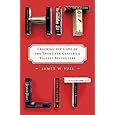 "Read books. As often as you can. Mostly classics."
We posted Maura Kelly's slow books manifesto not long ago. She promoted the idea of reading the good stuff, and it makes sense. There is a lot of great literature out there, and an awful lot of it is simply wonderful to read. So, why not read it?
There's another side to this coin, however. Sure, I love Moby-Dick, but I have to admit, I also like James Bond novels. I have Melville and Fleming both on my Kindle. As a proselytizer for books and reading, I have to believe that any reading is a good thing, and that reading for pure entertainment is a perfectly acceptable activity. When I recommend books to teenagers, I always suggest books that I think they will enjoy, not books that I think will be good for them. James W. Hall, author of Hit Lit, makes this point at Speakeasy:
How can anyone who loves books not take heart in seeing so many new readers huddled up with a novel? Whether it’s “Harry Potter,” “The Hunger Games” or “Infinite Jest”—does it really matter? These days, when reading fiction seems like an endangered activity, why should we begrudge the success of any book, especially one that stirs such passion with younger readers?
We can't let an artificial line between so-called good books and books that will capture kids' imagination keep them away from reading in general. And, perhaps, the reading of what they want to read today make them eventual readers of those so-called good books tomorrow.
The weekend is here. Take a gander at Beware Literary Snobbery: Why We Should Read Bestsellers. And then go off and read a good book, however you define it.
Fernwood 2Night
According to Dangerous Minds, Fernwood 2Night shows are hard to come by. It's a shame, really, as this was one of the defining shows of 70s comedy, the sort of postmodern, everything so tongue-in-cheek that it was coming out their ear humor that followed the end of the straight vaudeville turns that we were so used to on television. At that time, a generation of old comics was passing, and a new generation was just beginning to come down the pike. Martin Mull was definitely part of that new generation; he always struck me as one of the funniest people around, no matter what he was doing. And this was the show that brought Fred Willard to the masses:
In a scene-stealing role that defined his entire career playing the clueless white guy—is there ANYONE more Caucasian that Fred Willard?—Willard portrays what is quite possibly the dumbest, most dense character in all of television history. I’ve always thought that Willard was a comedic genius—the obtuse angles of his observations, so off the cuff and spontaneous, so REAL—and he was never funnier than he is in this role.
The first clip in the article, with the race expert, shows Willard at his best. And I couldn't resist extracting the Tom Waits segment above; he's the perfect Fernwood guest. Anyhow, get the whole story, and more clips, at Fernwood 2Night: The Great Lost American Comedy.
 When something new comes along that's really popular, we at Grinwout's feel an obligation to check it out and give it a try. So, we checked out Pinterest and gave it a try.
We didn't get it.
I mean, what exactly is the point of going online and finding a picture of something, and pinning it on your private bulletin board? Sure, there's a lot of pictures one might like, but making a virtual collection of them? Then again, Grinwout's doesn't collect anything in real life, either, aside from Disney pins when actually on a Disney property, and that's more a symptom of mass hysteria than a collecting interest.
Still, Pinterest is, at least for the moment, the site that is wowing them. We looked at Complex's The Top 10 Museums On Pinterest (and yes, it's a slide show, if you saw our remarks in the last post, but note that you don't switch pages, which makes it acceptable), and finally saw at least one use of the site that made sense. We especially liked what the Smithsonian and the Met were doing with the site. The thing is, if you have a collection of your own art, then Pinterest can provide a clever way to display it.
Then again, maybe you're a collector, and already use Pinterest like there's no tomorrow. In that case, have at it.
Lists
 The top ten films of all time? The best films? The most popular films? The films you watch over and over again? How do you make those determinations? When people ask my favorite films, despite the fact that I consider myself something of a film buff, and I've seen a lot of movies and spent plenty of time seeking out classics, and I can name both American directors who wore eyepatches, and I really do think Citizen Kane is amazing, I am reluctant to offer an answer. It would take a lot of time to compose a list of my "favorite" films. What do I recommend? It depends on you. If you've seen a lot of movies, including the complete Ozu, I might suggest something different than if you've never even seen The Wizard of Oz.
Roger Ebert has his own take on lists:
Long-suffering readers will have read many times about my dislike of lists, especially lists of the best or worst movies in this or that category. For years they had value only in the minds of feature editors fretting that their movie critics had too much free time. ("For Thursday's food section, can you list the 10 funniest movies about pumpkin pie?") Now their value has shot way up with the use of slide shows, a diabolical time-waster designed to boost a web site's page visits.
I'm with him there. Lord, save us from slide shows! I've seldom made it to the end of one, even if I like the content, because I don't want to reward the greed of the webmaster who wants to artificially increase the number of "eyeballs." I mean, really. If Grinwout's touts a slideshow, it is an unusual event (and more often than not, slides on a page rather than multiple pages). I just don't like playing their silly game.
Ebert's remarks are from The best damned film list of them all, which is a good starting point for the business at hand, the top ten movies of all time. Sight & Sound publishes this list every decade, and Ebert is about to embark on submitting his picks for the 2012 list. He talks about the whys and wherefores, and that's interesting enough. But then you can go to S&S and take a look at all the different lists from 2002. This is the sort of thing to do with a group, because it will give you something to fight about.
Thursday, April 12, 2012
The Toy Fair
Illustrator/blogger Lisa Hanawalt and her boyfriend masquerade as chia seed employees to visit the Toy Fair at NYC's Javits Center, which is sort of an architectural Death Valley, without all the fun spots. It's the perfect place for a manufacturers' or any kind of sales convention. The toy show, of course, is absolutely limited to the trade—no kids running around here, thank you very much, despite what they happen to be offering. This is serious business, and Hanawalt is the perfect guide:
Do you remember your favorite toys as a child? And maybe you wondered why adults didn't seem as enchanted with your toys as you were? I used to swear I'd never lose interest in my figurines and dolls, I feared it would mean losing my entire sense of self. But of course I grew older and started leaving those beloved things behind. I can pick up a Breyer horse, admire the smooth plastic and artful details, but … that's it. I'm not going to sit on the floor with it for hours, making it talk to other toys, acting out my latest conflicts and fantasies, forming pretend relationships. I wish I could enjoy toys on that level again.
Sigh...
Breyer horses are at the show. And Legos. And this poor guy below selling bobble heads. Take the trip: The Toy Fair (via).

Do you remember your favorite toys as a child? And maybe you wondered why adults didn't seem as enchanted with your toys as you were? I used to swear I'd never lose interest in my figurines and dolls, I feared it would mean losing my entire sense of self. But of course I grew older and started leaving those beloved things behind. I can pick up a Breyer horse, admire the smooth plastic and artful details, but … that's it. I'm not going to sit on the floor with it for hours, making it talk to other toys, acting out my latest conflicts and fantasies, forming pretend relationships. I wish I could enjoy toys on that level again.
Sigh...
Breyer horses are at the show. And Legos. And this poor guy below selling bobble heads. Take the trip: The Toy Fair (via).
The guy who played Data
Whatever happened to Brent Spiner:
Fresh Hell is one of those web series that are popping up nowadays, and having just watched a couple of episodes, we can report that this is goofy, funny stuff. Whether or not the web is the source of all of tomorrow's entertainment, as some would suggest, remains to be seen, but there's good material out there beyond just clips. Vice.com (there's a URL for you) interviewed Spinter recently:
The part and the show was a gift and I am eternally grateful. I’m delighted that other people have opinions and affection for the character. The only thing that bothers me—and it happens all the time—is when people see me and shout, “DATA! DATA”! I’m fine with people recognizing me. I just wish they shouted, “Guy who played Data”!
Check out Off Hollywood - Brent Spiner, and follow his show, Fresh Hell.

Fresh Hell is one of those web series that are popping up nowadays, and having just watched a couple of episodes, we can report that this is goofy, funny stuff. Whether or not the web is the source of all of tomorrow's entertainment, as some would suggest, remains to be seen, but there's good material out there beyond just clips. Vice.com (there's a URL for you) interviewed Spinter recently:
The part and the show was a gift and I am eternally grateful. I’m delighted that other people have opinions and affection for the character. The only thing that bothers me—and it happens all the time—is when people see me and shout, “DATA! DATA”! I’m fine with people recognizing me. I just wish they shouted, “Guy who played Data”!
Check out Off Hollywood - Brent Spiner, and follow his show, Fresh Hell.
Thomas Kinkade
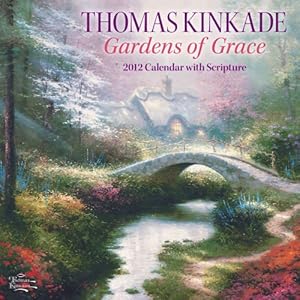 There's a Thomas Kinkade store in the mall next door to my office. When you walk past it, you see a mixture of sports paintings, simulations of Disney parks and movies, and cozy cottages. All of these images are of a piece. They represent something we long for, presented in an idealized way that takes the desirable and makes it even more desirable. Gilding the lily, you might say, almost literally, given Kinkade's use of light effects in his work. You can purchase his work at all levels of price: there's something for everyone. His success, at least in terms of popularity, was undeniable.
When Kinkade died last week, the knives were immediately drawn. Art critics have, almost universally, panned his worked. Then again, plenty of these same art critics think the world of sharks floating in formaldehyde, so I don't exactly know how good a barometer they might be. That's the problem with art. The gatekeepers are this exclusive group of critics and gallery owners who explain to the rest of us what we should like and dislike. Well, that's all well and good, and I appreciate learning from an expert where a given piece might fit in history, but I'll be the one who decides if I like it. (There's a great play on the old joke in a New Yorker cartoon of someone carefully studying a painting: "He knows a lot about art but he doesn't know what he likes.")
The point is, say what you will about Kinkade, a lot of people loved his stuff:
His images are basically devoid of emotional darkness. Whether you find that cloying or comforting is “the essential divide between people who respond to his work and people who don’t,” [art historian Alexis] Boylan says. “It all comes down to: What part of yourself do you want to see reflected when you look at a work of art?...‘Soothing’ is not how a lot of people would define a lot of the art you see in museums and galleries, but historically, a lot of art has been produced with the sole purpose of being beautiful and comforting, and giving people pleasure.”
Like him or not, he's a force to be reckoned with. So is the question of the purpose of art. Read Why Thomas Kinkade’s Art Touched So Many.
Tiny Tim
One has to admit that Herbert Khaury, AKA Tiny Tim, is best referred to as an acquired taste. He seemed to come out of nowhere in the Sixties, and he seemed to be quite genuine. The song below was his biggest hit, but his most popular moment was when he was married, live, on the Tonight Show. It was the real thing; Johnny Carson and Ed McMahon stood off to the side, just like any wedding guests. (Sadly, the marriage did not last.)
TT was born on this date in 1932, and died (almost literally while playing the ukulele onstage) in 1996.
There's more TT on YouTube. Most of it is about the same. As we said, he was, at best, an acquired taste. But one has to point out that as offbeat as he was, he had a love of old music at a time when old music was almost going out of business. He had the courage of his convictions, in other words. He just happened to have unique convictions.
TT was born on this date in 1932, and died (almost literally while playing the ukulele onstage) in 1996.
There's more TT on YouTube. Most of it is about the same. As we said, he was, at best, an acquired taste. But one has to point out that as offbeat as he was, he had a love of old music at a time when old music was almost going out of business. He had the courage of his convictions, in other words. He just happened to have unique convictions.
Wednesday, April 11, 2012
The Titanic
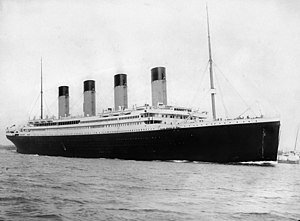
The disaster has become so invested with mythical status—it’s been said that the name Titanic is the third most widely recognized word in the world, after “God” and “Coca-Cola”—that it almost seems to be a constant, an event that repeats itself on a never-ending loop.
As we approach the 100th anniversary of the sinking of that most famous ship, it seems that everyone under the sun is writing something about it, and the whole thing is inescapable. Masochists can even go watch the Cameron film in theaters, this time in 3-D. As far as nights to remember go, this one just goes on and on and on.
But there's a reason for this, because at its heart, the story of the sinking of the Titanic is, on its own, a narrative that we are simply drawn to because of its singularity in the history of human tragedy. But the sinking of the ship is just the beginning of the Titanic narrative. The stories of the survivors, and the story of the telling of the story, over time becomes every bit as important as the original event. The best piece we've seen that sums all this up is Why the Titanic Still Fascinates Us (via). If you read only one Titanic story, let it be this one.
The Hulk

Yet more comics stuff you're probably unaware of, unless you keep up with your comics.
As we said earlier today, in regard to Wonder Woman, we were avid comic readers in our day, from grammar school through college. As far as higher education was concerned, there was a bookstore downtown that sold out-of-date comics in the basement, at bargain-basement prices. You could stock up on a five-year supply of whatever, but mostly Marvels. Thor, the Silver Surfer, Spidey—they were all there. And the Hulk, of course. My fellow scholars and I spent many happy hours collecting and reading these volumes.
The Hulk has gone through a lot of changes over the years. He got tossed into a goofy TV show, for one thing, and there have been a couple of movies, but meanwhile, he's still had his magazine life. Until the final issue.
And then he is reborn. Wreaks some havoc.
And then there's the final issue.
And then he is reborn. Wreaks some havoc.
He's green.
He's gray.
And then there's the final issue.
And then he is reborn. Wreaks some havoc.
He's red (and not Bruce Banner).
And then there's the final Bruce Banner issue.
I may be getting some of this out of order. For an up-to-date look at the life, and death, and life, and death, and life, etc., of the Hulk, check out Gallery: The Evolution Of The Hulk In Comics.
Wonder Woman's new Amazons
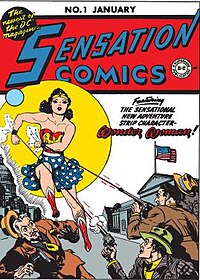 As a comic-addicted kid in the Fifties, I have to admit that Wonder Woman was not on my required reading list. Theoretically she ought to have at least appealed to the nascent leering adolescent that lurked within me, but as a superhero she just didn't make the grade. I was of the Superman persuasion myself, with a nod in the direction of the Flash and Green Lantern and the like. I preferred male superheroes because I wanted to be one myself. I could easily imagine myself flying around saving the world a la Clark Kent, but couldn't quite work in Diana of Themyscira. Overcoming villains with a lasso and a pair of bracelets? Gimme a break! That is not pre-adolescent boy material, not no how, at least for this particular pre-adolescent boy.
I'm not sure if Wonder Woman was intended as a superhero for girls or not, but there was no question that she was something of a feminist, given the definition of feminism at the time. And she was part of the all-female Amazon world of Paradise Island, where the women were head and shoulders above any men one might dig up on other parts of the world. Part of my pre-adolescence elided the problem of where all these women came from in the first place, but one lets that sort of thing ride in aid of a better narrative, I guess.
Things are not the same in the Wonder Woman universe these days. Writing for Tor.com, Shoshana Kessock reports on some seriously disturbing new origins:
In the original DC history, Wonder Woman is raised by the immortal Amazon women as the only child on Paradise Island, daughter of their Queen Hippolytta. Her sister Amazons live isolated from men pursuing perfection of their culture without having children, focused on their own interests and largely happy. This history has largely stood untouched until the drastic recent rewrite. In Wonder Woman #7, Wonder Woman is still reeling from the discovery that she is in fact the daughter of Zeus from an extra-marital affair with the queen of the Amazons when she is forced to plan an invasion of the underworld to rescue a woman also bearing Zeus’s child. When she goes to the god Hephaestus for help, he reveals that all the men working in his forge are in fact the offspring of Amazons, sold as unwanted male children for weapons.
Yikes! The Amazons sell of their used men as slaves to Hephaestus? That, in a word, is pretty cold.
What to make of all of this? Decide for yourself. Read Wonder Woman Comics and the Violation of the Amazons.
Bill Irwin
Bill Irwin was born on April 11, 1950. He's done drama and comedy and musicals, but at heart, he's a modern-day clown, a physical comedian of extraordinary ability. This tiny clip of him walking down stairs is emblematic:
This cute little segment has a history:
Watch that same scene from Irwin's Broadway show, Largely New York:
And, in an example of perfect casting, Irwin is Sesame Street's Mr. Noodle (when he's not playing a serial killer on CSI):
Clown, comic, serial killer... Happy Birthday, Bill Irwin.
This cute little segment has a history:
Watch that same scene from Irwin's Broadway show, Largely New York:
And, in an example of perfect casting, Irwin is Sesame Street's Mr. Noodle (when he's not playing a serial killer on CSI):
Clown, comic, serial killer... Happy Birthday, Bill Irwin.
Tuesday, April 10, 2012
Packing up
I’ve only been to one previous NDCA tournament, last year in Scranton. We had a pretty good showing and a lot of fun, because the attendees are all friends and the trip wasn’t long and tabbing was an interesting challenge due to size. This year it looks about the same. PF and LD get decent turnouts, and CX gets a seriously large turnout. My guess is that the reason for this is that the CX people have about had it with TOC, for one reason or another, while LD and PF just haven’t taken NDCA to heart yet. Whatever. If I had to pick one national tournament to attend, I don’t know which it would be, to tell you the truth. It would depend on my teams.
Anyhow, I’m bringing no one to Las Vegas, site of this year’s event, but I’m tabbing anyhow. Last shot of the year, the way I see it. Last year Kaz and Bietz and I did LD and PF both, but I’m not sure if that’s true again this year. CP has been less than forthcoming with information. I imagine him working on his new tabbing program, sitting on his deck wearing his Hawaiian shirt and drinking a g&t and just being…louche about life in general. Whatever. I just hope somebody’s got a printer in the joint when I get there, since I can’t fly with one.
There’s plenty of time to sort out the details. I’ll be arriving Thursday, and the tournament starts Saturday. I’m looking forward to a little time roaming around on my own. The last time I was in Vegas was maybe a decade ago, en famille. The first time was at the other end of a famille, when I was seven years old. And I’ve been a handful of times in between. It’s different every time. What I think I’ll do is tweet for a few days. I’ll set up an automatic feed from Twitter to here (which I think I can do). If you read an entry, “Just won multi-zillion dollars from one quarter in slot machine,” that will be my last entry for a while. A long, long while.
Anyhow, I’m bringing no one to Las Vegas, site of this year’s event, but I’m tabbing anyhow. Last shot of the year, the way I see it. Last year Kaz and Bietz and I did LD and PF both, but I’m not sure if that’s true again this year. CP has been less than forthcoming with information. I imagine him working on his new tabbing program, sitting on his deck wearing his Hawaiian shirt and drinking a g&t and just being…louche about life in general. Whatever. I just hope somebody’s got a printer in the joint when I get there, since I can’t fly with one.
There’s plenty of time to sort out the details. I’ll be arriving Thursday, and the tournament starts Saturday. I’m looking forward to a little time roaming around on my own. The last time I was in Vegas was maybe a decade ago, en famille. The first time was at the other end of a famille, when I was seven years old. And I’ve been a handful of times in between. It’s different every time. What I think I’ll do is tweet for a few days. I’ll set up an automatic feed from Twitter to here (which I think I can do). If you read an entry, “Just won multi-zillion dollars from one quarter in slot machine,” that will be my last entry for a while. A long, long while.
Ray Bradbury lectures
 Ray Bradbury's writing had a tremendous effect on me when I was young. I was in seventh or eighth grade, and grabbing books at random from what to me was the newly available adult section of the library, and among those books was Dandelion Wine. I was a kid myself, and here was a novel of summer and reminiscence and nostalgia that seemed both terribly remote and terribly immediate. I went on read everything else of Bradbury's that the library had to offer, and enjoyed every bit of it. "A Medicine for Melancholy"—if that's not one of the best story titles ever...
Open Culture presents a lecture that Bradbury gave in 2001, to a group of young writers, in which he is crusty, funny, sharp and totally entertaining. He's giving advice to them, and revealing a lot about himself along the way. It's a must for Bradbury fans (and prospective writers): Ray Bradbury Gives 12 Pieces of Writing Advice to Young Authors (2001).
Google Art Project
In its evil plan to own all the information in the universe, Google has done some amazing things. And some of them we don't all even necessarily know about. We can probably take a poll of random folks on the street and get the vast majority of them to identify Google with searching, but after that, everyone is on their own. Sometimes it's things that come and go (did anyone ever understand Google Wave?), and lately it's Google+, but put all that to the side for the moment. Watch this video:
The site is http://www.googleartproject.com/. Here's how they describe it (and you have to dig to find this):
The Art Project is a collaboration between Google and 151 acclaimed art partners from across 40 countries. Using a combination of various Google technologies and expert information provided by our museum partners, we have created a unique online art experience. Users can explore a wide range of artworks at brushstroke level detail, take a virtual tour of a museum and even build their own collections to share. With a team of Googlers working across many product areas we are able to harness the best of Google to power the Art Project experience. Few people will ever be lucky enough to be able to visit every museum or see every work of art they’re interested in but now many more can enjoy over 30 000 works of art from sculpture to architecture and drawings and explore over 150 collections from 40 countries, all in one place. We’re also lucky at Google to have the technology to make this kind of project a reality.
There is an enormous difference between seeing works of art in person and seeing representations of them, but that said, since we obviously can't see all of them, a representation like this is a pretty good second best. You can get lost in here for months.
Try it.
The site is http://www.googleartproject.com/. Here's how they describe it (and you have to dig to find this):
The Art Project is a collaboration between Google and 151 acclaimed art partners from across 40 countries. Using a combination of various Google technologies and expert information provided by our museum partners, we have created a unique online art experience. Users can explore a wide range of artworks at brushstroke level detail, take a virtual tour of a museum and even build their own collections to share. With a team of Googlers working across many product areas we are able to harness the best of Google to power the Art Project experience. Few people will ever be lucky enough to be able to visit every museum or see every work of art they’re interested in but now many more can enjoy over 30 000 works of art from sculpture to architecture and drawings and explore over 150 collections from 40 countries, all in one place. We’re also lucky at Google to have the technology to make this kind of project a reality.
There is an enormous difference between seeing works of art in person and seeing representations of them, but that said, since we obviously can't see all of them, a representation like this is a pretty good second best. You can get lost in here for months.
Try it.
The commercialization of Star Wars
When the movie that some of us still think of as Star Wars came out in 1977 (it's name today is Star Wars: Episode IV - A New Hope), there were no toys to go with it. The movie must have had some hype, because I saw it the day it opened (when they gave out buttons that read "May the Force be with you"), but the fan merchandise wasn't in the stores yet. At best you could get a promise of a toy, when they were finally released. Bad planning on somebody's part...
It took a while to get from there to here:
George Lucas has long ago gone off on his own personal tangent regarding his intellectual property. On the positive side, he allows fans to create their own fiction, while on the negative side, he keeps mucking around with the canon, so that for all intents and purposes, even the presumably canonical materials, that is, the movies themselves, are these days simply Lucas's own fan fiction based on the originals. (Which may be one of the most profound things Grinwout's will say this week.)
No longer are fans waiting for the merchandise, of course. In fact, the movies have crossed over into promoting other people's merchandise. Occasionally, as with the Volkswagen ad above, it's pretty funny. But the ads are as likely to be terrible. I don't necessarily agree with Topless Robot's The 5 Best (and 5 Worst) Star Wars-Themed Commercials—that tuna fish ad is one of the best?—but I had to watch every single one of them. No doubt you will too. May the force (of commerce) be with you.
It took a while to get from there to here:
George Lucas has long ago gone off on his own personal tangent regarding his intellectual property. On the positive side, he allows fans to create their own fiction, while on the negative side, he keeps mucking around with the canon, so that for all intents and purposes, even the presumably canonical materials, that is, the movies themselves, are these days simply Lucas's own fan fiction based on the originals. (Which may be one of the most profound things Grinwout's will say this week.)
No longer are fans waiting for the merchandise, of course. In fact, the movies have crossed over into promoting other people's merchandise. Occasionally, as with the Volkswagen ad above, it's pretty funny. But the ads are as likely to be terrible. I don't necessarily agree with Topless Robot's The 5 Best (and 5 Worst) Star Wars-Themed Commercials—that tuna fish ad is one of the best?—but I had to watch every single one of them. No doubt you will too. May the force (of commerce) be with you.
Rockabilly!
Brian Setzer was born on April 10, 1959. This is how his hair looked early on:
The question is, can the Stray Cats really play? Same song, live for real:
A little older, a little wiser, a little amazing:
So you want to play like Setzer? Here's a lesson from an even older and wiser Brian:
Got that? Excellent.
Happy birthday to a modern day rockabilly god, and one hell of a guitar player.
The question is, can the Stray Cats really play? Same song, live for real:
A little older, a little wiser, a little amazing:
So you want to play like Setzer? Here's a lesson from an even older and wiser Brian:
Got that? Excellent.
Happy birthday to a modern day rockabilly god, and one hell of a guitar player.
Monday, April 09, 2012
Hedy Lamarr
 Much has been made recently of actress Hedy Lamarr as an inventor, with the convenient and predictable backstory of "beauty and brains."
 Feh.
Why is it that one's appearance, over which one has little control, could somehow preclude one's having intelligence? Do men really want dumb but good-looking women, or more to the point, do they believe that all good-looking women must of necessity be dumb?
Hedy Lamarr didn't make a lot of great movies, and is far from an icon today, as Rhagen Russell writes in her preceptive article, In Which Hedy Lamarr Refuses To Stand Still And Look Stupid. To some extent it may be that she looked so good she didn't look real, and the filmmakers couldn't figure out what to do with her. She might, also, not have been that great an actress. But one thing is absolutely certain—she was beautiful. Russell has her own ideas on the subject:
In a culture that compels women to view themselves as they imagine others view them, and to act always in anticipation of or response to that assessment, the camera is a perfect catalyst for self-objectification. The vast public eye becomes a special Panopticon for women already given to excessive body discipline and commodification of self. Selecting to consciously utilize one’s feminine sexual assets (and thereby present oneself as an object to others) in a bid for empowerment is a far trickier game than most anticipate. To put it simply, we more often than not fall for our own tricks — we become the objects we imitate, and buy into the gender roles we contrive to exploit. This was Lamarr’s story, on a grander scale than most.... She was ever-aware of her aesthetic allure, and deftly wielded it to get ahead in her career and manage her love life. The same maneuvering may well have engendered the inescapable emptiness of her film roles and real-life romances, and deeply distorted her personal standards of success.
An article of interest both to movie fans and students of sexual politics.
Kubrick's first films
Said the director: “Even though the first couple of films were bad, they were well photographed, and they had a good look about them, which did impress people.”
Stanley Kubrick’s Very First Films: Three Short Documentaries is a post from Open Culture. It outlines the story of Kubrick, a Look photographer, deciding to make a few bucks as a documentarian. At best, you can say he didn't lose his shirt, but the interesting thing is, this early work is good. He was 21 when he filmed this, and it is, as is pointed out in the article, not the work of a beginner:
Kubrick went on to make two more documentaries before heading into features. The story, and the films, are all in the post.
Stanley Kubrick’s Very First Films: Three Short Documentaries is a post from Open Culture. It outlines the story of Kubrick, a Look photographer, deciding to make a few bucks as a documentarian. At best, you can say he didn't lose his shirt, but the interesting thing is, this early work is good. He was 21 when he filmed this, and it is, as is pointed out in the article, not the work of a beginner:
Kubrick went on to make two more documentaries before heading into features. The story, and the films, are all in the post.
The latest on the moon
We could argue till the cows come home that we need to explore space. Or we could post this video.
Via Open Culture.
Via Open Culture.
Sunday, April 08, 2012
Saturday, April 07, 2012
Make your own amusement park rides!

This being the Saturday before Easter, right now Walt Disney World is not crowded. Not at all. What it is is CROWDED!!! For the people who are there waiting in line, this would be the perfect time to catch up on old Grinwout's entries. For the rest of us, this might be good time to design some new rides, so that these people won't have to wait in line for so long.
Yeah, right. I'm sure the Disney folks are just dying to hear from us.
It was only a generation or so ago when the idea of inventing amusement park rides might not seem so farfetched. America was a country of inventors and engineers. We could make anything we needed when we needed it. We had toys for kids who were the inventors of tomorrow (erector sets and chemistry sets) and we had magazines for the grownup inventors of the day (Popular Science and Popular Mechanics). To some extent these were probably inventor porn, just laying out all the things we could invent if in fact we invented anything but we never did, but then again, this was a golden age of electronic kits so that people could build their own stereos or radios or whatever. (Steve Wozniak was one of these build-it-yourselfers; the original Apple was entirely aimed at this market.) Maybe there really were a lot of DIY amusement park rides.
The June 1945 issue of Mechanix Illustrated (you've gotta love that futuristic x in Mechanix) explained how your inner inventor could make a fortune designing carnival rides. Because they were portable, every traveling carny in the country would want to buy one, as compared to the stodgier permanent parks. As a matter of fact, the "ride men" were apparently just waiting at their mailboxes for you to send in your designs, provided your designs were what the industry needed.
Safety, of course, is a prime consideration no matter what type of ride you create. All amusement riding devices are perfectly safe and no new ride will be considered unless it is safe not only for adults but for small children; a big slice of riding device income comes from small kids, and a ride operator doesn’t want to kill off his customers! It is possible, however, to make even the most violent ride perfectly safe. But you’d be surprised how many would-be inventors never give this vital factor a thought.
Even back in 1945, killing off your patrons was frowned on. Very sharp thinking on the part of the ride men!
There's jpgs of the original article, plus the transcribed text, at WANTED – A MILLION-DOLLAR RIDE (Jun, 1945).
Via Boing Boing.
Friday, April 06, 2012
Grinwout's Pt 4
So, if you haven't looked yet, here's what we've covered just this week:
Honi Coles (an amazing tap dancer), S.S. Van Dine's rules for writing detective fiction (he created Philo Vance), a gallery of contemporary art photographers, Casanova, Doris Day, Marlon Brando, Ulysses on audio, the need to be first at things, various versions of Snow White in the movies, how to create memorable secondary characters in fiction, AKB48 (the enormous Japanese girl group, including the one that's CGI), a history of space opera, who's controlling the legacies of dead rockers, the history of the word "dude." cryptozoological postcards, a site filled with free live concert music, Peanuts, The Science Fiction Encyclopedia, Roger Corman, the Rock and Roll Hall of Fame inductees for 2012, James Patterson, Eugene O'Neill, the Garbage Pail Kids, Tim Rice, alternate movie casting, an interview with Mark Twain and Tiger Woods.
Every one a winner! And that's just this week.
The site is grinwouts.blogspot.com. RSS is feed://grinwouts.blogspot.com/feeds/posts/default?alt=rss. Twitter is @grinwouts. And you can like it on Facebook at http://www.facebook.com/Grinwouts. I mean, it has to be better than most of what you see on a given day. Right?
Honi Coles (an amazing tap dancer), S.S. Van Dine's rules for writing detective fiction (he created Philo Vance), a gallery of contemporary art photographers, Casanova, Doris Day, Marlon Brando, Ulysses on audio, the need to be first at things, various versions of Snow White in the movies, how to create memorable secondary characters in fiction, AKB48 (the enormous Japanese girl group, including the one that's CGI), a history of space opera, who's controlling the legacies of dead rockers, the history of the word "dude." cryptozoological postcards, a site filled with free live concert music, Peanuts, The Science Fiction Encyclopedia, Roger Corman, the Rock and Roll Hall of Fame inductees for 2012, James Patterson, Eugene O'Neill, the Garbage Pail Kids, Tim Rice, alternate movie casting, an interview with Mark Twain and Tiger Woods.
Every one a winner! And that's just this week.
The site is grinwouts.blogspot.com. RSS is feed://grinwouts.blogspot.com/feeds/posts/default?alt=rss. Twitter is @grinwouts. And you can like it on Facebook at http://www.facebook.com/Grinwouts. I mean, it has to be better than most of what you see on a given day. Right?
Tiger Woods
There was a period not long ago when getting a tee time on our local golf courses was about as hard as getting an invitation to sleep over at the White House. Maybe harder. And the whole reason for it was one man, Tiger Woods. Woods inspired all sorts of people to grab some golf clubs and get out there and play, and I have no idea why, because there was no way on the face of the earth that anyone he inspired could even remotely play the way he did. And he certainly wasn't the first golfer to come along and do really well, and he wasn't the first African-American to break down a sport's racial barriers, but there was something about him, a charisma in addition to his abilities, that just made us want to be like him. We knew we couldn't be, but there was no sin in trying.
When Tiger's famous personal collapse came along, his game collapsed along with it. But that was a while ago, and if Michael Weinreb, writing for Grantland, is to be believed, nobody really cares much anymore (except maybe Tiger himself). The question is, will Tiger find his game again?
Two months after Tiger won his first Masters, I went to see him play at the Memorial Tournament in Dublin, Ohio. I was doing what everyone else was doing at the time: I was there to write about how Tiger had changed the nature of golf, about how he might potentially change the nature of race relations in America... I subscribed to the mystique of Tiger because I was young, and he was of my generation, and I had never experienced a force of nature like him before. His youth and his background and his verve seemed intelligently designed to decontaminate a sport that clung hard to outdated tradition, and I imagined (naively, perhaps) that this would translate to the outside world as well.
This is a great essay about Tiger Woods and about golf and about aging and celebrity, and the timing of the Masters weekend makes this the perfect time to read it: The Aging Tiger Woods.
When Tiger's famous personal collapse came along, his game collapsed along with it. But that was a while ago, and if Michael Weinreb, writing for Grantland, is to be believed, nobody really cares much anymore (except maybe Tiger himself). The question is, will Tiger find his game again?
Two months after Tiger won his first Masters, I went to see him play at the Memorial Tournament in Dublin, Ohio. I was doing what everyone else was doing at the time: I was there to write about how Tiger had changed the nature of golf, about how he might potentially change the nature of race relations in America... I subscribed to the mystique of Tiger because I was young, and he was of my generation, and I had never experienced a force of nature like him before. His youth and his background and his verve seemed intelligently designed to decontaminate a sport that clung hard to outdated tradition, and I imagined (naively, perhaps) that this would translate to the outside world as well.
This is a great essay about Tiger Woods and about golf and about aging and celebrity, and the timing of the Masters weekend makes this the perfect time to read it: The Aging Tiger Woods.
Interviewing Mark Twain
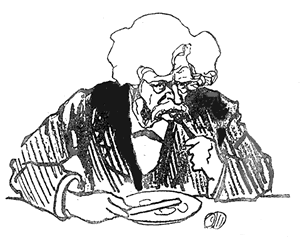 You would expect Twain, the great lecturer, to be a raconteur at all times. But like many performers, there seems to be on-stage and off-stage, and the two are not the same. When journalist and caricaturist Kate Carew met with him at breakfast ostensibly to sketch him, but secretly to interview him, one of the things he said, firmly, was "I won't be interviewed. I don't--approve--of interviews; don't like them--on-- principle."
This is a wonderful glimpse of Twain, 64 years old, a "wholesome old man" as young Carew describes him:
It would be impossible to exaggerate the composure and gravity with which Mark Twain utters his quaintnesses--and I'm sure he wasn't in much of a mood for quaintnesses that morning. There is no after-gleam of self-appreciation, no swift glance to see how his point has "taken." I am sure he does not try to say funny things, only he sees life through a glass that distorts every fact into a paradox. Or perhaps it is the serious people that have a distorted view of life. I wish Mark Twain would say what he thinks about it.
The interview is here.
Via.
Alternate casting
 We're suckers for articles about the other actors who were almost cast in famous parts. Some of these we know well, some of them are a little more obscure. For instance, the story of W.C. Fields playing the Wizard of Oz is not only famous, but also inevitable. Anyone who knows Fields's work has to imagine that he would have been perfect in the role. It all boiled down to money, leaving Frank Morgan to take on the part (which he did quite well, as it turned out). Shirley Temple was MGM's choice to play Dorothy, but her studio wouldn't make a deal with them. Why give away your biggest star to the competition? Come to think of it, Buddy Epsen was originally cast to play the Tin Man, but he was practically killed by the original makeup, and Gale Sondergaard was the first choice for the W.W. of the West, but she was too gorgeous, and she refused to play ugly. Oh, well. Lots of movies don't come together exactly as planned, but it doesn't seem to matter in the end.
For more recastings, check out Iconic Movie Roles That Were Almost Played by Other Actors.
Quick Take - Tim Rice
Jesus Christ Superstar and Evita are both on Broadway. (Come to think of it, so is The Lion King). Check in with the lyricist: Tim Rice reflects on stages of a life in theater.
Quick Take - Garbage Pail Kids
 Yuck. These things came out when my daughter was little, a parody of the Cabbage Patch Kids (also Yuck, but for different reasons). There's a slide show on Slate that will remind you of all of that, which I know you've been trying to forget, unless you're a kid yourself, in which case you can be nostalgic for someone else's youth.
Curiously enough, Art Speigelman was one of the artists behind these works.
Thursday, April 05, 2012
Grinwout's Pt 3
The blog is not pure aggregation. That is, it’s not just a hot link to something else. Each link is part of a short article, and it was always my intention, in every version of the blog, that it could stand alone. That is, you could read just the entry I’ve written and get enjoyment out of that, but if you were interested in the subject and wanted to know more, there was the link to click through. I guarantee that you won’t be disappointed on the other end, but by giving what I consider entertainment on the front end as well, you won’t be disappointed coming or going. Additionally, there are occasional birthday commemorations, usually drawn from YouTube. There I try to be less than predictable, looking for the less than famous who should be more famous, or finding the obscure rather than the obvious (although, occasionally, only the obvious will do). And once in a while, I just get inspired to write something up because I want to write it up, much as I do here.
I played around with different configurations of blog, Facebook and Twitter, thinking that they might be complementary somehow, but in the end decided that they would just be different gateways to the same material. So Twitter gets the RSS from the blog directly, while I just enter the link and a couple of words into the Facebook page. (That used to be automatic, RSS to fb, but they killed that functionality, and I figure it won’t kill me to enter directly rather than automate Twitter to fb, which doesn’t grab me, for some reason.) If you’re a Facebooker, I’d appreciate your liking the Grinwout’s page, because if I hit a certain number, I get some goodies that aren’t available to the riff and the raff directly off the streets.
As we enter the dry season for debate, and people stop debating every week, and all that’s left are some finals and then institutes, there won’t be much for me to talk about here, so however you follow this blog you should also follow Grinwout’s. If you’re an actual debater, it will do you good. You need to put something into your brain other than the knowledge of whether it makes sense to run an RVI when the moon is in Pisces. Having not terribly much to say here may lead me to simply pointing there, from here, once in a while, just to drive some traffic. In the end, of course, I don’t have unrealistic expectations. I know the traffic that CL drives, and I’d like to see likewise with Grin, which would mean a sizeable enough audience to warrant the time I’m spending on it. If it doesn’t come to pass, so be it, and I’ll finally give up and start playing videogames. (I can’t wait to dance with Mara Jade in the new Star Wars Kinnect game. Don’t tell Luke…)
I played around with different configurations of blog, Facebook and Twitter, thinking that they might be complementary somehow, but in the end decided that they would just be different gateways to the same material. So Twitter gets the RSS from the blog directly, while I just enter the link and a couple of words into the Facebook page. (That used to be automatic, RSS to fb, but they killed that functionality, and I figure it won’t kill me to enter directly rather than automate Twitter to fb, which doesn’t grab me, for some reason.) If you’re a Facebooker, I’d appreciate your liking the Grinwout’s page, because if I hit a certain number, I get some goodies that aren’t available to the riff and the raff directly off the streets.
As we enter the dry season for debate, and people stop debating every week, and all that’s left are some finals and then institutes, there won’t be much for me to talk about here, so however you follow this blog you should also follow Grinwout’s. If you’re an actual debater, it will do you good. You need to put something into your brain other than the knowledge of whether it makes sense to run an RVI when the moon is in Pisces. Having not terribly much to say here may lead me to simply pointing there, from here, once in a while, just to drive some traffic. In the end, of course, I don’t have unrealistic expectations. I know the traffic that CL drives, and I’d like to see likewise with Grin, which would mean a sizeable enough audience to warrant the time I’m spending on it. If it doesn’t come to pass, so be it, and I’ll finally give up and start playing videogames. (I can’t wait to dance with Mara Jade in the new Star Wars Kinnect game. Don’t tell Luke…)
Eugene O'Neill
 Let's just say that, most likely, Eugene O'Neill is the most depressing playwright in American history. He may also be the most important.
He introduced psychological and social realism to the American stage; he was among the earliest to use American vernacular, and to focus on characters marginalised by society. Before O'Neill, American theatre consisted of melodrama and farce; he was the first US playwright to take drama seriously as an aesthetic and intellectual form. He took it very seriously indeed; one cannot accuse O'Neill of frivolity. Of more than 50 finished plays, O'Neill wrote just one ostensible comedy, Ah, Wilderness! (1933), and even its plot hinges on drunkenness, prostitution, revenge and repressed desire. Of course, most of O'Neill's plays involve drunkenness, prostitution, revenge and repressed desire.
Then again, his life seemed to hinge on drunkenness, prostitution, revenge and repressed desire. His mother was a morphine addict, his brother drank himself to death... I mean, it sounds just like a Eugene O'Neill play!
Sarah Churchwell writes a great introduction to the man, Eugene O'Neill, master of American theatre.
James Patterson
As James Patterson puts it, "My work is just pure storytelling." But Patterson is more than just a storyteller. He's a combination writer, editor and publisher, drawing from a prodigious imagination and working with a group of co-writers, resulting in success beyond most authors' wildest dreams.
Any image one might have of Patterson in an ivory tower shouting out ideas and having some slaveys type them up and turn them into novels is completely erroneous. This man works on his books, from outlines to scene-writing to rewriting. It all seems to depend on what a given book needs at the moment as he works with his collaborators. And this year he has 13 books coming out. 13!!!
Lauren A.E. Schuker interviewed Patterson for Speakeasy. As productive as he is, one question had to be, how can all his books be successful? Patterson answers:
When you have as many books as this coming out, it’s hard to keep getting people excited about them. I’m excited about them. Otherwise I wouldn’t do them, but you have to make sure that the publisher is excited and that they go out with a lot with enthusiasm because in reality they are probably going to have 13 number one bestsellers. Maybe one or two will be number two. But it’s a constant process making sure that everybody is pumped up.
Of course, none of this pumping up would work if people didn't like the books. And they do like them. All that storytelling has its purpose, apparently.
Read James Patterson Explains Why His Books Sell Like Crazy.
Any image one might have of Patterson in an ivory tower shouting out ideas and having some slaveys type them up and turn them into novels is completely erroneous. This man works on his books, from outlines to scene-writing to rewriting. It all seems to depend on what a given book needs at the moment as he works with his collaborators. And this year he has 13 books coming out. 13!!!
Lauren A.E. Schuker interviewed Patterson for Speakeasy. As productive as he is, one question had to be, how can all his books be successful? Patterson answers:
When you have as many books as this coming out, it’s hard to keep getting people excited about them. I’m excited about them. Otherwise I wouldn’t do them, but you have to make sure that the publisher is excited and that they go out with a lot with enthusiasm because in reality they are probably going to have 13 number one bestsellers. Maybe one or two will be number two. But it’s a constant process making sure that everybody is pumped up.
Of course, none of this pumping up would work if people didn't like the books. And they do like them. All that storytelling has its purpose, apparently.
Read James Patterson Explains Why His Books Sell Like Crazy.
Rock and Roll Hall of Fame Inductees
 If you're in Cleveland on April 14, you can drop by the ceremony and catch this year's inductees. (Cleveland, "city of light, city of magic," as Randy Newman once wrote.)
This year's inductees are Guns N' Roses (and much has been made on the interwebs recently about the feuding Slash and Rose), Red Hot Chili Peppers, Donovan, Small Faces, Beastie Boys, the Crickets, the Famous Flames, the Midnighters, the Comets, the Blue Caps, the Miracles, Freddie King, Don Kirshner, Cosimo Matassa, Tom Dowd and Glyn Johns. You can get data on all of them on this page. Some of them are obviously more well-known than others.
The Hall has also provided a list of 10 essential songs for some of the inductees, with YouTube links. (Why not all of them?) For some of these people, like Donovan, this can be an interesting history lesson. How many people under 40 have ever heard his songs, yet he was one of the first major breakthrough stars of 60s music. A little folky, a little rocky, a little jazzy, a little psychedelic, a little mystical; put that way, it really does sound pure 60s. Laura Nyro was more successful as a songwriter than a performer, but she was a trailblazer, one of the most influential women singer-songwriters of the day. Small Faces (later Faces) was one of the most British of the British groups. Their music transformed completely when Rod Stewart joined them (and for 60s people, this was the Stewart we like to remember, not the one who
Which reminds me of a magic trick. Get a group of your friends in your car and put "Paradise City" on the stereo. Then during the chorus, sing the words, "Take me down to the prairie dog city." Your friends will be amazed at how they'll never be able to get this out of their minds thereafter, and they will start believe that Axl actually is saying Prairie Dog City. And if they're Guns N' Roses fans, they may never talk to you again.
Roger Corman
So many birthdays today. Spencer Tracy, Bette Davis, Melvyn Douglas, Gregory Peck. Obviously something about April 5 brings out one's inner thespian. But I'd prefer to talk about a man who spent his entire career bringing out other people's inner thespians. And their inner directors, and producers, and editors. If anyone could be deemed a one-man film school on the hoof, it's Roger Corman. He nurtured Coppola, Scorsese, Cameron, Dante—the list goes on. He acted, directed, produced. This interview from around 1999 gives a good sense of his contributions overall.
But nothing captures a filmmaker like the films he's made. Like this one, made in, as Corman says, "two days and a night." Needless to say, Corman also discovered a few actors:
Pain magazine?
Happy Birthday, Roger. Thanks for all that exploitation!
But nothing captures a filmmaker like the films he's made. Like this one, made in, as Corman says, "two days and a night." Needless to say, Corman also discovered a few actors:
Pain magazine?
Happy Birthday, Roger. Thanks for all that exploitation!
Wednesday, April 04, 2012
Grinwout's Pt 2
The last time I tried something like this was the quite different Coachean Feed. Since I was trawling through debate-related articles anyhow, philosophical or social or cultural or whatever, I figured I’d pass them along to anyone in the community who was interested. I never bothered to check the stats, but I don’t think this was particularly popular except among a few people who got it, so to speak. Of course, as LD has moved along from resolutional concentration to positional concentration, all the articles in the world about, say, drones, wouldn’t matter much anymore. And certainly articles on rights and ethics and so forth would be mostly falling on deaf ears, or blind eyes, or whatever. So, I stopped.
While I was doing it, though, I tried various ways to popularize it, including mixing it up with the entries here on CL, which proved quite unpopular. The VCA clearly wanted their RSS feed stuff separate from my rantings and ravings. Okay, sez I. In any case, those postings never aspired to anything aside from pointers, that is, I found something, here it is if you’re interested. I added little or no comment, because they mostly needed no comment.
I created the DJ blog to serve a particular purpose, to support a web presence for my DJ products. But, alas, I’m an editor, not a marketer, with only editorial powers. I couldn’t develop a book-rich site beyond the content I created myself. I did create content, though, not much different from Grinwout’s. It was fostered by the belief that I could use the DJ brand to demonstrate that there was good stuff out there, and that we could find it for people. This was true, and again, I don’t know the stats, but I do know that I found myself suddenly on mailing lists and getting requests for stuff and being invited to screenings of obscure independent films. Whether or not the DJ appreciated what I was doing, the subjects I was writing about did. But my goal was never to garner some particular popularity for the blog beyond pointing out that we had a rich entertainment heritage that we wanted to share by applying our editorial skills to selecting articles on the web that we thought were of interest. A couple of months ago the DJ redesigned the website, and that was the end of me.
But I had gotten so wrapped up in doing this that I couldn’t stop. The thing is, the regular actions of the DJ are such that doing the blog was the perfect coffee break. It used totally different mental muscles, and actually helped keep me more focused when I was concentrating on the main event. And as I’ve said, I liked scouring RSS feeds for the good stuff, and I liked writing about the good stuff when I found it. Hence Grinwout’s was born.
Pt 3 next time.
While I was doing it, though, I tried various ways to popularize it, including mixing it up with the entries here on CL, which proved quite unpopular. The VCA clearly wanted their RSS feed stuff separate from my rantings and ravings. Okay, sez I. In any case, those postings never aspired to anything aside from pointers, that is, I found something, here it is if you’re interested. I added little or no comment, because they mostly needed no comment.
I created the DJ blog to serve a particular purpose, to support a web presence for my DJ products. But, alas, I’m an editor, not a marketer, with only editorial powers. I couldn’t develop a book-rich site beyond the content I created myself. I did create content, though, not much different from Grinwout’s. It was fostered by the belief that I could use the DJ brand to demonstrate that there was good stuff out there, and that we could find it for people. This was true, and again, I don’t know the stats, but I do know that I found myself suddenly on mailing lists and getting requests for stuff and being invited to screenings of obscure independent films. Whether or not the DJ appreciated what I was doing, the subjects I was writing about did. But my goal was never to garner some particular popularity for the blog beyond pointing out that we had a rich entertainment heritage that we wanted to share by applying our editorial skills to selecting articles on the web that we thought were of interest. A couple of months ago the DJ redesigned the website, and that was the end of me.
But I had gotten so wrapped up in doing this that I couldn’t stop. The thing is, the regular actions of the DJ are such that doing the blog was the perfect coffee break. It used totally different mental muscles, and actually helped keep me more focused when I was concentrating on the main event. And as I’ve said, I liked scouring RSS feeds for the good stuff, and I liked writing about the good stuff when I found it. Hence Grinwout’s was born.
Pt 3 next time.
The Ultimate SF resource
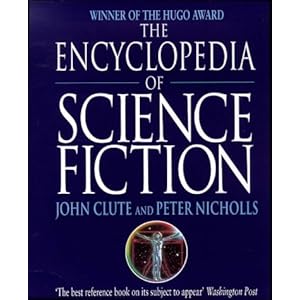 Maybe Grinwout's is a tad prejudiced about this one, having been the publisher of the first US edition back in the 70s, but The Encyclopedia of Science Fiction by John Clute and Peter Nicholls is the most useful, and most entertaining, SFF resource in the galaxy. I remember reading every word of this as it came to us, not because I needed to (we were picking up the British edition) but because I couldn't stop myself. For instance, I discovered the legendary editor T O'Conor Sloane (and there is no period after the T, an affectation that my colleague, T O'Conor Sloane, III, carried on). Sloane the FIrst was the editor of Amazing Stories. Here's how he is described in the Encyclopedia:
Nearing his 80th year when he finally succeeded to the editorship, Sloane had a long white beard and an appropriately Rip Van Winkle-like approach to the job; though he worked for twelve years on SF Magazines, he stated publicly (in a 1929 Amazing editorial) his belief that Man would never achieve space travel. Amazing nevertheless bought the first stories of such writers as E E Smith, John W Campbell Jr and Jack Williamson... Sloane actually lost the manuscript of Campbell's first story, and returned Clifford D Simak's first submission after four years' silence, remarking that it was "a bit dated".
Priceless.
All SFF fans need this book in their library, end of story. But this being the age of the interwebs, and this being an encyclopedia of the fantastic, after all, you can now get it online. Bookmark this site, make it your homepage, follow it on Twitter or Facebook, but whatever you do, link up with it. You'll wonder how you lived without it till now.
Quick Take: Love among the Peanuts
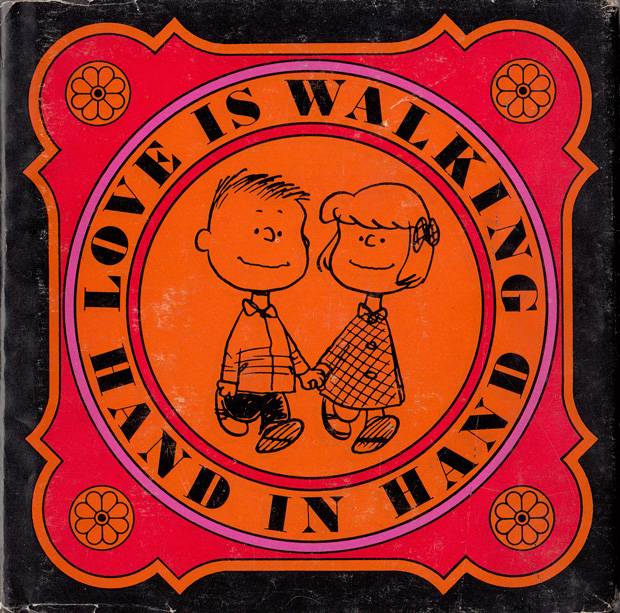 From the Aw Shucks files: Love Is Walking Hand In Hand: The Peanuts Gang Defines Love, 1965
Sexy vs informative
 If it's looks vs smarts on the interwebs, it becomes a matter of front end and back end. The front end needs to look good. The back end needs to be smart. If you can create a site with just one end that's both smart and good-looking, you win.
 That's my problem with the Internet Archive. It may be one of the smartest resources on the net, but it looks as dry as dust. Look at this. It's obviously a music archive, but you have to go way down below the fold to see things like the Grateful Dead, Apollo Sunshine, Flux Capacitor and Jerry Joseph and the Jackmormons (a group we are not necessarily endorsing, having never heard them, but we do like their name), Now look at this. The organization's blog is sexy looking, with artist logos and a picture of Garcia and Lesh and the gang (who started the whole live taping thing) going at it in performance. This archive is obviously an amazing source of music, all of it free (provided you don't go trying to make money off of it). We should all be diving into this over and over.
If only it had a sexy front end...
Quick Take: Fanciful postcards
 The jackalope isn't the only animal to roam the countryside, or at least to roam the front sides of American postcards.
 Greetings From the Land of the Make-Believe Species.
Yo, Dude!
"Or el Duderino, if you're not into the whole brevity thing."
What is it about the word dude? Slang usually has a really short half life. As soon as your mother says it, or worse, some teacher trying to be cool (a rare slang word that has lasted virtually forever), it's over. But dude is different. As Robert Lane Greene explains,
Slang rarely has staying power. That is part of its charm; the young create it, and discard it as soon as it becomes too common. Slang is a subset of in-group language, and once that gets taken up by the out-group, it’s time for the in-crowd to come up with something new. So the long life of one piece of American slang, albeit in many different guises, is striking. Or as the kids would say, “Dude!”
The history of the word goes back to Victorian England, of all places, before wending its way out to the wild west and, eventually, The Big Lebowski. You should read this article, dude. Or, we could put it another way. Dude, you should read this article:
Hey Dude.
What is it about the word dude? Slang usually has a really short half life. As soon as your mother says it, or worse, some teacher trying to be cool (a rare slang word that has lasted virtually forever), it's over. But dude is different. As Robert Lane Greene explains,
Slang rarely has staying power. That is part of its charm; the young create it, and discard it as soon as it becomes too common. Slang is a subset of in-group language, and once that gets taken up by the out-group, it’s time for the in-crowd to come up with something new. So the long life of one piece of American slang, albeit in many different guises, is striking. Or as the kids would say, “Dude!”
The history of the word goes back to Victorian England, of all places, before wending its way out to the wild west and, eventually, The Big Lebowski. You should read this article, dude. Or, we could put it another way. Dude, you should read this article:
Hey Dude.
Quick Take - Rock performers' legacies
Who controls the legacies of rock stars who have passed away, and how are they handling them? From Elvis to Whitney: The Big Business of Rock Estates.
Space Opera
 Charlie Jane Anders and Gordon Jackson have put together a great compilation of the highlights of the genre for io9. Some of these books and movies and television shows are personal favorites at Grinwout's. You should know them too.
Major Highlights in the History of Space Opera.
Tuesday, April 03, 2012
Grinwout's

In publishing, the area of my DJ, there are definitely foxes and hedgehogs. You can be a very specific kind of publisher, concentrating on, say, medicine or antique automobiles or cat breeding. There are books and magazines on all of these, and many of them. (Cat Fanciers Association recognizes 40 pureblood breeds, so one has to wonder what they talk about in the 41st issue of their magazine, but who am I to cast stones?) On the other hand, you can be a very general kind of publisher. The age of the generalist editor in print has sort of moved on (Life magazine would be the perfect example), but what is the internet if not one gigantic generalist publication, comprising a bazillion little specialized publications. The net is that giant, labyrinthine library that Jorge Luis Borges would have invented if he were a computist.
I maintain that the nature of the interwebs library is so overwhelming that most individuals hardly bother with it. We all have an infinite-access library card to a library that is virtually infinite, and most of us run past the thing with fear and trembling. At best there are some who pop into the coffee shop for chats with their friends, or we go look something up in the encyclopedia, but that’s about it. Because there’s too much to digest, we don’t even try.
There are some tools that purport to help us access this library, but they’re far from perfected, if they ever will be. RSS can take certain internet material and collect it for us, but only certain internet material. Twitter can aggregate other certain information. There are the Flipboard-type programs in the iPad that collect material (from RSS and Twitter and Facebook). But while we can automate access to some extent, soon enough the automation is as overwhelming as the lack thereof. There’s just too much damned information out there. There’s even just too damned much information that we want! It’s not as if all that stuff is of no interest to us. We just have trouble getting at it.
The librarians of the future will be the people who help us access the internet. We’re presently calling them curators or aggregators, but the key thing is, they bring some human discrimination to the material on the web, selecting a reasonable number of materials to pass along. Which makes them very much like editors (or exactly like editors, really), picking out material that they think others will like. They can be hedgehogs, picking out very specific material, or foxes, picking out a broader base of material.
That’s what Grinwout’s is all about. I do this because I am compelled by internal forces. It is the way my mind works. I thrive sorting through data. I enjoy picking out the best data, and I love writing it up and passing it along. I’m trying to provide an access point to arts and entertainment (and some miscellaneous) content on the web, because I think people will enjoy it. I was trying to do this for my DJ, but it just didn’t fit into their digital plans. Whatever. I thought I could stop doing it, and I went cold turkey, but it took only a few weeks and I fell back into my addiction. I think I’m actually good at it because, well, viewed other ways, it’s been my career for the last 40 years, and I just happen now to be applying it this particular way.
The site is still evolving. I’ll talk more about specifics tomorrow.
AKB48
Grinwout's saw a squib somewhere that AKB48 was in Washington, D.C., recently, to give their American fans a chance to see them live. This group, according to The Washington Post, is among the highest earning musical acts in the world, pulling down $200 million last year from CD and DVD sales alone. By comparison, Taylor Swift earned $35 million. Now, if there were 56 more Taylor Swifts... Yep, not only do they make a lot of money, but there's a real lot of them:
AKB48 is something of a cross between the Rockettes, Lolita, and whatever comprises Tin Pan Alley these days. American groups are lucky to have 3 or 4 members. AKB48 have had as many as 90. And I know what you're thinking: they seem interchangeable. Which might explain Aimi Eguchi:
Yep again. So interchangeable that she's not real. I guess when all 57 of the AKB48ers are too busy elsewhere, you call in the clones. Made thus:
If you want to make your own Aimi Eguchi, there's a website for that. We at Grinwout's, with our limited knowledge of the Japanese language, didn't get too far. Which, when all is said and done, might have been a good thing. There's something scary about this whole enterprise. This is way too uncanny valley for the likes of us.
AKB48 is something of a cross between the Rockettes, Lolita, and whatever comprises Tin Pan Alley these days. American groups are lucky to have 3 or 4 members. AKB48 have had as many as 90. And I know what you're thinking: they seem interchangeable. Which might explain Aimi Eguchi:
Yep again. So interchangeable that she's not real. I guess when all 57 of the AKB48ers are too busy elsewhere, you call in the clones. Made thus:
If you want to make your own Aimi Eguchi, there's a website for that. We at Grinwout's, with our limited knowledge of the Japanese language, didn't get too far. Which, when all is said and done, might have been a good thing. There's something scary about this whole enterprise. This is way too uncanny valley for the likes of us.
Secondary characters
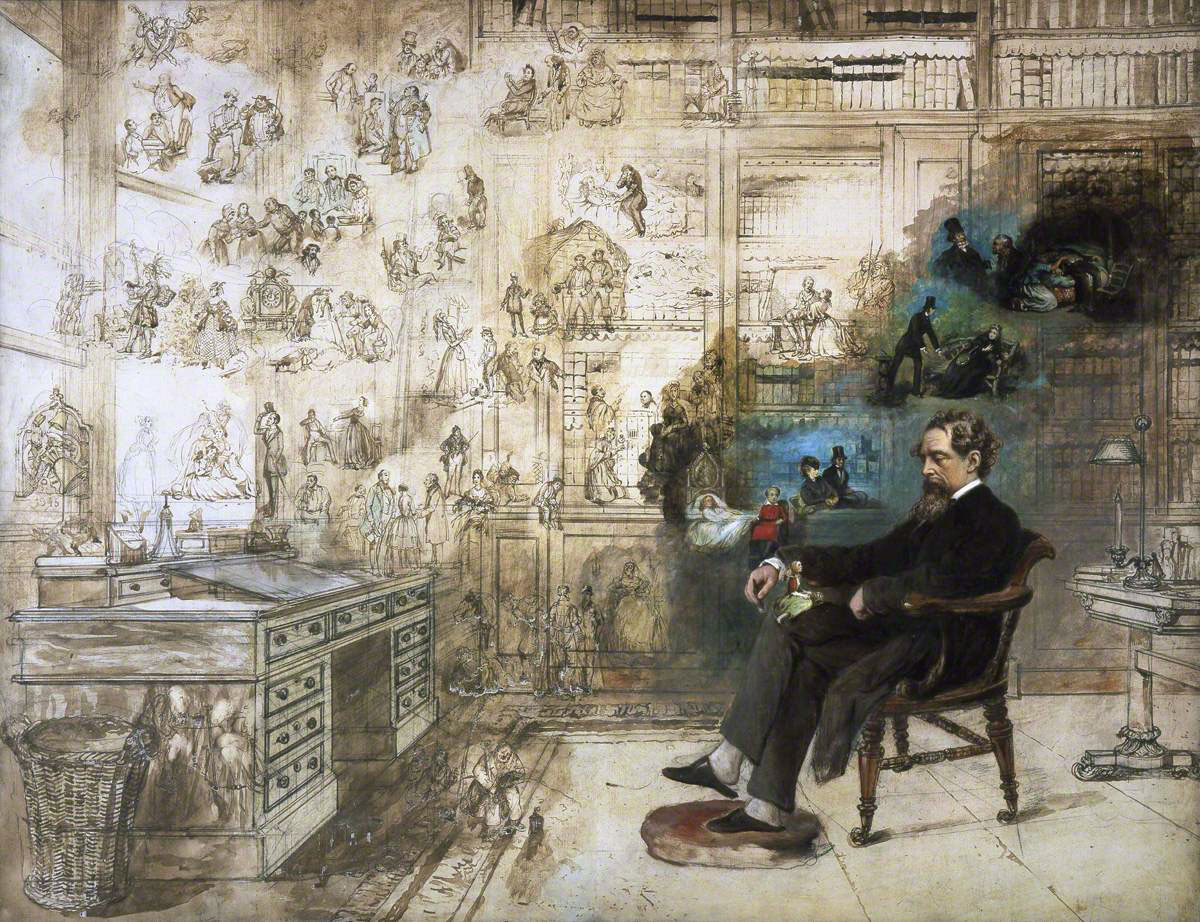 Stories require heroes and villains, but they also require everyone else in the world, or at least everyone else in the fictional world at hand. If Harry Potter comprised just some kid and some evil wizard, it wouldn't really stick in our minds all that well. But how many characters are there in Rowling's fictional universe? Or take Dickens: I love the Robert W. Buss painting "Dickens's Dream," with all those characters swirling around in his imagination. As Charlie Jane Anders writes: The master of "sprawling supporting cast," for my money, is Dickens. He probably created a few thousand people, out of thin air, over the course of his career, and many of them are so recognizable they've become words in the English language.
 So how do authors create these secondary characters that make or break a story? Anders, a writer herself, tries to pin down 10 Secrets to Creating Unforgettable Supporting Characters. She nails it well. And even if you're not in the business of writing yourself, you'll enjoy applying it to books or movies you know. If you have favorite characters, no doubt more than a few of them are supporting actors. I mean, think Star Wars. Luke? Han? Meh. R2D2? C-3PO? Now you're talking!
Quick Take - Snow White
 IMDB currently lists 91 films and TV shows featuring a character named "Snow White."
 Really?
Some of these look amazingly dreadful, especially the deservedly banned "Coal Black." Check out Snow White's Strange Cinematic History.
On being first
In science, if one discovers, say, the force of gravity, the important thing is not so much the discovery as the fact that we now know the force of gravity, and our knowledge about the universe can proceed accordingly. Nevertheless, from the discoverer's point of view, nobody wants to be second. In science, being second means that someone else discovered or invented it first. Their name will go down in history. Yours will not.
Contrast this to art. With art, if you paint the Sistine chapel, well, you painted the Sistine Chapel. If you wrote War and Peace, you wrote War and Peace. There's no such thing as coming in second, because works of art are unique (or at least, have been unique up until the contemporary period, thanks to folks like Andy Warhol). Then again, all works of art flow historically from all previous works of art. Individual achievement incorporates prior achievements by others. Nowadays it's as simple as sampling a riff from a Beatle song, but for the Beatles, it was the absorption of the music that preceded them, the blues and skiffle and swing, and transforming it into Beatle music. Of course, samplers will insist that they are part of this tradition, and they may be right!
Creativity is a wondrous subject.
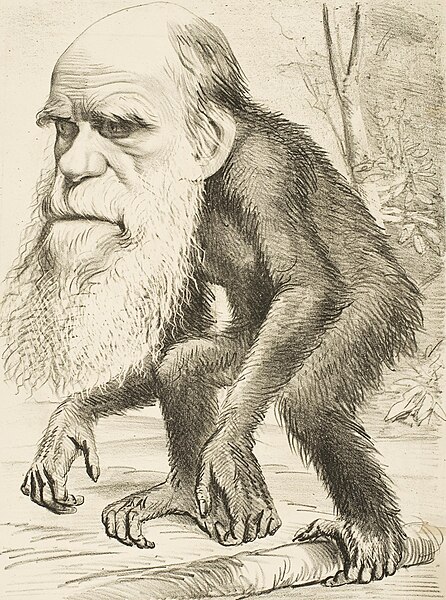 Ian McEwan compares scientific creativity with artistic creativity in an article for The Guardian. He begins by telling the story of Darwin and Wallace. They had both been working on the subject of evolution, but Darwin hadn't published (although he had begun his work prior to Wallace), and then he received Wallace's papers, to make them public. Darwin was put in the position of having been the first, but making himself look like the second. Fired up by a sense of purpose, he wrote The Origin of Species. And that sense of purpose was informed by one thing:
The Origin, written in 13 months, represents an extraordinary intellectual feat: mature insight, deep knowledge and observational powers, the marshalling of facts, the elucidation of near-irrefutable arguments in the service of a profound insight into natural processes. The reluctance to upset his wife Emma's religious devotion, or to contradict the theological certainties of his scientific colleagues, or to find himself in the unlikely role of iconoclast, a radical dissenter in Victorian society, all were swept aside for fear of another man taking possession of and getting credit for the ideas he believed to be his.
In a word, Darwin couldn't abide not being the first.
McEwan's article covers a lot of philosophic, scientific, artistic and humanistic ground. It's called The originality of the species. It's worth a look.
Contrast this to art. With art, if you paint the Sistine chapel, well, you painted the Sistine Chapel. If you wrote War and Peace, you wrote War and Peace. There's no such thing as coming in second, because works of art are unique (or at least, have been unique up until the contemporary period, thanks to folks like Andy Warhol). Then again, all works of art flow historically from all previous works of art. Individual achievement incorporates prior achievements by others. Nowadays it's as simple as sampling a riff from a Beatle song, but for the Beatles, it was the absorption of the music that preceded them, the blues and skiffle and swing, and transforming it into Beatle music. Of course, samplers will insist that they are part of this tradition, and they may be right!
Creativity is a wondrous subject.
Ian McEwan compares scientific creativity with artistic creativity in an article for The Guardian. He begins by telling the story of Darwin and Wallace. They had both been working on the subject of evolution, but Darwin hadn't published (although he had begun his work prior to Wallace), and then he received Wallace's papers, to make them public. Darwin was put in the position of having been the first, but making himself look like the second. Fired up by a sense of purpose, he wrote The Origin of Species. And that sense of purpose was informed by one thing:The Origin, written in 13 months, represents an extraordinary intellectual feat: mature insight, deep knowledge and observational powers, the marshalling of facts, the elucidation of near-irrefutable arguments in the service of a profound insight into natural processes. The reluctance to upset his wife Emma's religious devotion, or to contradict the theological certainties of his scientific colleagues, or to find himself in the unlikely role of iconoclast, a radical dissenter in Victorian society, all were swept aside for fear of another man taking possession of and getting credit for the ideas he believed to be his.
In a word, Darwin couldn't abide not being the first.
McEwan's article covers a lot of philosophic, scientific, artistic and humanistic ground. It's called The originality of the species. It's worth a look.
Ulysses audiobook
 We saw this on Sunday and for a second thought it might be an April's Fool trick: James Joyce’s Ulysses: Download the Free Audio Book
Grinwout's loves audiobooks, and Grinwout's loves free, but is of mixed mind regarding this one. Will we give it a try eventually? Probably. Or, more to the point, "...Yes I said yes I will Yes."
Day and Night
April 3, 1924. In Ohio, Doris Day, nee Doris Mary Ann Von Kappelhoff, is born. In Nebraska, Marlon Brando, Jr., makes his first appearance. They were both destined to become show business icons, their images virtually defining their era. One of them was what we thought we were, or maybe what we wanted to be. The other was what we really were, or afraid we might be.
Day started out as a girl singer with the big bands, and played plenty of movie roles that could be described as out-of-character, if we think of in-character as the quintessential Doris Day persona of being competent, funny, virginal, probably a businesswoman, not necessarily looking for a man but going to get either Rock Hudson or Cary Grant before the movie is over. Even when she played the housewife, she embodied all those characteristics. Her character was a creation of the 50s and early 60s, as defined by the mainstream mores of the time. Pre-feminist, post-war, middle American. She was America's Sweetheart, Eisenhower era version.
Her astrological twin also played a variety of roles over the space of his career. An unusually large number of those roles became individually iconic, as compared to Day's general iconic impact. Think of Brando, and you'll think of Johnny in The Wild One ("What are you protesting against?" "What do you got?"), Stanley Kowalski or Don Corleone. What unifies those three? Beats me, except that Brando made them unforgettable. They too are creations of the times, and they seem way more real than Day's image, although they are hardly run-of-the-mill Americans. But what individual Americans actually are run-of-the-mill. You? Me? Maybe that's why we might have loved Doris Day as an image, but were wowed by Marlon Brando as a person.
To celebrate the dual birthday, let's have some singing. The 50s saw a lot of Broadway musicals made into Hollywood musicals. Most of them are a little drab, unfortunately. In the 50s Hollywood was making stunning originals like Gigi and An American in Paris, so The Pajama Game and Guys and Dolls, while they have their moments, are not classics. Still, here's a couple of those moments.
Day started out as a girl singer with the big bands, and played plenty of movie roles that could be described as out-of-character, if we think of in-character as the quintessential Doris Day persona of being competent, funny, virginal, probably a businesswoman, not necessarily looking for a man but going to get either Rock Hudson or Cary Grant before the movie is over. Even when she played the housewife, she embodied all those characteristics. Her character was a creation of the 50s and early 60s, as defined by the mainstream mores of the time. Pre-feminist, post-war, middle American. She was America's Sweetheart, Eisenhower era version.
Her astrological twin also played a variety of roles over the space of his career. An unusually large number of those roles became individually iconic, as compared to Day's general iconic impact. Think of Brando, and you'll think of Johnny in The Wild One ("What are you protesting against?" "What do you got?"), Stanley Kowalski or Don Corleone. What unifies those three? Beats me, except that Brando made them unforgettable. They too are creations of the times, and they seem way more real than Day's image, although they are hardly run-of-the-mill Americans. But what individual Americans actually are run-of-the-mill. You? Me? Maybe that's why we might have loved Doris Day as an image, but were wowed by Marlon Brando as a person.
To celebrate the dual birthday, let's have some singing. The 50s saw a lot of Broadway musicals made into Hollywood musicals. Most of them are a little drab, unfortunately. In the 50s Hollywood was making stunning originals like Gigi and An American in Paris, so The Pajama Game and Guys and Dolls, while they have their moments, are not classics. Still, here's a couple of those moments.
Monday, April 02, 2012
State (as O'C insists on calling it)
We got off to a rollicking start for last weekend when Meh announced that she was coming down with the yaws, or something, and couldn’t debate. With Zip out of commission because of the break, there was nothing for it but to drop the single Sailor entry at State.
Sigh.
That didn’t stop me personally, of course. I’m on the board, for one thing, and I’m expected to tab, for another thing, and it’s actually what I wanted to do this weekend, for a final thing. I don’t do this because I hate it, in other words. Without the burden of all those pesky students (well, 2 pesky students), I was free to come and go as I pleased. Big deal. The only difference this meant was that I didn’t have to find Meh’s house again, even though her family has obligingly kept the Christmas decorations up for me.
There were mostly the usual trials and tribulations over the weekend. We played around with the pair-on-screen function, but ended up preferring cards. Still, I finally did get the hang of it. Maybe next year. We screwed one poor kid by misreporting who broke, so we’ll never do it that way again (i.e., scribbling it vs. pulling a pdf). However, said screwee was scheduled to debate the one other kid who didn’t show for his own reasons, meaning he both got screwed and managed to advance to quarters. There’s worse ways to go.
Our biggest problem was disappearing judges. One school changed virtually all their preffed judges on arrival, which is about as unprofessional as a team can get. This was matched by the disappearing judges who didn’t fulfill their obligations. Do they really think we don’t remember? My list of schools not welcome, when I have the opportunity to pick and choose, grows and changes. One school that had been on that list performed admirably, staying till when they should have and checking with us to make sure. Good for them, and so noted. One judge who’s been on my radar as never being around to pick up a ballot, ever, proved herself again by disappearing completely. Sorry, but you’re on that list now. We call them invitationals because we’re inviting people. But we’re not inviting you…
Mostly, of course, it was a fine event. We did some single-flighting and got out at reasonable times on both days, which is always nice. It continues to grow, and that’s a good thing. And the best news is, we found a new tab room for Big Jake. O’C, who claims that this was all my fault, has been holding out on us, falling back on my declaration back when he was a pup that we needed a central tab room. That was when we had 200 runners, all of them running at the same time, in all directions, willy-nilly. Once the operation got organized, what we needed was a tab room with couches, space and a microwave. Such a room has been found.
If O’C doesn’t deliver next season, there will be hell to pay.
Sigh.
That didn’t stop me personally, of course. I’m on the board, for one thing, and I’m expected to tab, for another thing, and it’s actually what I wanted to do this weekend, for a final thing. I don’t do this because I hate it, in other words. Without the burden of all those pesky students (well, 2 pesky students), I was free to come and go as I pleased. Big deal. The only difference this meant was that I didn’t have to find Meh’s house again, even though her family has obligingly kept the Christmas decorations up for me.
There were mostly the usual trials and tribulations over the weekend. We played around with the pair-on-screen function, but ended up preferring cards. Still, I finally did get the hang of it. Maybe next year. We screwed one poor kid by misreporting who broke, so we’ll never do it that way again (i.e., scribbling it vs. pulling a pdf). However, said screwee was scheduled to debate the one other kid who didn’t show for his own reasons, meaning he both got screwed and managed to advance to quarters. There’s worse ways to go.
Our biggest problem was disappearing judges. One school changed virtually all their preffed judges on arrival, which is about as unprofessional as a team can get. This was matched by the disappearing judges who didn’t fulfill their obligations. Do they really think we don’t remember? My list of schools not welcome, when I have the opportunity to pick and choose, grows and changes. One school that had been on that list performed admirably, staying till when they should have and checking with us to make sure. Good for them, and so noted. One judge who’s been on my radar as never being around to pick up a ballot, ever, proved herself again by disappearing completely. Sorry, but you’re on that list now. We call them invitationals because we’re inviting people. But we’re not inviting you…
Mostly, of course, it was a fine event. We did some single-flighting and got out at reasonable times on both days, which is always nice. It continues to grow, and that’s a good thing. And the best news is, we found a new tab room for Big Jake. O’C, who claims that this was all my fault, has been holding out on us, falling back on my declaration back when he was a pup that we needed a central tab room. That was when we had 200 runners, all of them running at the same time, in all directions, willy-nilly. Once the operation got organized, what we needed was a tab room with couches, space and a microwave. Such a room has been found.
If O’C doesn’t deliver next season, there will be hell to pay.
Casanova
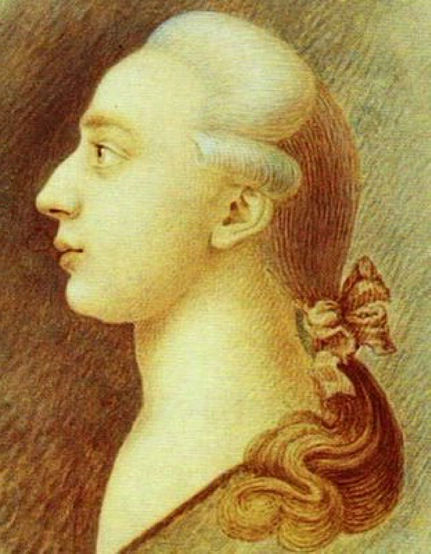 His name is synonymous with lover, and he certainly had an affection for the opposite sex. A couple of years ago the original manuscript of his memoirs sold for a record-breaking $9.6 million. A Venetian by birth, he has apparently become especially celebrated by the present-day French.
 An article about the man, and the manuscript, is at Smithsonian.com. Grinwout's loves the Smithsonian!
Author Tony Perrottet writes:
Giacomo Girolamo Casanova lived from 1725 to 1798... He was a true Enlightenment polymath, whose many achievements would put the likes of Hugh Hefner to shame. He hobnobbed with Voltaire, Catherine the Great, Benjamin Franklin and probably Mozart; survived as a gambler, an astrologer and spy; translated The Iliad into his Venetian dialect; and wrote a science fiction novel, a proto-feminist pamphlet and a range of mathematical treatises... The memoir teems with fantastic characters and incidents... Apart from the more than 120 notorious love affairs with countesses, milkmaids and nuns, which take up about a third of the book, the memoir includes escapes, duels, swindles, stagecoach journeys, arrests and meetings with royals, gamblers and mountebanks.
Read Who Was Casanova? You owe it to your love life, as well as your sense of adventure.
Modern photographers
 We are all photographers. It used to be, if you wanted to be a photographer, you had to have a camera and some film. But as a mark of total cultural upheaval, Kodak doesn't manufacture Kodachrome anymore. You can still pick up rolls of Tri-X, the quintessential black-and-white film that all hobbyists used to start out with (and photojournalists would swear by, although I gather that now professionals have gone on to T-MAX). Instead of film today we use digital media, and we've traded in our cameras for telephones. But there is a boon in digital photography with all those non-cameras available in half the devices we all own. We now take more pictures than we ever have before. And there are so many digital photography apps that it's impossible to keep track.
 In other words, photography is dead, and it is thriving. It depends on how you define photography.
So what does this mean to artists who use photography as a medium? Complex posts a survey of The 25 Photographers You Should Know by Elisa Carmichael that is a great starting point for figuring out the state of the art. Check out the specs on the pictures. For the most part, even if the images were captured digitally, a lot of hand-crafting went into their printing. In other words, while looking at them on the computer gives you a sense, is it only a sense, much like looking at a painting on the computer. Seeing that Monet slapped down some green paint to capture those water lilies in the pond next to his house is not the same as being surrounded by these paintings on the wall. I think we shortchange photography a lot, especially now that its digital nature makes it seem so fungible.
In any case, since you're probably taking a lot of pictures yourself, it's nice to see that the pros are up to.
Philo Vance

Philo Vance was one of the original twentieth century detectives, created by S. S. Van Dine. William Powell (right), later of Thin Man fame, was the original Philo Vance in the movies, starting in 1929. If he doesn't look like the quintessential detective, I don't know who does.
Van Dine, whose real name was Willard Huntington Wright, was a literary editor and a Nietzsche scholar who, while recovering from cocaine addiction, turned his hand to detective fiction. As a scholar, he couldn't help but approach the subject in a scholarly fashion. Hence, he not only wrote his novels, but he outlined 20 rules for writing detective stories. This is one of my favorites:
There simply must be a corpse in a detective novel, and the deader the corpse the better. No lesser crime than murder will suffice. Three hundred pages is far too much pother for a crime other than murder. After all, the reader's trouble and expenditure of energy must be rewarded.
Reading Van Dine's Rules For Detective Writers in this day and age is like looking at a list of literary opportunities that absolutely must be seized at the first possible moment. Take apart today's bestseller list, and you'll find all these rules being broken on a regular basis and virtually no one, not even the coziest of authors, adhering to all of them. But for Van Dine, the genre was just beginning, and it was too soon to start experimenting. That would happen soon enough.
Van Dine's books hold up pretty well, by the way, at least the early ones. Take a look. And then compare them to his list, and decide for youself if he's following the rules he himself set.
Honi Coles
As Arlene Croce said about Fred Astaire, he could tap, but he wasn't one of the all-time great tap dancers. That distinction goes to a handful of others; prominent among these is Charles "Honi" Coles, born on April 2, 1911.
We are blessed, first, with film of much of the art of the 20th Century, and second, easy access to all that film in the 21st. I don't have to say anything about the amazing elegant Mr. Coles, or the speedy music of his feet. You can see it for yourself. This clip is about 8 minutes long, and you're not going to be able to tear yourself away, so set aside those few minutes to savor:
We are blessed, first, with film of much of the art of the 20th Century, and second, easy access to all that film in the 21st. I don't have to say anything about the amazing elegant Mr. Coles, or the speedy music of his feet. You can see it for yourself. This clip is about 8 minutes long, and you're not going to be able to tear yourself away, so set aside those few minutes to savor:
Subscribe to:
Posts (Atom)