Bob Dylan is opening there next month, marking a rebirth of the famous music venue.
Pfffft.
Music venue? I was raised in Port Chester. It was a movie theater when I was a kid. And every Saturday, they had kids' matinees. The best of these included space/monster movies. Creature Features. Whatever you wanted to call them. Double features, plus cartoons and coming attractions. A movie theater virtually packed to the ceiling with an audience ranging in age from about 8 to 12, with one sole adult, the theater manager, doing his futile best to keep a lid on the proceedings.
These were the movies I would watch with gaping jaw, and then go home nonchalantly and not be able to get to sleep out of sheer cold terror. One of the best of these, if not the best, was Enemy from Space. I only ever saw it the once, 50 some odd years ago, and I still remember that this gook came from Jupiter attached to rocks, and it jumped off the rocks and took over humans and made them slaves, collecting the rest of the rocks and getting their passengers into giant tanks where they could breathe their native methane. The monsters, once assembled, were fairly blobbish and run of the mill, but that whole idea of a mind-controlled slave army... In a way it was another twist on Invasion of the Body Snatchers, of course, but when an idea is good, run with it.
By the time Five Million Years to Earth came around, I was too old to lose sleep over a movie, but let me tell you, this one with its primal satanic imagery still managed to shake me up a bit. The whole exercise was way more complex than simple invading extraterrestrials.
I don't know when I finally put it all together and realized that they were of a part, both being Quatermass stories. As explained in ‘QUATERMASS AND THE PIT’: THE ORIGINAL, CLASSIC TV SERIES BY NIGEL KNEALE, this all started as a British TV series. And my guess is, it is pretty well forgotten, as are the movies. I can't recall, until seeing this article, a mention of Quatermass in years.
There's a video of the TV version of Million in the posting. I wonder how it compares to the movie, and if it holds up on its own. As soon as I get a few hours... In any case, find the two movies, if you're a classic SF film buff. At the very least, you'll be amused.
Tuesday, August 14, 2012
The Capitol Theater in Port Chester, NY
Your science dollars at work
This is sort of amazing. On the one hand, it's a human interest story, but at the same time, it's a science/tech story.
I mean, they just whip up spare parts on the old 3D printer? And it's the same material as Legos? There's more to see at the WREX site, if you want.
It's an amazing world we live in.
[Via]
I mean, they just whip up spare parts on the old 3D printer? And it's the same material as Legos? There's more to see at the WREX site, if you want.
It's an amazing world we live in.
[Via]
Monday, August 13, 2012
Debate: In which familial aspersions are cast
Over the weekend the trouble-and-strife suggested that my blog was often longwinded and pedantic. To which I looked at her askance, wondering if she had just noticed this. It is curious that I make my DJ living in the business of cutting and simplifying, but when I put pen to paper myself, so to speak, I never think twice about quantity. It’s not that I don’t edit these pieces a little bit, but honestly, I just write them, read them, fix them when something doesn’t make sense, and post them. Anything beyond that would be inhibiting. I can write pretty polished if I want to, but the blog is more thoughts and ideas and general annoyances than any attempt at perfect prose. Which is why Flaubert never blogged. That and, well, a couple of other reasons.
CP finally got the email function back into tabroom.com, so I was able to send out a blast to the collected MHL membership about the workshop on the 29th. I’m using the same template for the agenda from 2010. 2011, you may remember, was the crazy collection of weekends where there were more Jewish holidays than ever before, and even Monticello had to move to new digs away from its traditional Columbus Day home. Things calm down this year, although the first-timers’ will precede rather than follow Fairly Largish Bronx, causing all sorts of confusion on the local front. We’ll cope.
I feel as if we’re really in business for the season, as today I put in the request for September buses. We’ll need one for the Speecho-Americans going to Yale, plus I’m hopeful of having a teeming multitude heading for the workshop, so there you are. I am at the edge of my seat waiting for the topic to be released Wednesday. Both of my Pups PFers say they will be coming over that night for a burger and a minimal brainstorm; that should get them started, anyhow.
Now see? That was neither pedantic nor longwinded. I can do it if I want to. I just seldom want to.
CP finally got the email function back into tabroom.com, so I was able to send out a blast to the collected MHL membership about the workshop on the 29th. I’m using the same template for the agenda from 2010. 2011, you may remember, was the crazy collection of weekends where there were more Jewish holidays than ever before, and even Monticello had to move to new digs away from its traditional Columbus Day home. Things calm down this year, although the first-timers’ will precede rather than follow Fairly Largish Bronx, causing all sorts of confusion on the local front. We’ll cope.
I feel as if we’re really in business for the season, as today I put in the request for September buses. We’ll need one for the Speecho-Americans going to Yale, plus I’m hopeful of having a teeming multitude heading for the workshop, so there you are. I am at the edge of my seat waiting for the topic to be released Wednesday. Both of my Pups PFers say they will be coming over that night for a burger and a minimal brainstorm; that should get them started, anyhow.
Now see? That was neither pedantic nor longwinded. I can do it if I want to. I just seldom want to.
Music: This Nearly Was Mine
No reason for this, except it's one of the most beautiful, and saddest, songs ever.
To fly away as day flies from moonlight...
Helluva performance, too!
To fly away as day flies from moonlight...
Helluva performance, too!
The AIDS quilt
Sometimes you see something that simply overwhelms you. This is one of those things.
You know about the AIDS quilt. Here's the story and all the details. 48,000 panels. Now Microsoft has digitized it. And here's the link.
Be warned. It may be the most amazing, and moving, thing you've ever seen on your computer screen.
[Via OpenCulture.]
You know about the AIDS quilt. Here's the story and all the details. 48,000 panels. Now Microsoft has digitized it. And here's the link.
Be warned. It may be the most amazing, and moving, thing you've ever seen on your computer screen.
[Via OpenCulture.]
Movies: Who left the pod bay doors open?
Well, after all, it is on the 50. If I recall, it's the only SF picture. Not surprising. As I said earlier, it is on the dull side, but then again, I saw it about 20 times, so it's not as if I didn't like it. I know I saw it in 70mm. I may have even seen it in Cinerama. I saw it sitting in the front, sitting in the back. I've watched it on television. I've watched it on a computer. I can honestly say that I've probably memorized all the dialogue. Then again, there's only about three lines of it, so my cat could probably memorize all the dialogue after way fewer viewings.
I was unaware of this documentary, though. Good stuff, via Mentalfloss.
Saturday, August 11, 2012
Iron Baby
This is totally viral, but I just saw it for the first time and figured, why not?
Friday, August 10, 2012
Riding off into the weekend
This time out, a virtual waterslide, described at Makers' Faire. These guys actually built the thing, and you know you want to ride it.
Labels:
amusement parks,
ride of the week
More on the 50
If there’s any secondary theme to CL after debate life, it’s probably art. I’ve certainly written a lot about art that I’ve subsequently collected for permanent access, e.g. Caveman. I am intrigued by what art is, and what it does, for many reasons. Not least among these is the difficulty in actually establishing in many cases what, indeed, art is. From there, one takes on the issues of good art and bad art, of taste and fashion, of all sorts of things that would not necessarily be meaningful if we were talking about something else. The thing is, because of the importance of art to the human spirit, the subject of art warrants our deep analysis. Whatever it is, it is one of the things that makes us human. And as such it has been a subject for philosophers since the very beginning of philosophy. Given the audience for CL, it seems like a good subject for us.
When I wrote about the so-called best films of all time, I was talking off the top of my head, mostly. Not that I didn’t mean what I said, but I hadn’t dug too deeply. But the idea of movies and art is a rich one, worthy of more analysis. RM commented thus: Isn't film for trained critics the way debate is for trained critics? Clearly there's a place for popularization in both spheres, but there's also a place in both for the education of the audience into a realm where they do understand and benefit from the interconnections. I'm clearly not there in film, but in other areas like painting, theater, philosophy, and debate, I find myself riveted by a lot of performances that 'laypeople' would find terminally boring. So it's not that I value other things over engagement so much as I've been molded into the kind of viewer who finds more abstract material engaging.
I’m not terribly excited about discussing the idea of debate for trained critics at the moment, which I don’t think is a question of art. But I do think Ryan’s point about critics in general is a good one. Simply put, isn’t it true that the more we are trained to understand things, the more we understand them? And the more we understand things, the better able we are to appreciate them? The answer is obviously yes. And no. (I love when Ryan takes me to task!)
First of all, critical knowledge is no guarantee of taste. I don’t have to explain that.
Secondly, critical knowledge is no guarantee of understanding anything but what one has been taught to understand. The history of art is rife with examples of new people coming along and being dismissed by the critics, and later being recognized. The Impressionists, Van Gogh, Melville, Charles Ives, etc. This also connects to a narrowing of critical opinion, rather than a broadening, based on one’s belief that one’s education was definitive and correct, rather than merely one step on an endless journey.
Third, there is the “conspiracy of art” a la Baudrillard, where commerce in the arcane is masterminded by those with the most to gain, i.e., the galleries and critics “conspire” to call something good art because it is to their mutual benefit, not because the item in question is, in fact, good art. (Damien Hirst polka dots? Not even painted necessarily by Damien Hirst? Now that's a shark.)
Fourth, there is often a tendency of critics to show off their knowledge, in pure self-aggrandizement, a sort of Ellsworth Toohey haughtiness that I think does tend to demonstrate itself in areas where the average person may not have a lot of background (like architecture, and I can’t believe I used an example from Ayn Rand, and I should rot in hell for that).
And then there’s movies themselves. Of all the things we might want to call an art form, movies might be the least like art. First of all, it is a collaboration. Take The Godfather, which most people agree is a great movie. What makes it great? The script? Which parts of the script, those from Puzo or those from Coppola? Is it the direction? The acting? Would it have been as good if the studio had managed to keep Brando out? The photography? The music? Absolutely every single one of those things? Boy, that’s a tough one. Given that all those things except for Brando are repeated in The Godfather Part 2, which most people also agree is a great movie, and that all those things in Part 2 are also repeated The Godfather Part 3, which most people agree is pretty much just meh, you’ve got to wonder.
Maybe we can pin down what makes a movie great or not great, when we have the similar sets of pieces from something like the Godfather trilogy, if we have the time and energy. It should be the easiest case to do so, when you think about it, because of the similar sets of pieces. But I wonder…
One thing about movies that is different from every other form of entertainment, except, perhaps, video games, is their expense. Because they cost millions of dollars, they must also sell millions of dollars of tickets. But we wouldn’t equate popularity with quality. The Godfather was enormously successful, as a matter of fact, but that doesn’t make it better or worse than any other picture, it just makes it more popular. Still, at some point all movies must have it in their DNA to be seen. Even something like Warhol’s Empire has no point if no one sees it. That movie would have only been made as an example of some sort of artistic vision, though. I know a lot about movies, and a lot about Warhol, and I don’t care how many National Film Registry recognitions it gets, I don’t want to watch more than the two minutes I’ve already seen. After all, I know how it ends.
My point is that a movie, to be successful on its own DNA terms, must pay for itself, and therefore must sell tickets, and the only way it can do that is to entertain (unless the movie stars Adam Sandler). There must be an audience for a film, or the film won’t exist in the first place. Or at least, that’s the presumption of everyone along the way. The producers won’t produce it if they think it won’t pay; the studios won’t back it; the agents won’t put their people into it. (Except, again, for Adam Sandler. I don’t begin to understand Adam Sandler, and let’s face it, neither do you. No one does. Which may, in fact, completely explain the regular creation of Adam Sandler movies.)
So popularity does, in fact, play a part in filmmaking. Which means that filmmakers must, at some level, strive for success by connecting with paying audiences. This can be done, of course, with no pretense to creativity beyond craft. I recently say Moneyball and enjoyed it quite a bit, but I doubt if anyone involved in it saw it as anything but a piece of commerce. Good commerce, smart commerce, but commerce all the same. They set out to make an entertaining movie—nothing wrong with that—and they did. Good for them. It will never be on anyone’s top hundred list. But that’s true of every single movie ever made (except for a hundred of them).
So let’s look at Citizen Kane. To say that Orson Welles had artistic ambitions is to say that rice comes in little grains that are usually white. His theater history prior to heading out to Hollywood is nothing if not ambitious on a grandiose scale. He wanted to reinvent everything, to move the needle on everything, to change everything. (In a way, his biography is a tragedy of his ultimate failure to do so after his prodigious beginnings.) When he got his hands on “the biggest electric train set a boy ever had,” i.e., the RKO back lot, he made the most of it. Practically every scene in Kane, if not every shot, is an attempt to shake things up. It redefines a closeup or a a longshot, it reinvents depth of field, it does three things when most shots barely do one. Characters age, characters change. Imagery and allusions collect in an embarrassment of riches. Just the opening scene alone, fade after fade after fade, is amazing. For that matter, just watch the movie for scene changes: it wipes, it pans, it blacks out, whatever. If you’re knowledgeable about movies, it makes you dizzy to watch all of this, not used at random, but put in aid of a fascinating story. In other words, if you’re an educated audience, the more you know, the more you appreciate.
But here’s the thing. If you’re not an educated audience, if you’ve never seen a movie before in your life, you are still going to be blown away by this movie. You will be drawn in to the opening series of fades, and you won’t be let go of until you see the sled on the fire. This is a movie for everybody. The fact that you might be able to refine your tastes to make it even better is a plus, but the bottom line is already greatness.
My complaint against some of the movies on the list was not that some of them aren’t as exciting as Kane, first of all because some of them are, and second of all, a movie doesn’t have to be exciting to be great. My complaint was that some of them were there because of the Ellsworth Toohey factor: "I have learned a lot and gotten my tastes remarkably refined, and this is the sort of movie that appeals to tony taste buds that only those of my high quality can appreciate." The two movies that most reflect that for me have been for years Vertigo and The Searchers. I don’t dislike them—don’t get me wrong—but I see in them critic-bait (not deliberate on the directors’ parts) that makes them pets of people who don’t care as much about movies as an overall experience as much as a measure of their own ability to read into them intellectual themes that don’t necessarily make them good movies. My problem with Vertigo versus lots of other AH films is that it is so psychologically cerebral that it fails to connect to the visceral. The Searchers is just too damned long and needs twenty minutes cut from the second act. The thing about The Searchers is that practically every filmmaker cutting his teeth in the 70s was so influenced by it that they elevated it to ideal status that it didn’t deserve, and then alluded to it so much that you felt that every picture you saw was just another homage to John Ford.
Anyhow, I think Ryan has a valid point, but I don’t think it’s absolute. And it’s so much fun to write about this stuff!
When I wrote about the so-called best films of all time, I was talking off the top of my head, mostly. Not that I didn’t mean what I said, but I hadn’t dug too deeply. But the idea of movies and art is a rich one, worthy of more analysis. RM commented thus: Isn't film for trained critics the way debate is for trained critics? Clearly there's a place for popularization in both spheres, but there's also a place in both for the education of the audience into a realm where they do understand and benefit from the interconnections. I'm clearly not there in film, but in other areas like painting, theater, philosophy, and debate, I find myself riveted by a lot of performances that 'laypeople' would find terminally boring. So it's not that I value other things over engagement so much as I've been molded into the kind of viewer who finds more abstract material engaging.
I’m not terribly excited about discussing the idea of debate for trained critics at the moment, which I don’t think is a question of art. But I do think Ryan’s point about critics in general is a good one. Simply put, isn’t it true that the more we are trained to understand things, the more we understand them? And the more we understand things, the better able we are to appreciate them? The answer is obviously yes. And no. (I love when Ryan takes me to task!)
First of all, critical knowledge is no guarantee of taste. I don’t have to explain that.
Secondly, critical knowledge is no guarantee of understanding anything but what one has been taught to understand. The history of art is rife with examples of new people coming along and being dismissed by the critics, and later being recognized. The Impressionists, Van Gogh, Melville, Charles Ives, etc. This also connects to a narrowing of critical opinion, rather than a broadening, based on one’s belief that one’s education was definitive and correct, rather than merely one step on an endless journey.
Third, there is the “conspiracy of art” a la Baudrillard, where commerce in the arcane is masterminded by those with the most to gain, i.e., the galleries and critics “conspire” to call something good art because it is to their mutual benefit, not because the item in question is, in fact, good art. (Damien Hirst polka dots? Not even painted necessarily by Damien Hirst? Now that's a shark.)
Fourth, there is often a tendency of critics to show off their knowledge, in pure self-aggrandizement, a sort of Ellsworth Toohey haughtiness that I think does tend to demonstrate itself in areas where the average person may not have a lot of background (like architecture, and I can’t believe I used an example from Ayn Rand, and I should rot in hell for that).
And then there’s movies themselves. Of all the things we might want to call an art form, movies might be the least like art. First of all, it is a collaboration. Take The Godfather, which most people agree is a great movie. What makes it great? The script? Which parts of the script, those from Puzo or those from Coppola? Is it the direction? The acting? Would it have been as good if the studio had managed to keep Brando out? The photography? The music? Absolutely every single one of those things? Boy, that’s a tough one. Given that all those things except for Brando are repeated in The Godfather Part 2, which most people also agree is a great movie, and that all those things in Part 2 are also repeated The Godfather Part 3, which most people agree is pretty much just meh, you’ve got to wonder.
Maybe we can pin down what makes a movie great or not great, when we have the similar sets of pieces from something like the Godfather trilogy, if we have the time and energy. It should be the easiest case to do so, when you think about it, because of the similar sets of pieces. But I wonder…
One thing about movies that is different from every other form of entertainment, except, perhaps, video games, is their expense. Because they cost millions of dollars, they must also sell millions of dollars of tickets. But we wouldn’t equate popularity with quality. The Godfather was enormously successful, as a matter of fact, but that doesn’t make it better or worse than any other picture, it just makes it more popular. Still, at some point all movies must have it in their DNA to be seen. Even something like Warhol’s Empire has no point if no one sees it. That movie would have only been made as an example of some sort of artistic vision, though. I know a lot about movies, and a lot about Warhol, and I don’t care how many National Film Registry recognitions it gets, I don’t want to watch more than the two minutes I’ve already seen. After all, I know how it ends.
My point is that a movie, to be successful on its own DNA terms, must pay for itself, and therefore must sell tickets, and the only way it can do that is to entertain (unless the movie stars Adam Sandler). There must be an audience for a film, or the film won’t exist in the first place. Or at least, that’s the presumption of everyone along the way. The producers won’t produce it if they think it won’t pay; the studios won’t back it; the agents won’t put their people into it. (Except, again, for Adam Sandler. I don’t begin to understand Adam Sandler, and let’s face it, neither do you. No one does. Which may, in fact, completely explain the regular creation of Adam Sandler movies.)
So popularity does, in fact, play a part in filmmaking. Which means that filmmakers must, at some level, strive for success by connecting with paying audiences. This can be done, of course, with no pretense to creativity beyond craft. I recently say Moneyball and enjoyed it quite a bit, but I doubt if anyone involved in it saw it as anything but a piece of commerce. Good commerce, smart commerce, but commerce all the same. They set out to make an entertaining movie—nothing wrong with that—and they did. Good for them. It will never be on anyone’s top hundred list. But that’s true of every single movie ever made (except for a hundred of them).
So let’s look at Citizen Kane. To say that Orson Welles had artistic ambitions is to say that rice comes in little grains that are usually white. His theater history prior to heading out to Hollywood is nothing if not ambitious on a grandiose scale. He wanted to reinvent everything, to move the needle on everything, to change everything. (In a way, his biography is a tragedy of his ultimate failure to do so after his prodigious beginnings.) When he got his hands on “the biggest electric train set a boy ever had,” i.e., the RKO back lot, he made the most of it. Practically every scene in Kane, if not every shot, is an attempt to shake things up. It redefines a closeup or a a longshot, it reinvents depth of field, it does three things when most shots barely do one. Characters age, characters change. Imagery and allusions collect in an embarrassment of riches. Just the opening scene alone, fade after fade after fade, is amazing. For that matter, just watch the movie for scene changes: it wipes, it pans, it blacks out, whatever. If you’re knowledgeable about movies, it makes you dizzy to watch all of this, not used at random, but put in aid of a fascinating story. In other words, if you’re an educated audience, the more you know, the more you appreciate.
But here’s the thing. If you’re not an educated audience, if you’ve never seen a movie before in your life, you are still going to be blown away by this movie. You will be drawn in to the opening series of fades, and you won’t be let go of until you see the sled on the fire. This is a movie for everybody. The fact that you might be able to refine your tastes to make it even better is a plus, but the bottom line is already greatness.
My complaint against some of the movies on the list was not that some of them aren’t as exciting as Kane, first of all because some of them are, and second of all, a movie doesn’t have to be exciting to be great. My complaint was that some of them were there because of the Ellsworth Toohey factor: "I have learned a lot and gotten my tastes remarkably refined, and this is the sort of movie that appeals to tony taste buds that only those of my high quality can appreciate." The two movies that most reflect that for me have been for years Vertigo and The Searchers. I don’t dislike them—don’t get me wrong—but I see in them critic-bait (not deliberate on the directors’ parts) that makes them pets of people who don’t care as much about movies as an overall experience as much as a measure of their own ability to read into them intellectual themes that don’t necessarily make them good movies. My problem with Vertigo versus lots of other AH films is that it is so psychologically cerebral that it fails to connect to the visceral. The Searchers is just too damned long and needs twenty minutes cut from the second act. The thing about The Searchers is that practically every filmmaker cutting his teeth in the 70s was so influenced by it that they elevated it to ideal status that it didn’t deserve, and then alluded to it so much that you felt that every picture you saw was just another homage to John Ford.
Anyhow, I think Ryan has a valid point, but I don’t think it’s absolute. And it’s so much fun to write about this stuff!
Music: There's still a little summer left
Enjoy it.
This one is such a classic, and it's amazing to see a live performance.
Okay, this is synched, and Mungo Jerry never got around to a second hit, but like Beethoven's Ninth, this ditty will live forever.
I saw these guys live when I was in high school. Unlike me, they've gotten older.
If it is possible to put together a posting like this without these guys, I'm unaware of it. Not bad for live!
It's going to be a scorcher today in NY, with thunderstorms threatening. Stay in and listen to music.
This one is such a classic, and it's amazing to see a live performance.
Okay, this is synched, and Mungo Jerry never got around to a second hit, but like Beethoven's Ninth, this ditty will live forever.
I saw these guys live when I was in high school. Unlike me, they've gotten older.
If it is possible to put together a posting like this without these guys, I'm unaware of it. Not bad for live!
It's going to be a scorcher today in NY, with thunderstorms threatening. Stay in and listen to music.
Thursday, August 09, 2012
Les Temps Perdu: Menick and the mountain of meatballs
I feel obligated to complete the great tales of employment that I’ve started.
At some point during my freshman year of college I decided that I needed a source of additional income, and got myself a job working nights at a cafeteria style restaurant on the main commercial drag of the campus. This was one of my most successful career stories. I started out as the dish washer and, by the time I retired, I was the head chef, with seniority over the entire rest of the staff. Curiously enough, I only worked there a week.
I don’t know by virtue of what idiocy I felt I could hold down what amounted to a regular job while going to school. I guess it was the need for money; even though I had been a hard worker in high school, everything that I had earned had gone toward my education. I was not raised poor by any means, but my parents were not aware of it. Like a lot of people whose formative years were during the Depression, my parents continued to think that Hoover was in the White House and that the bottom could fall out of everything any minute. And they applied the lessons of their youth to me: whenever we disagreed about something, their response was that they didn’t have that during the Depression, and that was the end of the argument. No wonder I enjoy debate. If your opponent makes an argument that the social contract entails rights protection, you can’t respond, “Rights protection? We didn’t have rights protection during the Depression! We didn’t even have Rights! For that matter, we didn’t even have the letter R. You kids are spoiled rotten these days.” Anyhow, the money I had earned as a high school student was earmarked for education, and out of my immediate reach. My expenses as a college student were greater than my resources. A job seemed like the right idea.
The first night I arrived for work, I was show the dishwashing machine. This was an object the size of a bus, but it operated fairly simply. You put a lot of dirty dishes into it on one end, and took out a lot of clean dishes from the other end. Various amounts of water, steam and soap were also entailed, making the immediate environs a little less pleasant than would otherwise be the case. And, of course, you had to get the dirty dishes from their previous resting spots, on the tables in the dining room, and put them in their new resting spots, in piles ready to go back to the kitchen. Provided there were people around eating, the dishwashing job was pretty steady. A great way to start in the culinary business, I’d say. That and my other responsibilities, which included sweeping up. And mopping. And wiping tables.
That was my first night.
My second night I moved on to meatballs. I am not quite sure of the number of meatballs eaten by the average college student in my day, but the evidence of my experience was that the number was pretty high. My task of making meatballs saw me with an ice cream scoop in hand, facing a pile of meatball muck roughly four sizes greater than my own height and weight. I had to take the meatball mountain, scoop by scoop, and remove it to roasting trays, then put the trays in the oven for a while until the red chopped meat was magically transformed into the humble polpettina, as my Italian grandmother might say. (I never knew my Italian grandmother, but I can’t imagine her not saying it, so there you are.) It is impossible to appreciate the numbness of mind that comes with eight or so hours of nonstop meatball production. Making a couple of dozen meatballs for Christmas Eve? Heaven. Making a couple of thousand meatballs for the hungry stomachs of the Syracuse University student body? Not quite so heavenly.
On my third night, while continuing odd tasks, especially clearing up, I began to work the counter and learn the grill. Not a lot of food was cooked to order aside from burgers and eggs, which didn’t require a lot of training. What does require perhaps training but I would suggest that it’s more innate talent, is timing things and keeping track of things. A short order cook is not a master of cuisine but a master of scheduling, knowing what’s due when, and delivering it on time. Orders never come occasionally. There is never one person wanting something to eat. Either the line is empty, or it’s the nightmare of Malthus. The only number of people ever ordering food was too many. And somehow you had to keep track of it all.
In the days that I worked in the cafeteria, the turnover of employees was both ridiculous and nonstop, and I do not exaggerate when I report that on day seven I had seniority, and I was no longer just filling in or helping out on the line, but I was the chief cook. No more dishwashing for me. No more mountains of meatball muck. No, for me it was hour after hour of burgers and fries and scrambled eggs and you name it, and I went home that night after I got paid and collapsed and never returned.
I just didn’t need the money that badly. There was no way to do this job even a couple of nights a week and still go to school. This wasn’t work. This was WORK. No wonder kids didn’t hold on to the jobs, which in my recollection were a commitment of all or nothing. The cafeteria wanted regular employees, but they could never dependably come from the ranks of fulltime students. It was one or the other. The other won out.
I wish I could say that this experience was traumatic, but it wasn’t until I was thinking about jobs and wracking my brain that I even remembered it. Repressed? I don’t think so. It was only one week, long ago, one mountain of meatballs, one never ending line of fries, fries, burger, fries—it's not the sort of thing that sticks with you. So that may be the moral of the story. No matter what you’re doing this week, if you don’t ever do it again, eventually you’ll forget about it. Sometimes that’s a good thing to know.
At some point during my freshman year of college I decided that I needed a source of additional income, and got myself a job working nights at a cafeteria style restaurant on the main commercial drag of the campus. This was one of my most successful career stories. I started out as the dish washer and, by the time I retired, I was the head chef, with seniority over the entire rest of the staff. Curiously enough, I only worked there a week.
I don’t know by virtue of what idiocy I felt I could hold down what amounted to a regular job while going to school. I guess it was the need for money; even though I had been a hard worker in high school, everything that I had earned had gone toward my education. I was not raised poor by any means, but my parents were not aware of it. Like a lot of people whose formative years were during the Depression, my parents continued to think that Hoover was in the White House and that the bottom could fall out of everything any minute. And they applied the lessons of their youth to me: whenever we disagreed about something, their response was that they didn’t have that during the Depression, and that was the end of the argument. No wonder I enjoy debate. If your opponent makes an argument that the social contract entails rights protection, you can’t respond, “Rights protection? We didn’t have rights protection during the Depression! We didn’t even have Rights! For that matter, we didn’t even have the letter R. You kids are spoiled rotten these days.” Anyhow, the money I had earned as a high school student was earmarked for education, and out of my immediate reach. My expenses as a college student were greater than my resources. A job seemed like the right idea.
The first night I arrived for work, I was show the dishwashing machine. This was an object the size of a bus, but it operated fairly simply. You put a lot of dirty dishes into it on one end, and took out a lot of clean dishes from the other end. Various amounts of water, steam and soap were also entailed, making the immediate environs a little less pleasant than would otherwise be the case. And, of course, you had to get the dirty dishes from their previous resting spots, on the tables in the dining room, and put them in their new resting spots, in piles ready to go back to the kitchen. Provided there were people around eating, the dishwashing job was pretty steady. A great way to start in the culinary business, I’d say. That and my other responsibilities, which included sweeping up. And mopping. And wiping tables.
That was my first night.
My second night I moved on to meatballs. I am not quite sure of the number of meatballs eaten by the average college student in my day, but the evidence of my experience was that the number was pretty high. My task of making meatballs saw me with an ice cream scoop in hand, facing a pile of meatball muck roughly four sizes greater than my own height and weight. I had to take the meatball mountain, scoop by scoop, and remove it to roasting trays, then put the trays in the oven for a while until the red chopped meat was magically transformed into the humble polpettina, as my Italian grandmother might say. (I never knew my Italian grandmother, but I can’t imagine her not saying it, so there you are.) It is impossible to appreciate the numbness of mind that comes with eight or so hours of nonstop meatball production. Making a couple of dozen meatballs for Christmas Eve? Heaven. Making a couple of thousand meatballs for the hungry stomachs of the Syracuse University student body? Not quite so heavenly.
On my third night, while continuing odd tasks, especially clearing up, I began to work the counter and learn the grill. Not a lot of food was cooked to order aside from burgers and eggs, which didn’t require a lot of training. What does require perhaps training but I would suggest that it’s more innate talent, is timing things and keeping track of things. A short order cook is not a master of cuisine but a master of scheduling, knowing what’s due when, and delivering it on time. Orders never come occasionally. There is never one person wanting something to eat. Either the line is empty, or it’s the nightmare of Malthus. The only number of people ever ordering food was too many. And somehow you had to keep track of it all.
In the days that I worked in the cafeteria, the turnover of employees was both ridiculous and nonstop, and I do not exaggerate when I report that on day seven I had seniority, and I was no longer just filling in or helping out on the line, but I was the chief cook. No more dishwashing for me. No more mountains of meatball muck. No, for me it was hour after hour of burgers and fries and scrambled eggs and you name it, and I went home that night after I got paid and collapsed and never returned.
I just didn’t need the money that badly. There was no way to do this job even a couple of nights a week and still go to school. This wasn’t work. This was WORK. No wonder kids didn’t hold on to the jobs, which in my recollection were a commitment of all or nothing. The cafeteria wanted regular employees, but they could never dependably come from the ranks of fulltime students. It was one or the other. The other won out.
I wish I could say that this experience was traumatic, but it wasn’t until I was thinking about jobs and wracking my brain that I even remembered it. Repressed? I don’t think so. It was only one week, long ago, one mountain of meatballs, one never ending line of fries, fries, burger, fries—it's not the sort of thing that sticks with you. So that may be the moral of the story. No matter what you’re doing this week, if you don’t ever do it again, eventually you’ll forget about it. Sometimes that’s a good thing to know.
More articles we didn't finish reading
These headlines are all real, directly copied from our RSS feed to here without editing. When we say we didn't read them, we mean it. They didn't exactly pull us in, for some reason...
- Do You Want to Dance With Justin Bieber?
- Kanye West Unveils 'Perfect B*tch' Song About Kim Kardashian
- Joan Rivers chains herself to Costco shopping cart; police respond
- So What Is Neo-Nazi Hate Music?
- The Penises of the Icelandic Handball Team
- The Hidden Power of Whale Poop
Wednesday, August 08, 2012
Nothing like an OS upgrade to get your mind computing
Come to think of it, I also back up iTunes to Little Elvis, which I use as the chez jukebox. So the safety argument falls. Unless the chez burns down…
My latest wonder is if I should get Word for the Mac. I use Pages at home, which is perfectly adequate, but I was doing some writing last night and realized that I do so much in Word at the DJ that, while Pages is okay, it’s mildly annoying to have multiple programs doing the same thing. I could work in the version of Word on XP on my virtual PC, but I could also etch my writing onto stone tablets. I think I’m making the argument in favor of it even as I type.
Meanwhile, I’ve been poking around things since the Mt Lion update. It turns out that if you want Reminders to work across all your devices via the cloud, you have to turn on all the parts (i.e., Google and Yahoo) that you don’t want to be a part of it. Then the part you do want works fine. It makes you remember why you love computers!
One sure sign of the coming season is my updating my various web pages. I’m dumping some of the stuff, perking up some of the other stuff. There are some gaps I’ve discovered in the documentation that I’ll try to fill over the year, e.g., a beginner’s guide to PF. I’ve updated the rules of the team to include things like my phone number that I’ve now had for two years. I’ve managed to promote my favorite piece of art, O’C in the Pipe, to an index page. At the bottom, nothing much has changed, but at least it looks a little better. More 2007 than 1997. The incoming novices will be absotively dazzled.
Next up, when all this housekeeping is done, will be to update Bump. [Sigh.] This year it’s back to Friday and Saturday, which means there’s lots of rewriting, and also the problems of damage at the grammar school need to be addressed. It turns out that Cousin Joe, AKA Joe Gazzola, is getting married that day. This means that O’C will be wondering off permanently at some point from his post running novice tab. I’m not going to tell Kaz. Let’s see if she can tell the difference on her own.
My latest wonder is if I should get Word for the Mac. I use Pages at home, which is perfectly adequate, but I was doing some writing last night and realized that I do so much in Word at the DJ that, while Pages is okay, it’s mildly annoying to have multiple programs doing the same thing. I could work in the version of Word on XP on my virtual PC, but I could also etch my writing onto stone tablets. I think I’m making the argument in favor of it even as I type.
Meanwhile, I’ve been poking around things since the Mt Lion update. It turns out that if you want Reminders to work across all your devices via the cloud, you have to turn on all the parts (i.e., Google and Yahoo) that you don’t want to be a part of it. Then the part you do want works fine. It makes you remember why you love computers!
One sure sign of the coming season is my updating my various web pages. I’m dumping some of the stuff, perking up some of the other stuff. There are some gaps I’ve discovered in the documentation that I’ll try to fill over the year, e.g., a beginner’s guide to PF. I’ve updated the rules of the team to include things like my phone number that I’ve now had for two years. I’ve managed to promote my favorite piece of art, O’C in the Pipe, to an index page. At the bottom, nothing much has changed, but at least it looks a little better. More 2007 than 1997. The incoming novices will be absotively dazzled.
Next up, when all this housekeeping is done, will be to update Bump. [Sigh.] This year it’s back to Friday and Saturday, which means there’s lots of rewriting, and also the problems of damage at the grammar school need to be addressed. It turns out that Cousin Joe, AKA Joe Gazzola, is getting married that day. This means that O’C will be wondering off permanently at some point from his post running novice tab. I’m not going to tell Kaz. Let’s see if she can tell the difference on her own.
Art/books: Edward Gorey
Edward Gorey used to haunt the upper west side of Manhattan, and you would often see him sitting in a restaurant, looking like, well, Edward Gorey. He'd wear a big old coat and have a grim expression just like the one in the picture.
If you're unfamiliar with Gorey, maybe actually you're not. His artwork famously opens the PBS "Mystery" show, for one thing. And he did an awful lot of illustration work in his day; Maria Popova has a nice display at Edward Gorey Illustrates Little Red Riding Hood and Other Classic Children’s Stories if you want a refresher. Personally, I am eternally grateful to him for introducing the word chthonic into my everyday vocabulary. I am just waiting for a word game where I can use it to absolutely destroy my opponent. (The ch is silent, by the way, if you wish to casually toss this one off at your next cocktail party.)
I bring all this up because I came across the video below via Failblog, of all places. This is no fail, people. The Gashlycrumb Tinies didn't need any animation, but I have to admit, the animation is fun. Cute? Perhaps not. But chthonic? Absolutely.
If you're unfamiliar with Gorey, maybe actually you're not. His artwork famously opens the PBS "Mystery" show, for one thing. And he did an awful lot of illustration work in his day; Maria Popova has a nice display at Edward Gorey Illustrates Little Red Riding Hood and Other Classic Children’s Stories if you want a refresher. Personally, I am eternally grateful to him for introducing the word chthonic into my everyday vocabulary. I am just waiting for a word game where I can use it to absolutely destroy my opponent. (The ch is silent, by the way, if you wish to casually toss this one off at your next cocktail party.)
I bring all this up because I came across the video below via Failblog, of all places. This is no fail, people. The Gashlycrumb Tinies didn't need any animation, but I have to admit, the animation is fun. Cute? Perhaps not. But chthonic? Absolutely.
Tuesday, August 07, 2012
I can feel the tingle of the new season...
Professor Miller makes a rather preemptive argument in his comment to my ramblings about music. iTunes in the Cloud for $25 bucks a year is a pretty cheap backup. I hate the thought of my music being eaten alive, but in technology, if it has happened, it can happen. I do backup to Time Machine, but only everything excluding my music, for reasons too confused to explain. I guess I see the path before me.
One thing that's missing from the new tabroom.com is a way to do an email blast to a membership of a group, as in, the MHL. CP is working on it (or at least he says he knows it isn't there, which I'm interpreting as the same thing). I'm ready to remind people that the workshop is coming on September 29, and to point out that it should be really good because in addition to the usual suspects we'll also have Brother T with us. For those who don't know who that is, I do not mean that Mr. T's brother will be with us, but that Kevin Tidd will be with us. You may recognize the top of his head from the lectures he gives on PF topics for the NFL. (He's also going to be doing Yale with us, probably in LD. We have obviously found a way to lure this poor unfortunate soul over to the Dark Side.) Anyhow, I'll get everything ready, including the agenda and the signup on tabroom, and be ready when the time comes.
Speaking of Yale, that damned thing is chock full. I've already gotten people asking about the waitlist, but I'm figuring that that should be handled for all divisions by one person, viz., JV, to coordinate schools across events. Unfortunately, he and Mrs. Vaughan (a reference which will be familiar to those who follow him on Facebook) are traveling the West Coast at the moment, and he is wisely avoiding business for a while. Lucky #*&^@%$#! By the way, if you're looking to judge at Yale, the Pups are looking to hire. Diana Li is in charge of those proceedings.
With some nudging from the Panivore, I'm doing a little barbecue for the alums next Wednesday. If you are an alum and will be in town, let me know. I'll also have, as far as I can tell, one poor JV Pffffter. The topic comes out that day, 8/15, and we can spend three minutes telling him everything we collectively know about it. Oh, yeah. Despite the nudging, the Panivore isn't coming. She claims prior engagements. I claim that she's afraid that she'll actually like my macaroni and cheese and never be able to eat a KCD again.
One thing that's missing from the new tabroom.com is a way to do an email blast to a membership of a group, as in, the MHL. CP is working on it (or at least he says he knows it isn't there, which I'm interpreting as the same thing). I'm ready to remind people that the workshop is coming on September 29, and to point out that it should be really good because in addition to the usual suspects we'll also have Brother T with us. For those who don't know who that is, I do not mean that Mr. T's brother will be with us, but that Kevin Tidd will be with us. You may recognize the top of his head from the lectures he gives on PF topics for the NFL. (He's also going to be doing Yale with us, probably in LD. We have obviously found a way to lure this poor unfortunate soul over to the Dark Side.) Anyhow, I'll get everything ready, including the agenda and the signup on tabroom, and be ready when the time comes.
Speaking of Yale, that damned thing is chock full. I've already gotten people asking about the waitlist, but I'm figuring that that should be handled for all divisions by one person, viz., JV, to coordinate schools across events. Unfortunately, he and Mrs. Vaughan (a reference which will be familiar to those who follow him on Facebook) are traveling the West Coast at the moment, and he is wisely avoiding business for a while. Lucky #*&^@%$#! By the way, if you're looking to judge at Yale, the Pups are looking to hire. Diana Li is in charge of those proceedings.
With some nudging from the Panivore, I'm doing a little barbecue for the alums next Wednesday. If you are an alum and will be in town, let me know. I'll also have, as far as I can tell, one poor JV Pffffter. The topic comes out that day, 8/15, and we can spend three minutes telling him everything we collectively know about it. Oh, yeah. Despite the nudging, the Panivore isn't coming. She claims prior engagements. I claim that she's afraid that she'll actually like my macaroni and cheese and never be able to eat a KCD again.
Why the best films of all time are boring
The 70s were the Golden Age of film buffery. In NYC there seemed to be as many revival houses as there were first run theaters, and to some extent, these revival houses each had their own personalities. One might be dedicated to deep-cut Hollywood musicals, another might be mostly foreign films, another might be consciously arty, another more modern. At the same time, almost any movie might play at any of them, insofar as, say, Humphrey Bogart films seemed to fit into most categories, and if they didn’t, who cared, because Bogey brought in the audiences, and at some point one did have to pay the rent. Meanwhile, of course, there was a lot going on in the contemporary filmmaking of the time, and a lot of people consider the 70s not only a great time to see old movies but one of the best times to see new movies.
One of the things about a Golden Age is its contagion. It wasn’t just that there were a lot of old movies around for the viewing, or that Hollywood was redefining itself with a new more personal style of film in the mainstream, but there was an audience for all of this. A big audience. It seemed as if everyone and their uncle was a film buff. Every conversation was about the latest movie, or the meanings lurking within the old movies. Every date was a movie date. And nothing was out of bounds. The most mundane programmer samurai films and the equivalent oater serials of the Poverty Row studios and the latest incomprehensible Antonioni film or mumbly Jean-Luc Godard meditation on communism—they were all part of the mix. At the risk of glib analysis, what rock had been to the sixties, movies were to the seventies, the front line of popular culture.
In this heady cinematic atmosphere, a new kind of critic was born. As happens with any art form, sooner or later one stops connecting the art to life and begins to connect it with other examples of the art form. In movies, that means that you no longer respond to a film because it enlightens the human condition; you respond to a film because it quotes another film, or extends another film, or critiques another film. Film criticism became a self-feeding loop, its only referents being other films. Of course, this is not true of literally all film criticism, but it does sum up the mass. Now that there were film schools that could teach you to be a critic, by explaining all the machinery but perhaps none of the sense, critics were born who were a part of the machinery. The end result is, as with the art critics who rave most about art that is incomprehensible and ugly to the average individual who likes art, and as with the music critics who rave most about music that is unlistenable to the average individual who likes music, now there were film critics who raved most about movies that left the average individual cold. Because of the great expense of movies, unlike most art and music, there was never a sense that modern creators were working only for the critics. But the critics, as far as the average individual was concerned, weren’t watching the same movies, and weren’t responding in the same way. It’s not that the average individual is a schlub and the critic is a refined arbiter. It’s that the critic has virtually nothing in common anymore with the average individual when it comes to thinking about movies. So movie critics, and the rest of us who watch movies, have little or nothing in common.*
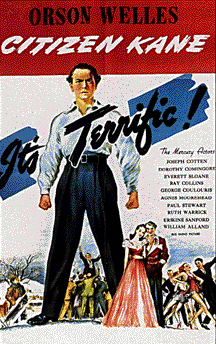
The best example of this distance between academic critics and the rest of us is the BFI list of The Top 50 Greatest Films of All Time. If you’ve followed the flap, the big news is that Vertigo supplanted Citizen Kane at the top. As far as I’m concerned, this means that the critics have finally taken over completely, and the rest of us are totally out. Vertigo, of all of Hitchcock’s pictures, is the one that most appeals to critics, for a variety of reasons, none of which are related to the movie being really a great viewing experience. It is to Hitchcock what The Searchers (which is also on the list) is to John Ford, the movie the critics all swoon over that the rest of us sort of greet with a giant “meh.” The critics see all sorts of things that we don’t see, or so one would imagine, without ever seeing what it is that we do see in movies, to wit, a transcendent experience of art. Or failing that, a transcendent experience of being in the picture and not in our seat. Citizen Kane is one of the few movies on the list that actually does the job of carrying us away. I hate to see it demoted, so to speak, because in the past you could recommend the so-called top film of all time to somebody who had never seen it, and they could watch it, and they’d be captivated and blown away. Show them Vertigo, and they’ll sort of shake their heads. It’s a film critic’s movie, as simple as that.
For the record, the top ten pix are 1: Vertigo; 2: Citizen Kane; 3: Tokyo Story (which I sort of like, but absolutely the dullest movie on the entire list); 4: La Regle du jeu (closest to Kane in some respects, but a little cold); 5: Sunrise (the most consciously arty in a very dated way); 6: 2001 (which is one of my favorite movies but, again, a little dull); 7: The Searchers; 8: Man With a Movie Camera (one of the few I haven’t seen); 9: The Passion of Joan of Arc (also haven’t seen); 10: 8½ (a personal favorite that is incomprehensible to the average filmgoer). The list goes on. The unifying factor seems to be a level of dullness, although a couple aren’t. Seven Samurai, which really is one of the best movies ever made without a single dull moment, does come in at 17. But then again, Apocalypse Now comes in at 14 while The Godfather comes in at 21? In what universe?
I’m not suggesting that we need a top 50 films judged by average schlubs, because if we did create that list, we’d have to account for Atlas Shrugged and The Fountainhead being number one and number two, but by the same token, there are some movies I have watched and enjoyed many times, but only a handful of these are on this list. Mostly these are movies I’ve seen, maybe liked, maybe not, but would never put in my top 50. Oh, well. At least Psycho is on there, at 35. If you and I were voting, it would be North by Northwest and Psycho, and Vertigo wouldn’t even make the list.
But then again, that’s what makes lists like this so much fun.
-----
* We should point out that Pauline Kael came to prominence in this period, and she was anything but academic. She was a critic who reported on how a movie knocked her socks off, and she'd talk as much about her socks as about the movie. For years, she and the cartoons were the only reason I read The New Yorker.
One of the things about a Golden Age is its contagion. It wasn’t just that there were a lot of old movies around for the viewing, or that Hollywood was redefining itself with a new more personal style of film in the mainstream, but there was an audience for all of this. A big audience. It seemed as if everyone and their uncle was a film buff. Every conversation was about the latest movie, or the meanings lurking within the old movies. Every date was a movie date. And nothing was out of bounds. The most mundane programmer samurai films and the equivalent oater serials of the Poverty Row studios and the latest incomprehensible Antonioni film or mumbly Jean-Luc Godard meditation on communism—they were all part of the mix. At the risk of glib analysis, what rock had been to the sixties, movies were to the seventies, the front line of popular culture.
In this heady cinematic atmosphere, a new kind of critic was born. As happens with any art form, sooner or later one stops connecting the art to life and begins to connect it with other examples of the art form. In movies, that means that you no longer respond to a film because it enlightens the human condition; you respond to a film because it quotes another film, or extends another film, or critiques another film. Film criticism became a self-feeding loop, its only referents being other films. Of course, this is not true of literally all film criticism, but it does sum up the mass. Now that there were film schools that could teach you to be a critic, by explaining all the machinery but perhaps none of the sense, critics were born who were a part of the machinery. The end result is, as with the art critics who rave most about art that is incomprehensible and ugly to the average individual who likes art, and as with the music critics who rave most about music that is unlistenable to the average individual who likes music, now there were film critics who raved most about movies that left the average individual cold. Because of the great expense of movies, unlike most art and music, there was never a sense that modern creators were working only for the critics. But the critics, as far as the average individual was concerned, weren’t watching the same movies, and weren’t responding in the same way. It’s not that the average individual is a schlub and the critic is a refined arbiter. It’s that the critic has virtually nothing in common anymore with the average individual when it comes to thinking about movies. So movie critics, and the rest of us who watch movies, have little or nothing in common.*
The best example of this distance between academic critics and the rest of us is the BFI list of The Top 50 Greatest Films of All Time. If you’ve followed the flap, the big news is that Vertigo supplanted Citizen Kane at the top. As far as I’m concerned, this means that the critics have finally taken over completely, and the rest of us are totally out. Vertigo, of all of Hitchcock’s pictures, is the one that most appeals to critics, for a variety of reasons, none of which are related to the movie being really a great viewing experience. It is to Hitchcock what The Searchers (which is also on the list) is to John Ford, the movie the critics all swoon over that the rest of us sort of greet with a giant “meh.” The critics see all sorts of things that we don’t see, or so one would imagine, without ever seeing what it is that we do see in movies, to wit, a transcendent experience of art. Or failing that, a transcendent experience of being in the picture and not in our seat. Citizen Kane is one of the few movies on the list that actually does the job of carrying us away. I hate to see it demoted, so to speak, because in the past you could recommend the so-called top film of all time to somebody who had never seen it, and they could watch it, and they’d be captivated and blown away. Show them Vertigo, and they’ll sort of shake their heads. It’s a film critic’s movie, as simple as that.
For the record, the top ten pix are 1: Vertigo; 2: Citizen Kane; 3: Tokyo Story (which I sort of like, but absolutely the dullest movie on the entire list); 4: La Regle du jeu (closest to Kane in some respects, but a little cold); 5: Sunrise (the most consciously arty in a very dated way); 6: 2001 (which is one of my favorite movies but, again, a little dull); 7: The Searchers; 8: Man With a Movie Camera (one of the few I haven’t seen); 9: The Passion of Joan of Arc (also haven’t seen); 10: 8½ (a personal favorite that is incomprehensible to the average filmgoer). The list goes on. The unifying factor seems to be a level of dullness, although a couple aren’t. Seven Samurai, which really is one of the best movies ever made without a single dull moment, does come in at 17. But then again, Apocalypse Now comes in at 14 while The Godfather comes in at 21? In what universe?
I’m not suggesting that we need a top 50 films judged by average schlubs, because if we did create that list, we’d have to account for Atlas Shrugged and The Fountainhead being number one and number two, but by the same token, there are some movies I have watched and enjoyed many times, but only a handful of these are on this list. Mostly these are movies I’ve seen, maybe liked, maybe not, but would never put in my top 50. Oh, well. At least Psycho is on there, at 35. If you and I were voting, it would be North by Northwest and Psycho, and Vertigo wouldn’t even make the list.
But then again, that’s what makes lists like this so much fun.
-----
* We should point out that Pauline Kael came to prominence in this period, and she was anything but academic. She was a critic who reported on how a movie knocked her socks off, and she'd talk as much about her socks as about the movie. For years, she and the cartoons were the only reason I read The New Yorker.
70 years of Garrison Keillor
In other words, today is his 70th birthday; I don't mean to suggest that he's been on the radio for 70 years. This being a pretty hot time across the country, we should mark the day with a little Lake Wobegon cold weather.
Keillor is, of course, most famous for the Wobegon monologues, which for all practical purposes he extemporizes, but they're only a part of "A Prairie Home Companion," his weekly radio program. There's lots of music, for one thing, and Keillor is not shy about either his own songs or his pleasant singing voice, but he also brings on big guns to the show, like Shawn Colvin or Joe Ely or Steve Martin (in his banjo-playing persona). And there's plenty of comedy in addition to Wobegon, everything from the detective Guy Noir to the Lives of the Cowboys. Keillor is keeping alive classic old-timey radio, and while he regularly threatens to retire, fortunately he doesn't do so.
How could you better celebrate Keillor's birthday than to pop over to the PHC website and have a listen? The Ketchup Advisory Board will thank you for it.
Keillor is, of course, most famous for the Wobegon monologues, which for all practical purposes he extemporizes, but they're only a part of "A Prairie Home Companion," his weekly radio program. There's lots of music, for one thing, and Keillor is not shy about either his own songs or his pleasant singing voice, but he also brings on big guns to the show, like Shawn Colvin or Joe Ely or Steve Martin (in his banjo-playing persona). And there's plenty of comedy in addition to Wobegon, everything from the detective Guy Noir to the Lives of the Cowboys. Keillor is keeping alive classic old-timey radio, and while he regularly threatens to retire, fortunately he doesn't do so.
How could you better celebrate Keillor's birthday than to pop over to the PHC website and have a listen? The Ketchup Advisory Board will thank you for it.
Monday, August 06, 2012
Music, the cloud and everything
I am becoming progressively more confused about my music needs.
First of all, I have a lot of music on CDs. Much of that music has been turned into mp3s, in my iTunes library. Secondly, there's music I've bought as mp3s, which by now is not insubstantial. That too, of course, is in iTunes. But since Amazon is usually cheaper than iTunes, and often has remarkable sales making it crazy not to buy music you're even remotely interested in, most of the music I've bought is from Amazon. Because of this, Amazon not too long ago allowed me to store everything I have in iTunes on their cloud server, for free. And I recently got a classic iPod, which is now a little over half full, which holds my entire iTunes library as well. For the record, my iTunes library is on a remote disk attached to my MacBook Pro.
Here's the deal. Amazon says it's going to charge $25 a year for the formerly free service. iTunes Match is the same thing, also $25 a year, with no doubt better synchronization to my various Apple devices. Do I need either of these? After all, I do have all of it on the iPod already. I don't know.
Then there's the other apps. I listen to Pandora for maybe half an hour a day in my office when I first arrive. I don't pay for this. I looked into RDO, and really liked that vastness, but that cost money. It's not that I can't afford it, but that I wonder if I'd get the value out of it. Spotify is similar, I guess, but it annoys me to see what people are listening to via Facebook. No offense, but the number of people I care about what music they're listening to, if I'm not in the room, is Kelvin (i.e., absolute zero). Similarly, the number of people I want to know what music I'm listening to when they're not in the room is also K. I like finding new music, but I fail to see how the name of a song and the performer is somehow an aid in that quest, given that for all I know you're listening to the song and vomiting uncontrollably.
Modern life is tough. I'm bordering on getting iTunes Match, but not so much as to actually get it.
I wish someone could solve this for me.
First of all, I have a lot of music on CDs. Much of that music has been turned into mp3s, in my iTunes library. Secondly, there's music I've bought as mp3s, which by now is not insubstantial. That too, of course, is in iTunes. But since Amazon is usually cheaper than iTunes, and often has remarkable sales making it crazy not to buy music you're even remotely interested in, most of the music I've bought is from Amazon. Because of this, Amazon not too long ago allowed me to store everything I have in iTunes on their cloud server, for free. And I recently got a classic iPod, which is now a little over half full, which holds my entire iTunes library as well. For the record, my iTunes library is on a remote disk attached to my MacBook Pro.
Here's the deal. Amazon says it's going to charge $25 a year for the formerly free service. iTunes Match is the same thing, also $25 a year, with no doubt better synchronization to my various Apple devices. Do I need either of these? After all, I do have all of it on the iPod already. I don't know.
Then there's the other apps. I listen to Pandora for maybe half an hour a day in my office when I first arrive. I don't pay for this. I looked into RDO, and really liked that vastness, but that cost money. It's not that I can't afford it, but that I wonder if I'd get the value out of it. Spotify is similar, I guess, but it annoys me to see what people are listening to via Facebook. No offense, but the number of people I care about what music they're listening to, if I'm not in the room, is Kelvin (i.e., absolute zero). Similarly, the number of people I want to know what music I'm listening to when they're not in the room is also K. I like finding new music, but I fail to see how the name of a song and the performer is somehow an aid in that quest, given that for all I know you're listening to the song and vomiting uncontrollably.
Modern life is tough. I'm bordering on getting iTunes Match, but not so much as to actually get it.
I wish someone could solve this for me.
More articles we didn't finish reading
It was a rich and fruitful weekend.
These headlines are all real, directly copied from our RSS feed to here without editing. When we say we didn't read them, we mean it. They didn't exactly pull us in, for some reason...
- Ortega makes my taco pop
- Mitt Romney accused of not actually reading book he mentioned
- Toilet Bowl Brushes ARE the Enemy
- TV critics suspicious about Animal Planet’s ‘Finding Bigfoot’
- Arnold Schwarzenegger founds think tank at USC
- Andrew Lloyd Webber sets score to new Nintendo Wii video game
When you care enough to send some damned thing or other
Sometimes I find something that I want to share as is. If I don’t have much to say about it, I’ll put it either into a general links post, or if it’s debate-oriented, a Coachean Feed post. Sometimes I’ll be inspired to write at length. After all, I like writing stuff, so why not? There are some people who like reading it, and that’s good enough for me.
Take this article on The Best-Selling Greeting Card of All Time. I don’t have a lot to say about the article per se, but I have to admit, it did start me thinking about greeting cards in general. Hence, an article on greeting cards. That is how the mind works, take it or leave it.
I went over to hallmark.com, just to grab an image, and found this one, apparently just the tip of the Bieber greeting card iceberg. I also found that their site seems to organize one's greeting card life completely, so you can keep track of all the holidays you celebrate, and the people you wish to celebrate with. In other words, greeting cards are, apparently, alive and well. Who knew?
I come from a serious greeting card family on my mother's side. I don't mean just Christmas and birthdays. I mean every holiday and event imaginable. Valentine's Day. St. Patrick's Day. Easter. Fourth of July. Halloween. Thanksgiving. Mother's Day. Father's Day. Grandparents' Day. First Communion. Confirmation. Anniversaries. Thank you. Get well. And something tells me that I'm just scratching the Hallmark surface here, as far as the phenomenon itself is concerned. They have cards for events and holidays most of us have never heard of. Which raises the primary question, why do people send cards in the first place? I mean, half the cards we sent were to people we saw all the time. If I'm going to have Thanksgiving dinner with you, why am I sending you a Thanksgiving card? For that matter, what's so special about St. Patrick's Day that we need to send a card to acknowledge it? I can understand why Hallmark is motivated to create cards for every event, but why are people motivated to buy and send them?
I wonder if the answer is a combination of things. First, yes, a card does allow us to remove ourselves from actually having personal contact with people, so it can be a nice long-distance but vague connection. My parents would send Christmas cards like crazy, mostly to people they hadn't seen in years. By the time my mother reached her Aged P status, Christmas cards were a barometer of whether or not people were still alive. If she didn't hear from my Aunt Mary, for instance—a woman who is not my aunt and who I would not recognize if I found her cleaning the litter box on a dark night—she would wonder aloud if Aunt Mary might be dead. On further inquiry, it would turn out that if Aunt Mary were alive, she'd be about 124, leading me to suggest to the Aged P that,indeed, Aunt Mary was probably no more.
Another value of cards, and here I think we're talking about the incidental cards, like the St. Patrick's Days, is to give voice to one's inner cuteness. Cute, which as far as I'm concerned is a clinical pathology, runs rampant through my family, and of course, they're not alone. Fly onto the wall of a Hallmark store any day of the week and I'll bet you you'll hear the words, "Oh, that's cute," within three minutes of your arrival, and every three minutes after that. Humans, of course, have a predilection to favor cuteness memes like big eyes and big heads and so forth, which is fine if it means adopting a puppy or not eating your firstborn, but gets a little old when it means you subscribe to every holiday on earth just to send a cute card for it. If my mother were a computer person (an idea in which she lives in the direst fear), she would no doubt spend all her days watching cat videos. Cute St. Patrick's Day cards and cat videos are symptoms of the same disease. Any one of us might, at any moment, be taken by a quick bout of the cutes (after all, I'm a Disney fan), but I keep my cute moments pure and separated from all my other moments. Come visit me in a tab room at a tournament some weekend and watch me for a couple days straight. You will not see one moment of cute lapse. I promise.
Obviously I did not inherit the strong cute gene that runs rampant through the rest of my family. As the years went by, I sent progressively fewer and fewer cards, until now I send my mother a Christmas card and a Mother's Day card, the former because she decorates her room with them (and, by the way, decorating for holidays is strongly connected to the cute disease, and my mother had maybe six or seven holidays with boxes of crap pulled out every year to celebrate them, in addition to the expected Christmas ornaments), and the latter because no doubt otherwise she would disown me. I've cut literally everyone else from my card list. I don't send greeting cards to my staff or my colleagues, I've taken my birthday off Facebook and don't acknowledge anyone else's birthdays (because acknowledge one, you've got to acknowledge them all, and seeing that I'm on fb about once a week, that's 6 our of 7 I'd miss), and if you get sick, I might visit you, but I won't send a card with a cartoon nurse sticking a thermometer up your butt. It's just not me.
And I wonder how many other people it is these days, the literal card bit, that is. There is no question that Facebook has taken over indifferent social interactions. People who don't give a crap about certain other people feel obligated to like their various life events and wish them a happy birthday, in numbers that would have made Hallmark in their heyday drool uncontrollably. It's interesting. The postal system originally allowed us to remove the human from human interactions, and the interwebs merely develop it to 21st century dimensions. Maybe all we want out of life is a handful of real friends and a lot of connections to unreal friends, and greeting cards used to do it, but fb does it even better. I know for a fact that I am friends with people on fb who I don't know, whose names mean nothing to me. Since they're all also friends of O'C, I assume when they petition me for my amity, it is because they are denizens of the forensics universe. I certainly hope that's the case. I'd hate to be friends with them just because, say, they wash dishes at Japonica.
Anyhow, here's thinking of you, you're my bestest friend, you're invited, get well soon, may the Lord have mercy on your heathen soul, my sympathies, congratulations, you don't look a day over eighty, have you lost weight, and have a happy August Civic Holiday.
Take this article on The Best-Selling Greeting Card of All Time. I don’t have a lot to say about the article per se, but I have to admit, it did start me thinking about greeting cards in general. Hence, an article on greeting cards. That is how the mind works, take it or leave it.
I went over to hallmark.com, just to grab an image, and found this one, apparently just the tip of the Bieber greeting card iceberg. I also found that their site seems to organize one's greeting card life completely, so you can keep track of all the holidays you celebrate, and the people you wish to celebrate with. In other words, greeting cards are, apparently, alive and well. Who knew?
I come from a serious greeting card family on my mother's side. I don't mean just Christmas and birthdays. I mean every holiday and event imaginable. Valentine's Day. St. Patrick's Day. Easter. Fourth of July. Halloween. Thanksgiving. Mother's Day. Father's Day. Grandparents' Day. First Communion. Confirmation. Anniversaries. Thank you. Get well. And something tells me that I'm just scratching the Hallmark surface here, as far as the phenomenon itself is concerned. They have cards for events and holidays most of us have never heard of. Which raises the primary question, why do people send cards in the first place? I mean, half the cards we sent were to people we saw all the time. If I'm going to have Thanksgiving dinner with you, why am I sending you a Thanksgiving card? For that matter, what's so special about St. Patrick's Day that we need to send a card to acknowledge it? I can understand why Hallmark is motivated to create cards for every event, but why are people motivated to buy and send them?
I wonder if the answer is a combination of things. First, yes, a card does allow us to remove ourselves from actually having personal contact with people, so it can be a nice long-distance but vague connection. My parents would send Christmas cards like crazy, mostly to people they hadn't seen in years. By the time my mother reached her Aged P status, Christmas cards were a barometer of whether or not people were still alive. If she didn't hear from my Aunt Mary, for instance—a woman who is not my aunt and who I would not recognize if I found her cleaning the litter box on a dark night—she would wonder aloud if Aunt Mary might be dead. On further inquiry, it would turn out that if Aunt Mary were alive, she'd be about 124, leading me to suggest to the Aged P that,indeed, Aunt Mary was probably no more.
Another value of cards, and here I think we're talking about the incidental cards, like the St. Patrick's Days, is to give voice to one's inner cuteness. Cute, which as far as I'm concerned is a clinical pathology, runs rampant through my family, and of course, they're not alone. Fly onto the wall of a Hallmark store any day of the week and I'll bet you you'll hear the words, "Oh, that's cute," within three minutes of your arrival, and every three minutes after that. Humans, of course, have a predilection to favor cuteness memes like big eyes and big heads and so forth, which is fine if it means adopting a puppy or not eating your firstborn, but gets a little old when it means you subscribe to every holiday on earth just to send a cute card for it. If my mother were a computer person (an idea in which she lives in the direst fear), she would no doubt spend all her days watching cat videos. Cute St. Patrick's Day cards and cat videos are symptoms of the same disease. Any one of us might, at any moment, be taken by a quick bout of the cutes (after all, I'm a Disney fan), but I keep my cute moments pure and separated from all my other moments. Come visit me in a tab room at a tournament some weekend and watch me for a couple days straight. You will not see one moment of cute lapse. I promise.
Obviously I did not inherit the strong cute gene that runs rampant through the rest of my family. As the years went by, I sent progressively fewer and fewer cards, until now I send my mother a Christmas card and a Mother's Day card, the former because she decorates her room with them (and, by the way, decorating for holidays is strongly connected to the cute disease, and my mother had maybe six or seven holidays with boxes of crap pulled out every year to celebrate them, in addition to the expected Christmas ornaments), and the latter because no doubt otherwise she would disown me. I've cut literally everyone else from my card list. I don't send greeting cards to my staff or my colleagues, I've taken my birthday off Facebook and don't acknowledge anyone else's birthdays (because acknowledge one, you've got to acknowledge them all, and seeing that I'm on fb about once a week, that's 6 our of 7 I'd miss), and if you get sick, I might visit you, but I won't send a card with a cartoon nurse sticking a thermometer up your butt. It's just not me.
And I wonder how many other people it is these days, the literal card bit, that is. There is no question that Facebook has taken over indifferent social interactions. People who don't give a crap about certain other people feel obligated to like their various life events and wish them a happy birthday, in numbers that would have made Hallmark in their heyday drool uncontrollably. It's interesting. The postal system originally allowed us to remove the human from human interactions, and the interwebs merely develop it to 21st century dimensions. Maybe all we want out of life is a handful of real friends and a lot of connections to unreal friends, and greeting cards used to do it, but fb does it even better. I know for a fact that I am friends with people on fb who I don't know, whose names mean nothing to me. Since they're all also friends of O'C, I assume when they petition me for my amity, it is because they are denizens of the forensics universe. I certainly hope that's the case. I'd hate to be friends with them just because, say, they wash dishes at Japonica.
Anyhow, here's thinking of you, you're my bestest friend, you're invited, get well soon, may the Lord have mercy on your heathen soul, my sympathies, congratulations, you don't look a day over eighty, have you lost weight, and have a happy August Civic Holiday.
Subscribe to:
Posts (Atom)