Showing posts with label Architecture. Show all posts

Thursday, July 05, 2012

Random links

These pages speak for themselves, and don't need me adding anything to them.

(Why I used that hokey clipboard pic from Microsoft's clipart library is beyond me.)
.

Thursday, June 21, 2012

Do-It-Yourself House Building

Yes, sir. You like to work with your hands? You've got a tool set getting dusty? You want to share in the American dream of owning your own home?

Sears Roebuck to the rescue.

From 1908 to 1940, Sears sold house kits. That's right, house kits. Over 20 tons of materials would be shipped first by rail and then by truck directly to your (future) doorstep, ready for assembly. Wikipedia says that folks would put the houses together by gathering family and friends in an act of construction similar to an old-time barn-raising, which sounds about right because I don't care how handy you are, putting one of these suckers together by yourself probably would have taken about, oh, a lifetime.

The Betsy Ross (Four rooms and bath!) is one of the cheaper models, at $1691. That's about $23,000 in today's dollars, still quite a bargain:


One of my favorite sites, Retronaut, has a whole bunch of these from the 1923 catalog. Today, the houses built from these kits have a lot of extra cachet, and often sell for a premium in their local markets. As a person who can't screw in a nail, I am in awe of this phenomenon.
.

Tuesday, June 19, 2012

How I Spent Part 1 of My Summer Vacation, Part Two

One thing about Washington: you don’t go there for the variety of architecture. After having spent time recently in Toronto, which is falling over itself to build major, signature buildings, most noticeably the CN Tower, once the world’s tallest freestanding structure, and Las Vegas, which is a living textbook analysis of postmodernism and semiotics as applied to structure, Washington is one boring ponderous neoclassical pile after another. Occasionally there’s a neo-Gothic church somebody snuck in, but mostly it’s one Greek column after the other. There’s a reason for this, of course. It was built as a capitol city, and the new nation wanted to impress people with its permanence, and what better way is there to do that than build ancient Greek palaces? The birthplace of democracy, etc., etc., etc., and Greek it is. The major alternative, Gothic, was the architecture of the Palace of Westminster; obviously, that would not do.

On the other hand, the official monuments are a bit of a mix. Sure, Lincoln and Jefferson are all columns (although TJ at least has the sense of the Palladian, which itself has neoclassic roots), and GW is an obelisk (Egyptian classicism, but the word itself is Greek), but there are major exceptions. The Vietnam Memorial, for instance, is a modern as could be, a slash in the ground and engraved names. The FDR Memorial is virtually his life story in narrative of statuary and words and water: I loved it. MLK is a white representational slab of granite drawn from the words “Out of a mountain of despair, a stone of hope.” I have mixed feelings, I think because I wish it were something more modern in approach. It certainly is different from the other memorials, though. So there is some variety around, not to mention the mix of architecture in the mall structures, ranging from (yawn) neoclassical pile to the pure round modernism of the Hirshhorn and the zippy glass modernism of the Air & Space. Pretty much you get your greatest variety of eye candy in a very small radius, in other words. But as for the federal buildings—meh.

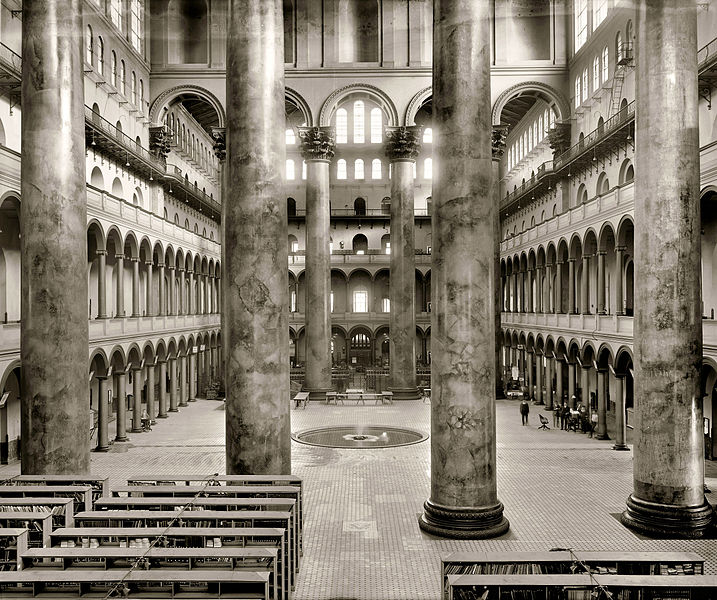
I did get a kick out of the Pension Building, home of the National Building Museum. Here’s the outside:


and the inside:


What’s not to like?

On the other hand, we visited the old town in Alexandria, and that was a bit of a hoot, with some just basically old buildings that are always fun to see. I’ll eventually put up some pix on FB so you’ll see what I mean. A lot of the old buildings have plaques on them indicating that they’ve paid their fire insurance, so the fire brigade could feel free in extinguishing any blazes that might erupt. (The ones without plaques must have burned down…)

I have to admit that I was a little disappointed in the Potomac. We cruised down to GW’s place, on the presumption that it would be nice to take a boat ride, and that the Potomac would be either interesting or pretty. One forgets that one lives on the Hudson; as far as I know, there is no Potomac River art style. Oh, well. It beat driving around on DC’s ridiculously busy roads, even if it couldn’t take on the Hudson. How many rivers can?
.

Wednesday, January 30, 2008

It's all Greek to me, Howard; calendar wars; various minutia

Howard Roark did not attend Columbia. If he had, it would have turned his red hair white. (By the way, I just read a Wikipedia piece that claimed that Atlas Shrugged was Rand’s “other great novel,” which just goes to show that Alan Greenspan is keeping busy in his retirement editing Wikipedia entries.)

Although I lived in the city for a decade once upon a time, I never visited the Gem of Harlem campus, despite having occasionally hung out with friends who lived in the neighborhood. I don’t know what I would have thought then, but if you haven’t been there, it is absolutely a “college campus” in postmodernist quotes. There’s this big open quad surrounded by buildings, the most imposing being the Low Library. Now, even if you’ve never seen the Low Library before, you have seen the Low Library. It is a classic, uh, Classic Revival. It is the Pantheon with upgrades (i.e., wings, plus there was a sale on columns that week). It is Palladian to its smallest atom. It is Monticello in rock. And it dominates the visual expanse. It reminds me more than anything of the art direction of 1960’s “Time Machine” film. And not to put too fine a point on it, but across the quad it faces a columnar pile that is more Parthenon than Pantheon. Between the two I expected Zeus (or Jupiter) to come down any minute and start molesting the pigeons. The official documentation of the Low calls it a blend of Parth and Panth, and so, I guess, it is. Certainly there’s no question what the designer was up to at the time.

There’s nothing wrong with Classic Revival, of course. Washington, D.C., is a perfect example of the style in action. And I use the word action advisedly. Classic Revival runs on the assumption that buildings that look like Ancient Greece and Ancient Rome will impart to the landscape and to what it conducted within a suitable dignified stateliness. Classic Revival says the Golden Age of Pericles and the power of the mighty Caesars. It mashes up all sorts of concepts of wisdom and strength of state into a simulacrum soup that tastes just like government. Hence the Capitol building and the Supreme Court building and the presidential mansion. And the Jefferson and Lincoln memorials. And just about every other building surrounding the mall. If you didn’t know where you were, you would have little difficulty figuring it out.

So when you look at Low, you think, obviously, Classic Revival, and you have all those thoughts about power and wisdom. Except that Classic Revival was about a hundred years earlier than the building of the Low. To that extent, if may be the first harbinger of postmodernism, predating modernism. What Howard Roark complains about (at least in the film; I, for one, find Rand’s writing to be, shall we say, loopy) is that everybody wants him to design buildings that have columns and look like Greek palaces, and of course Roark, individualist genius that he is, wants to go off and invent modernism and free love. In other words, the Low is a total anachronism, what Disney imagineers would design if you told them you needed a university campus. I make no value judgment of this—you can like or dislike Classic as you are so inclined—but I find it interesting. (And as a total aside, I will go to my grave thinking that the “Fountainhead” film would make an award-winning HI piece.)

On the other hand, our tab room was located in Lerner, which is very modern. Bernard Tschumi, the designer, is big on glass, and the whole place is bright and open and, frankly, terrifying. There are ramps switching back and forth up about 5 stories, and if you can negotiate these ramps, which border a tall open area from floor to ceiling, without a sense of vertigo, you have a stronger pudding in your belly than I. I took about one step down on the fifth floor and went screaming back into the stairwell. I have to admit, though, that the problem of open interior space is true of any building. The concept is great. I love the idea that a building isn’t just a block of rooms, especially if the building is in any way tall. Empty space in a building is somewhat exhilarating, which is why there is as much empty space as possible in cathedrals. But in cathedrals, we ponder that space from below. In modern buildings, we ponder that space from all perspectives. We take those elevators up your average Marriott and hold close to the walls as we pass from room to room. We don’t go anywhere near the rails unless we are absolutely fearless. We assume, incorrectly, that people are constantly falling off into the central well. I think the problem is the mix of glass and bright metals, which makes everything feel ephemeral and uncertain, compared to the rock of a cathedral—never underestimate the meaning of materials. I have certainly climbed up plenty of cathedral spires and back entrances and whatnot and never felt particularly insecure. But give me a glass expanse, and I’m in trouble, while nevertheless loving the idea of open interior space. Is this just me, or is this inherent to modern architecture? I don’t know.

Anyhow, the press on the Gem tournament has been almost completely positive. Who knew they had flex prep?! Anthony B went so far as to say it was a lot better than every other so-called bid tournament in the northeast, high praise indeed. (Who invited him, anyhow? I knew I should have dropped him that year at TOC!) From the debaters’ perspective, of course, now that I think about it, they had easy up and down times, since the two divisions alternated in the same rooms, which is always nice. Judges and debaters alike love a good couple of hours off between rounds. Too bad there were no hours off in tab. Then again, although I did lose a pair of gloves in a cab thanks to total discombobulated exhaustion, the Gem folks graciously gave me a gift of a new pair that was, honestly, a lot nicer than the pair I lost. Next year I’m going to lose Little Elvis and see if they buy me a new MacBook Air…

One of the minor events of Gem was the insertion of a ream of brochures into the packets, including a one-sheet for UPenn, scheduled for 10/25, the Manchester-Under-the-Sea weekend, aka the Regis CFL weekend. Whatever. As I remarked yesterday, it turns out that 10/25 is the Big Jake weekend, as I was reminded when I went to update my schedule online. This started, as you might imagine, some discussion between O’C and me about shoes and ships and sealing wax, and I’m not quite sure what the upshot will be. Is UPenn on the Jake or the Manch weekend? I gather their goal was the latter. In any case, next year’s calendar, like this year’s, is askew and hard to figure. Bump, for instance, went wildly off from where I expected it to land. And as is well known among the VCA, I’m not a big fan of dueling tournaments. On the other hand, I like the idea of complementary tournaments serving different aspects of the community at the same time, to wit most recently, the nice fit of Columbia and Emory, or the classic Manchester and local CFL, or Princeton and local MHL, etc. Something for everybody, in other words. Contrary to popular (AKA digressive) opinion, the world as a whole is only marginally interested in TOC bids and TOC-bid tournaments. But while two tournaments sharing a weekend can be a nice fit, three on a match means one soldier buys the farm. Which is why one needs to wear armor to those meetings where we try to lay out a schedule. I’m thinking that this year we’ll attempt this folly at Districts, or at least a first stab at it (primarily because I’m thinking of moving Districts next year, but more on that some other time). I’ll keep you posted.

Finally, I expect to either finish up the Goy of Districts or set up the new MHL printer tonight, followed the subsequent night by the other one, plus I need to set up the Newark MHL. Newark’s invitational is at good old East Side this year, which has as its chief virtue its location, i.e., on Van Buren. The streets in that part of Newark are all presidents, in order. If you know your history, you know where you’re going. I like that in a city. In Manhattan, if you know your numbers, you know where you’re going (most of the time). In my neck of the woods, the same streets often have two different names, or one name spelled two different ways, and your knowledge of the names of the women in the original contractor’s family is your best bet in finding your way around (turn left on Audrey, turn right on Louise and then go to the corner of Lorraine). Or maybe they were his fantasies. Whatever.

Monday, December 03, 2007

Structure

It used to be that you could find plenty of magazines to read on your train ride home from the city on a Saturday night, magazines being the medium of choice for such travel. But nowadays my magazine reading is down to the bare minimum: The New Yorker, of course, MacLife, Publishers Weekly, Rostrum (!) and Gourmet. And if I miss the latter two, I am not overcome with grief. But this particular train ride last Saturday (after seeing “Rock ‘n’ Roll,” about which I’ll probably comment soon) commences with a visit to the magazine shop at Grand Central, so you theoretically have the world to choose from, but the only magazine in addition to those above that I ever come away with (and those I actually subscribe to, so I wouldn’t exactly be buying them at a shop) is Wired. There’s stuff available along the lines of Critical Theory Today and various political and literary quarterlies that put you to sleep just reading the covers, and some guy that wouldn’t move was standing in front of the comic books (and looked as if he intended to read each one, in sequence, until the next issues of each came out, and he would just keep going on, forever) so there may have been something there but nowadays comics really are all part eleventy of a forty-seven part series so that’s pretty unsatisfying, so, Wired it was.

Now here’s the deal. Structure, in architecture, is whatever holds the building up. It is the framework of the building. Look here: http://www.wired.com/culture/design/magazine/15-12/mf_baker_sb
What Baker is able to do, and what he’s doing with Burj Dubai (which, according to the article, has already set the record as the tallest building/tower in the world, although it’s still under construction and steadily growing taller, to some unspecified height), is dwarfing other tall buildings because of the footprint of his structure, the buttressed core and the three wings. Look at the illustration. In the (real) Sears tower, you see usable space around a core, and crisscrossed structural elements. The problem at the top, and why you can’t go any further up (in the imaginary Sears), is that you need an immensely larger amount of structure to keep the thing from falling over or swaying so much that you get nauseous on the upper floors. Baker’s building doesn’t sway because of the three sides providing counterforces and counterbalance. It’s also fast and easy to build, with lots of space that isn’t structural.

So, what’s the point? There’s a quote in the article to the effect that the bigger and more complex you build, the more the framework takes over, until there’s no room left for anything else. This is an architectural truism. And a building that’s all framework/structure is no longer a building, it’s a sculpture. There’s no room in it anymore except for whatever it is that is holding it up.

And I’ve seen LD cases like that. All framework and no room left for anything else. They may be interesting, like sculptures, but they are not useful, like buildings. They can’t hold anything up except themselves. Which may be why I find theory debate so uninteresting: it might be aesthetically pleasing, but it has no content. It is jejune. It’s useless in a practical sense. And what is the point of an argument that is useless in a practical sense? A framework that structurally supports…nothing.

Architects of necessity fight this battle of engineering and art and practicality with everything they build. So should LDers. At the point where we’ve moved away from the resolution and simply concentrate on the structure, we have failed as architects of argumentation. And I’m not quite sure what we’ve become instead.

Tuesday, October 02, 2007

Coming soon; murk; NFL's site unseen; she's the one who carried the tubs; I could have painted that; Revelation?

Plan your summer now: Wall-E.

Last night I finished up the View from Tab podcast of Yale, and got the XML back in operation (I think), but for reasons I can’t determine, the recording of Part 3 was really murky. I wasn’t going to do it again, so I posted it as is, but I’m not happy with it. I don’t know if it’s the hardware or the software, but there needs to be some testing at the chez over the next few days, which is as likely as an attack by the Bolivian navy, given that there’s a Sailors meeting tonight, Monticello data to input tomorrow (and I’m also a little worried about TRPC these days, after the problems at Yale, which is why I think I’ll go with the new version, there being only the one division), and judge training on Thursday. I feel bad that I am leaving my Nostrum fan(s) in the lurch, but I know that he/she/they demand(s) high quality these days. Oy.

Last night I subscribed to Bietz’s podcast. I haven’t listened yet, but I noticed it’s about 11 hours long. Sigh. In any case, Mike was at Yale, and it was a pleasure to have him hang out with us in tab for a while. We commiserated a little over the “new” NFL. They seem to have discovered the online chat. Next up they will no doubt invent the wheel. Their intentions are admirable, but at some point they need to realize that much of their audience is in high school, with all the pertinent electronic connections that that entails. Mind you, the myth that all adolescents are tech savvy is not what I’m promulgating. But all adolescents are savvy about the technologies that they find essential, much like my aged mother, who bristles at the thought of having to use a computer, but who nonetheless is perfectly capable of operating a television set: one chooses one’s tools, if one is not interested in tools per se. For teenagers, that means iPods and cell phones and YouTube and Facebook and MySpace, etc. Anyhow, until NFL catches up with the NFL members, they will remain, at best, strivers. Admirable, but inessential. Too bad, because they do have a lot to offer, and they want to offer it. Lately they’re filling my mailbox with announcements of all manner of things, and I’m still sorting out their new website. So far it’s, well, old wine in a new bottle. I did notice some blogs, but they weren’t clearly presented, so I didn’t grok them immediately. I’ll spend more time with this when the time makes itself available. After all, I am the District Chairman. Which, according to some people I discussed it with over the weekend, is like winning the lottery in a Shirley Jackson short story.

Speaking of the NFL, who’da thunkit? I kept a copy of my ballot, and the Nov-Dec LD topic was my top choice for—you’re not going to believe this—Nov-Dec. How could this be, you ask. Good question. Usually the topics I like are never debated, and the topics I hate are so popular they give them extended runs. This year, following as it does the discussions of criminal justice that come along naturally with the death penalty topic, it’s a bonanza. My guess is that maybe I’m the only one who voted, because no one could figure out the ballot, except maybe Joe V. I’m not implying that I could figure out the ballot, or more to the point, that I thought it through in any great depth. I’m sure, actually, that there are some who analyzed every crook and nanny of the possibilities before sending it in, but then again, there are people in the world who collect barbed wire. (Check out barbwiremuseum.com if you don’t believe me: “Usually barbed wire specimens are collected in 18" lengths to show the spacing between the barbs. Due to space limitations, some collectors acquire specimens in 4" to 6" lengths to show the barb design only. Most collections are mounted on display boards with patent information shown in neat labels as well as occasional comments about the wire.” And if you think that’s a little sketchy, there are even people out there collecting Star Wars memorabilia!) My guess is that, if you pick all the topics in the right order on your ballot, you win some sort of prize like the Irish Lottery. The Ripon Lottery? What could they possibly send me? An autographed photo of the Wunn and Only? An autographed photo of Cherian K? An autographed photo of Paris Hilton (who, as you know, did Policy back in the day). I can’t imagine.

I keep meaning to talk about Yale in some depth, but the podcast took it out of me. There isn’t much that I didn’t include there. One high point was that we arrived early on Friday so to pass the time I took the Sailors I was shepherding into the art museum. The Pups have quite a collection, and we killed an hour or so staring at things like Cy Twombly and thinking cavemanish thoughts. My favorite piece was the blue sea Hopper, but there was plenty of good stuff from many periods. I did end up feeling that the British building across the street was a better display setup architecturally, but once again I felt that this architect just can’t do entrances. He also has some stair problems. Go visit the buildings and you’ll see what I mean. They are free, after all.

Oh, yeah. I didn’t mention that one debater walked into a round, took one look at the judge (O’C), and fainted dead away. What kind of hold does this man have on people, anyhow? Not even Soddy, in his days of highest glory, was able to vanquish debaters with a mere glance. If O’C keeps this up, he’s going to go beyond mere legend into categorically true cosmology. Come to think of it, what if, in fact, O’C is the Supreme Being, just toying with us? Na’ah. If that were the case, he wouldn’t have had to ask Termite to take the Joyful Finalists Embrace While Internally Cursing One Another photo. Still, I’ll try to stay on his good side. You never know.

Friday, September 07, 2007

When I was a kid, I used to think they were saying the Infant of Frog. That was a theological leap that was beyond me.

I did poke around Fred and Ginger a bit Wednesday, although they were working on the entrance, which meant I could only study the exterior. It's not very big, and it fits in remarkably well with its surroundings. Thumbs up!

Spent today updating all sorts of things. MHL site has the tabroom online link; tomorrow with the Catholics I'll sort out if we should have 2nd year folk. Read some NFL District Chair thingie that had a lot of ideas about LD that I liked. I would truly like to see NFL be useful to NY, and acting as a central hub for something other than their making money would be a start. Updated the first few sessions in the cur. Read the Manchester Under the Sea invite: JV LD? Who knew? Sent O'C a list of 1027 possible new traditions for this year's Vassar RR. Updated the parent/student handouts. Respelled Rolling Stones with 2 Ls on my iPod (that was HUGE). Thought about getting back to Civ 4 (my Chinese rock—nothing like 8 hours on a plane to conquer the world).

Anyhow, it's nice to be back. It will really feel like back when I hobnob with my fellow wizards tomorrow at the CFL meeting.

Friday, August 17, 2007

Vacation, part three: Copley Square

All things considered, you’d think I’d know Boston better. But it has always been a place of only middling interest to me. When I was a kid I knew people who went to various colleges there, but I didn’t visit often. With no driving need to ever go there after that, it’s always been low on my list. With in-laws nearby, we’ve done the Freedom Trail or the like over the years, or the odd meal with Kt when she was at Brandeis, and of course the various visits to Cambridge, but that about sums it up. So when we went to the Isabella S.G. museum last Christmas and drove through town, I might as well have been driving through Shanghai. Some of the architecture we passed was intriguing, so we figured, what the hey, we should take a closer look some day. Which turned out to be last week.

We stayed off Copley Square, and right away you’ve got some interesting sights. There’s a few skyscrapers that have popped up sort of incongruously (it’s not a particularly high city overall), and they’re attractive enough in a sterile sort of way; you’re not awed by them, but they’re okay. The Trinity Church, on the other hand, is quite the place. Neo-Roman, which is sort of like neo-Gothic without the doodads, but a great space inside with a fascinating assortment of stained glass by various artists, including Bourne-Jones (a PRB type). It’s a squared-off place, so there’s no dramatic vaulting overhead (cf. Westminster), no domes, but impressive nonetheless. There’s an odd steeple effect from what looks much more like a central turret than any sort of steeple you’re normally familiar with, but it does the job. The joint is run by the Episcopalians, whose gift shop has all manner of Episcopal souvenirs, if you need any. Practically made me want to convert, just for the tee shirt.

Across the square from the church is the Boston Public Library, which I would have to say has a very “eccentric uncle we hardly ever talk about” feel to it. It’s a fine building, and they’ve got the damnedest stuff in there. Dioramas from children’s books, dreadful J. S. Sargent murals, dreadful other people murals, WWII posters, miniature books, galleries, whatever. Even some regular books in one nice big open reading room, but mostly it’s as if you’ve stumbled into that eccentric uncle’s attic and you can’t for the life of you decide why, exactly, this is here. Worth a side trip, in any case.

Speaking of the Sargent stuff, he also did some murals for the MFA. Apparently he felt that his paintings were ephemeral, and if he wanted to be remembered for the ages, being a muralist was the way to go. The thing is, his murals, which have this semi-classical art-nouveau blandness about them, can’t hold a candle to most of his best paintings. His mastery of light and of character simply don’t come through. How little we know ourselves…

If you head down from Copley to the MFA, you pass, in turn, the mall that easily fits into the “end of the streets” mentality, i.e., a private space replacing the public space at street level, but it’s a busy enough neighborhood that this might not matter. We spent about 2 minutes in there, which was more than enough. Beyond that a ways, there’s the Christian Science area, which is absolutely a bizarre anomaly. There’s a church about the size of Peoria, which unfortunately wasn’t open for a looksee, but from the outside I would rate it as one of your more solid domed basilicas and not to be sneezed at. There’s also other buildings, postmodern (or, maybe better, non-modern or anti-modern reactionary) where they take the basic modernist glass and steel and cover it with stone-like facing to hide what it really is. Normal enough in its day (the 60s and 70s). There’s also a wonderful pool about as long as the campus that, from most angles, looks as if people on the other side are standing in it. All in all, a most impressive area filled with contrasts. Around that neck of the woods there is also the home of the BSO. Now, again, we didn’t go in, but I have to say, I do hope that the acoustics are exceptional, because this has to be the ugliest building I’ve seen in quite a while. It is, essentially and at best, a brick arsenal, and at worst, a refurbished baby buggy factory. Heaven forbid if it were actually built as a concert hall; I don’t know, and I’m sort of afraid to find out. No wonder these folks hightail it out to Tanglewood every summer. If I were them I wouldn’t want to have to enter this dungeon in nice weather either. At least in the winter you can crawl directly from the T into the arsenal and not spend too much time thinking about it…

The best part of Boston was absolutely revelatory and transcendent. And that’s something for next week.

Thursday, August 16, 2007

À la recherche du gigs perdu; Vacation, part two: Newport

I have this continuing problem where I run very close to the edge of Little Elvis’s memory abilities because there’s so little disk space available that the RAM functions threaten to come to a halt. This especially happens when I’m porting over my old cassettes, a true memory hog (the program doesn’t release the temp files until you shut down the machine, which is nice if it crashes and need to recover but murder if you’re trying to do anything else simultaneously). Until I can figure out a way to convince Little E to use one of the ancillary drives for temp files, if ever, I need to keep him as empty as possible, which is really hard. I’m lucky if there’s 2 gigs of his 30 available even with constant vigilance; Little E is one fluffernutter away from crashing all the time. Last night I dumped RCT (which I haven’t played in a while, and I’m sorry, but I prefer the versions prior to V3), but didn’t get much from it, but then I found about 3 gigs of audio backup files, so all of a sudden I’ve got over 5 gigs available of 30 (well, 27 you can actually access), and Little E is as happy as if he were being appointed Special Government Agent Extraoirdinare by Richard Nixon. I’ve barely made a dent in my transfers of cassettes to MP3s (last night I ported over some Phish), and with all this extra space, Little E and I are in memory hog heaven. More Phish tonight. And maybe some early Steve Earle. If only this didn’t have to be done in real time. That’s the story of my life: not enough real time. And not enough hard drive space. You can never have enough time, money or memory (static or dynamic). Always buy the biggest hard drive they sell, and max up the RAM. Trust me on this.

Anyhow, in the continuing debriefing on the short trip, we tootled up to Newport after New Haven. I’d never been to Newport before, but heard good reports from everyone. We stayed at a B&B near the center of things, and mostly walked around just soaking in the place. It’s old, of course, and there’s one part of town with mostly 18th Century houses with tiny well-kept gardens that you walk through and feel you have to photograph each and every one of them. These are the kind of houses that, if you went into them, you’d keep bumping your head on the ceiling because, well, that’s the way they built them then. People were not Lilliputian a couple of hundred years ago, contrary to the popular delusion. We have grown an inch or two, but not enough to throw off the scale of our living quarters. The idea of building big spaces to live in simply didn’t make a lot of sense in pre-central heating times (warm air rises, so why have high ceilings?). Ostentatious housing did indeed exist at the time, both here and in the Mother Country, of course, but that was for the gentry. But normal people lived in normal accommodations, some of which were quite nice, thank you very much. Of course, eventually a certain gentry in the 19th Century discovered the pleasantness of Newport, and ostentatious housing began to be built on the outskirts, and the other half of visiting the town today, in addition to the old area with its restaurants and tourist attractions and historical area, is visiting the mansions. Some of these are paradigmatically “piles” in the worst sense, some of the ugliest buildings you’ll ever see, albeit in their day some of the most expensive. Granted that salt water is destructive of many building materials, you still don’t have to have something that looks like it’s chiseled out of lead. The interiors of these places, on the other hand, define grandness, varying depending on their periods and what was popular at the time, from neo-Gothic to Victorian to Arts & Crafts, so what you’ll like depends on, well, what you like. They’re well worth seeing, in any case. My personal architectural fancy runs more to public than private spaces, but it is nice to imagine yourself dining with the nobs on a summer’s night at the turn of the (19th) century, all duded up and lah-di-dah and witty as all get out. I have the same vision of the great country houses of England, dropping by for a Brideshead weekend, tennis and cocktails and Bertie and whathaveyou. Very evocative.

So in the account book, Newport is definitely worth a stopover. Since every time you turn around you’re eating a lobster, even if you hate walking through people’s old houses, you’ll still have a happy day or two.

Tuesday, August 14, 2007

Vacation, part one: YCBA

Speaking of the Pups, which I know you were, I finally got to the Yale Center for British Art. The collection was worth the trip; it starts early and ends late, and there’s fine pieces from every conceivable period, including a spectacular Whistler (yeah, he’s only sort of half-British, but I’m willing to give them the benefit of the doubt on their “The guy hung out there for a while” approach), some fine PRBs, a few fairly cow-free Constables that improved him quite a bit in my estimation (usually I find his work a cacophony of deciduous jungle plants with no beginning, middle or end, interrupted by cud-chewers), decent Turners, plus a few discoveries, at least for me.

I’m less than taken by the building, though. The gallery spaces were pretty good, actually, although occasionally one could get lost, and since the main collection is thematically chronological, getting lost was not a good thing. It is a challenge for an architect to design a space that is open and inviting and inductive to contemplation that nonetheless moves you from one place to another in a logical fashion. The NYC Guggenheim is a good example of directed movement: you start at one end of the spiral and have to alternative but to end up at the other end, short of jumping off the edge. Not necessarily contemplative, though. Big rooms where you can step back and look at works from a distance, or up close, and sit maybe for a while, are what you get at the Met, but their special exhibition spaces are usually cramped and overcrowded (unless it’s a show no one wants to see, but there’s not much point in that). Aside from special shows, one easily gets lost at the Met; one never gets lost at the Guggenheim. One occasionally gets lost at YCBA. Not a terrible position on the spectrum, overall.

But I withhold approval of the two giant open spaces, which the literature of the place refers to as courtyards. The first of these is the entrance. It’s like walking into a vast open castle tower, albeit squared off. You look up and see…nothing. You look around and see…nothing. Just big empty space. Now this can be inviting (q.v. the upgrade of the Morgan library in NYC, with its wide open entryway that I love), but this one is just…nothing. Nothing to see, nothing to make you feel welcome at having come through the door. At the end of the space is the entry into the gallery, which is shrunken down from the vast scale of the entrance, so it’s like entering a little cave passage out of a big open cavern. It’s like a scene out of TLOTR. The building wants to swallow you up, and you don’t feel happy about it; even the stairs are weird. But if you take the elevator up to the top, you’re fine, and then you get very nicely lighted galleries and decent enough viewing scenarios. On the utilitarian side, at least, you’re getting what you paid for, most of the time.

But then there’s a second courtyard duplicating the entrance. This one’s on the other side of the building. It’s done up like an Adventurers’ Club with no roof, four stories high, with a layer of Stubbs (and others’) assorted wildlife paintings at eye level, and what looks like the laird’s relatives on a layer above them, all grand and big and overpowering. You get to sit on a nice leather couch and take a little nap (Stubbs will do that to you, unless you’re especially an equinophile). But you’re at the bottom of this well, with a disturbing shell of that bizarre staircase to one side, and people regularly sticking their heads out through the open spaces above you wondering, from their perspective, what the hell this is all about, and it just doesn’t seem right. Now if they put in an audioanimatronic Major and sold a few Kungaloosh coctails, things might be different…

The building across the street was one of the architect’s (Louis I. Kahn) first works; this was one of his last. When I’m up for the Pups next month, I’ll try to check out the early building for comparison purposes. Needless to say, the things I don’t like about YCBA are the things the literature touts. What a shock.

Monday, June 04, 2007

IAC

I first saw the IAC building on my way down to Stuyvesant in March. It was still wrapped in construction equipment, and I had no idea what it was, but it jumped out at me as a real comer. It’s on the corner of 18th (I think) and the West Side Highway, literally the last building on the west side before the docks (in this case, the Chelsea Piers). I tracked it down and found out that it was designed by Frank Gehry. You might know him from The Simpsons.

I was in Manhattan Friday, over at the Javits Center for the annual Book Expo, where all the publishers lay out their upcoming wares so that all the bookstore people can get free samples of stuff they would otherwise never hear of, or get their kids’ pictures taken with Michelin’s Bib, or as I did, pick up a Superman button to give to O’C. I had never been to Javits before, so that was something of a revelation too. It’s a wide open space, as a convention center must be, dreadfully airless and hot, and fancifully designed along the inspirational lines of the 1851 Crystal Palace, which was the phenomenon of its day, a modular construction of glass and metal with the structural elements clearly visible. Javits makes no secret of its roots, and even boasts some sort of Crystal Palace cafeteria, no doubt just like the one Victoria and Albert used to get their bagels at. The CP is the Grandaddy of World’s Fair exposition buildings, a ginormous space where everything was squeezed in willy nilly to provide a deliberate sensory overload. You were here to see the wonders of the world, after all. You shouldn’t be yawning through the whole thing.

Subsequent fairs kept the concept of the uberbuilding, but slowly branched out. By 1893, the Chicago Columbian Exposition was a whole series of these enormous buildings devoted to specific themes, collected in a grand White City. Walt Disney’s father was one of the construction workers on that fair; L. Frank Baum used the design as the germ of his Emerald City. By 1939 and the quintessential New York fair, buildings had gotten smaller and more specific: modernism had replaced classicism. I don’t know if form follows function when the National Cash Register company’s pavilion is shaped like a giant cash register, but I guess postmodernism’s seeds are inherent in modernism. At the same time, the Trylon and Perisphere are perfect examples of the Modernistic, architecture that claims to be the most up-to-date by predicting what architecture will look like in the future. Or this can be considered Futuristic, like the design of Space Mountain or much of EPCOT. (A lot of academic architecture is arguing orthodoxies and orthographies, which is why I’m not much of a fan of a lot of academic approaches to subjects.) By the time you get to Hanover in 2000, the architecture of the fair is literally and intrinsically about architecture (but you saw that coming, didn’t you). Hanover was pure post-contemporary.

Anyhow, I enjoyed rambling around the Javits, wishing that it were some mythical BIE (that’s the international World’s Fair folks) Expo 2007 rather than the BEA, but what are you going to do? After exhausting myself with the futility of making money off the written word in the 21st Century, I headed off to the IAC, it being in that general neck of the woods. If you’re so inclined you can read what the Times had to say about it (http://www.nytimes.com/2007/03/22/arts/design/22dill.html?ex=1181102400&en=59dd564376989178&ei=5070) and see some pictures (the href isn't working for some reason; sorry). It’s not a particularly large or grandiose building, which is one of the nice things about it. It’s exactly the right height for a building in that neighborhood. It fits in, yet it stands out. One expects Gehry designs to be, at least at some level, visual overload, with all those freeform roofs and crooked angles, but this is modest in its nonlinear angularity. It reminds me of a small iceberg, and when you’re close, it’s even more like an iceberg, with cool gray-white glass that you can just barely see through. The interior (at least the part I was able to get into) was clean and inviting, and I gather there’s an open arborium away from the public area, which I have to admit is one of the things I don’t like about modern buildings (the Hearst on 58th has this same problem): making the most dramatic interior spaces private seems to be counterintuitive to the public nature of these buildings. Granted they are privately owned, but not so private as not to be urban landmarks. Once you’re a landmark, you sort of forfeit your privacy. (That’s even true of people, at least in a legal sense.)

Overall, I’m reminded by the IAC of Gehry’s Fred and Ginger in Prague, which is also a surprisingly small but fun structure. Everything doesn’t have to be his Disney music hall or Bilbao. The one I haven’t seen yet that I should is MIT, because I haven’t been to Cambridge since it’s been built. I’m tempted to go just for that. For that matter, I’m tempted to go to Bilbao just to see the Guggenheim.

I’m very easy to please.

Tuesday, February 27, 2007

The begetting of comments; SSZZRRCRKKK; Curse you, JCH!; Dubai is the one with the oil

I have a tracking system which shows me where this blog is being read, number of views, all that sort of thing. I find it interesting that 1) anyone reads it, and 2) everyone doesn’t read it. There is no pleasing me. Anyhow, it’s curious how my comments on the comments drew comments of its own. I may be the only site kritiking WTF on a regular basis, so I think of myself as some sort of neutral counterbalance. What Antonucci discusses is interesting, but probably the issue of students not feeling free to speak up for fear of reprisals, as Bietz suggests, is true, given that most of the venom against Smilin’ J, according to my analysis, is simply coldly served vengeance from some rounds back in the 1940s. I guess the reason I like forums may be because, in addition to keeping discussions up front (or not) of their own momentum, they can afford complex systems of monitoring, plus there’s no reason not to encourage avatars for students who wish to make their opinions heard anonymously but clearly. Plus I’ve always also like the idea of discussions just for coaches (but audited by students); someone like Dave McGinnis, for instance, preaches virtually the opposite of everything I preach, and with great aplomb, and I would like to figure out more about things like theory debate from someone like him, rather than some shoulder-chipped yokel just recently pulled off the streets. I haven’t explored the new WTF forums that closely to see what, exactly, they have to offer, but I will, the next time I have some free time and remember that I wanted to do so.

On the life-goes-on-front, I am happy to report that thanks to my occasional dropping into iTunes to see what’s new, I have discovered that the Lake Wobegon monologues are now available. You used to have to pay for them through Audible. I will be adding this essential listening to the column at the right. Unfortunately my car thingie has started making funny noises; it got discombobulated not too long ago, and when I recombobulated it I have some concern that I was going for the short term at best. And now the thing is going SSZZRRCRKKK SSZZRRCRKKK off and on, which is not pleasant. While I hate to replace something that is almost working fine, I do like acquiring new electronics stuff whenever possible. Save me a place in line at the Apple Store.

Meanwhile, I’ve been remiss with updating Nostrums, and I apologize to the two of you who care about this. I’m choked up this week with all sorts of meetings and practice rounds, which do take precedence. Plus I spent an inordinate amount of time Sunday organizing the Red Light District festivities; I am annually shocked at how much time this event sucks out of my life, and curse the ground JCH, former Scarswegian coach, walks on for pulling me into this morass. With Scott the Wunn and Only joining us for this year’s confab, I guess I do need to be up with the rules, though. For one thing, I always forget about the whole draw-a-number deal for debate, and that’s not good. Then again, who among us doesn’t know who the other one is, for pete’s sake? Anyhow, organizing for Districts means also organizing the Sailors, and I’ll do that tonight at a pre-meeting. About 34 novices signed up to do LD and/or Duo. Yeah, right. Hearts will be broken. I do have a few judges lined up, at least, including Fists Phillips, thanks to O’C’s connections. Then again, you’d think O’C would be able to provide every judge from here to Catalonia, and not to put too fine a point on it, he doesn’t. Too busy earning those $5Ks, no doubt. He even reposted about Lakeland, including all the names (thank you very much, I’ve just ported them over to Excel for preprocessing).

On a critical note, we visited the Morgan Library over the weekend, and I give thumbs up to the Renzo Piano addition. Very spacious feeling, while effectively connecting the disparate pieces of the museum, and adding a nice little open space for the leisurely aperitif. If you check it out, think about what such an addition should do, and ask yourself if it does it. I think it does. The main exhibits (Steinberg and Victorian bestsellers) were also worth the trip. This will be my last off weekend for a month, and we at least used this one day advantageously. I love walking around NYC and looking at the buildings. I should give tours. (By the way, there was an article in the Times last week that got me thinking; are we done, architecturally, in New York, as compared to Dubai and/or Abu Dhabi, which I always confuse, and their similar up-and-coming cousins? More on this some other day, but I think the answer has to be yes.)

Wednesday, February 14, 2007

Architectural noodles

What, exactly, are you looking at when you look at something like the new architecture planned for Dubai? A week or so ago the newspapers were bursting with pictures of all the new buildings, including Gehry and Hadid works, and if you know nothing about these people and their work, or for that matter even if you do, a lot of questions are raised. On one level, there are the questions of artistic celebrity and a cocky country’s showboating and the meaning of local culture when it comes up against international aspirations. I like all of those questions, but they don’t concern me at the moment. Right now I’m just looking at the buildings, and I’m thinking of two different paradigms. These two paradigms are neither mutually exclusive nor congruent, although they can be, so it’s important not to confuse them. You don’t want to identify the concepts of one paradigm with the concepts of the other paradigm, except insofar as to point out that, yes, sometimes the paradigms match.

The first of these paradigms is the blend of form and function, which is an aspect of any design for a practical item. Form is simply the shape of an item, while function is the use to which the item is put. The two can be blended anywhere along the continuum from perfect marriage to absolute disconnect. In many circles, good design is when you have the marriage, regardless of how it looks. The rule is applied that “form follows function,” which means that, first, you figure out what the item is supposed to do, and then you design the item to do that thing that it is supposed to do. A well-designed item does the job it is supposed to do well, which is different from a merely good-looking item, which may be pleasing to the eye, but is also crappy at doing the job for which the item is intended. Presumably a well-designed item, because of its success at doing its job, is inherently attractive regardless of what it looks like, but that may be stretching things. For whatever reason, we are pleased by good design, as we perceive it, and we seek it out when we can.


You may like the look of the velocipede (I think it’s on blades, running on ice, no less) but you’d probably prefer to take your racing chances in something a little more sporty. Of course, if you were heading into the mountains, you might prefer this:


On a much simpler level, consider this:


Nothing really does the job better. This is one sleek little sucker, eh? This design goes back, apparently, to around 1890.


People have worked on designing the better mousetrap paper clip for over a century, but no one’s significantly improved on this design. And it is entirely an example of form following function.

On the other hand, there’s items like this (it's not showing in my edit, so you may have to click on the link):



You may feel a need for a flashdrive with a sake bottle décor, but the function of the item, something portable to stick into a USB port, is not supported by the addition of rice wine. We’re looking for size of memory, speed, portability combined with access (which is why many flashdrives are on key chains or lanyards). We’re just not looking for whatever it is that is associated with a bottle of sake. The value of this drive, absent its ability to hold X amount of megabytes, is in something other than the inherent success of its design. Of course, if it actually is a little bottle of sake, maybe it’s more valuable than I’m giving it credit for.

Anyhow, design is a big subject, and it covers much more than only architecture. But buildings are designed, and therefore factor in some combination of form and function. You design an art museum different from your design of an automobile factory or a hotel or a shopping mall. They are all big buildings, but they are all different, with different goals. Insofar as your designs for the one overlap with your designs for the other, you are at best becoming multifunctional, although more likely you threaten to become dysfunctional. It depends on the mix. Mostly, if you’re designing one of these buildings, that’s what you are designing, and you try to make it do the job for which it’s intended. In architecture, if form follows function, then these buildings are going to be radically different from one another. I can’t imagine a better way to understand the form/function concept in architecture than to consider it for these different buildings. This is not oversimplification but merely straightforwardness, although the subject as a whole is not quite this simple. But grasp the concept here, and you’ve got the nub of it.

And that’s the first paradigm. The second paradigm is specific to architecture, and especially relevant in the age of the post-dialectic. (I can see you wagging your tail in anticipation…)

Architecture is a balance of two elements. One is an art form—sculpture; the other is a practical science—engineering. It has ever been thus, from the first building ever to be erected. It was a physical shape, existing in space—a sculpture—and it needed to maintain its physical integrity—engineering. In other words, it had to look like something, and it had to exist. You could conceivably apply these ideas to a cave, but why bother? Let’s apply them instead to basic old classical architecture. Buildings have a certain look, for instance the columnar structures of ancient Greece, that answer to a strict and clear sense of the aesthetic, and at the same time, the walls (or the columns) have to be able to hold up the ceiling. The building has to stand up, and it has to look good. Pick your period, pick your aesthetic, and it’s always the same: the building has to stand up, and it has to look good. If it fails on either of those counts, it fails as architecture. And one of those counts is sculpture, the art of creating three-dimensional objects, and the other is engineering, the science of having those three-dimensional objects not break or fall apart. Whether we’re talking about putting domes on top of cathedrals or building elaborate gothic walls buttressed by cement struts or building igloos or wikiups or mosques or bridges, it’s always the same, the balance of sculpture and engineering.

So you’re saying, well, wait a minute, that’s not exactly sculpture (which means, of course, that you are at least agreeing with the engineering side of the equation). Michelangelo’s David is sculpture; the Santa Maria del Fiore (the church down the road from David with the big dome) is something else altogether. Okay, sure. The point is not that architecture is sculpture, but that architecture is an art form that combines sculpture and engineering inextricably. You could say that architecture also includes painting, in that we paint our buildings, but painting like that isn’t painting like Monet, whereas imagining three-dimensional structures in space is three-dimensional structures in space and the only difference is degree, whether they’re statues or buildings. Only the scale is different, with exceptions like the Statue of Liberty, which may be the perfect example of an object that paradigmatically combines sculpture and engineering, given the literal nature of what the statue is and how it was made. Think of the Eiffel Tower: Is that a sculpture? Architecture? An example of pure engineering? Obviously we would argue that it is architecture, and accept that it combines elements of both sculpture and engineering, in a way as paradigmatically as the Statue of Liberty, but in a different combination. (As a footnote, Monsieur Eiffel built the metal structure that holds the Statue up, if you’re ever in need of a trivia question.) Further examples of architecture that seems sculptural: the Taj Mahal, the Pyramids, the Washington Monument. It is a trip from these to, say, the Empire State Building, but you can at least see how the trip might happen, once you start thinking along these lines.

What keeps architecture from only being that balance of sculpture and engineering is the function of architecture, the use a building is put to. To some extent engineering is inherent in all sculpture, but not all sculpture is of buildings. So at some point in the architectural continuum of design aesthetics and design practicality—or as I’m calling them sculpture and engineering—the architect (or critic) must factor in the purpose of the building. I guess one could imagine a model where architecture comprises three aspects—sculpture, engineering and functionality—but as I see it the functionality is inherent in the design, and not a separate issue, and therefore inherent to some variable extent in both the sculpture and the engineering. I’m willing to concede that there are many other ways of looking at this. But looking at it this way allows us to understand postmodern architecture, and that’s my point here.

As I’ve said in the past, postmodern architecture is the architecture that comes after the modernist period of architecture, where modernist is represented by such buildings as the UN or the Seagrams Building, devolving eventually into the bland glass box held up by steel frameworks at whatever height you wish to build. Once the modernist idea goes away, with its complete urban vision, what happens next? Add to that question, what do you do when your materials pretty much allow you to do anything you want? For the first time in history, architects have the tools to design almost anything. There’s no longer the issues like wondering if these walls will hold up this dome, of unattainable heights or breadths. Contemporary materials and computer-aided design allow for almost anything conceivable that doesn’t break the immutable laws of physics. How do you design a building when you can design it to look like anything you want it to look like? It has been said that great art is the overcoming of limitations; what happens when art has no limitations?

The first big thing that happens is engineering for the purpose of efficiency. Or put another way, Green buildings. Buildings that don’t overuse resources, that are amenable to human use, that don’t harm the environment. No building can be built today that is not held accountable to these ideas. A non-Green building will be marked as a bad building, a morally or ethically incorrect building, or at the very least an example of bad architecture. Architects must factor environmental issues into their designs.

Secondly, the freedom of materials drives design into a much more pure form of sculpture. The Hadid and Gehry and Ando buildings couldn’t be better examples of sculpture as architecture. That’s exactly what these people are up to.


When does contemporary design go over the line from sculpture to engineering? I gather it is something of an insult to the soul of an architect to accuse him or her of favoring engineering over sculpture, or to dismiss work as mere engineering. I am fascinated by Santiago Calatrava ever since the Met had an exhibit on him. Check him out at his website. He actually makes sculptures. But are his buildings feats of sculpture, or engineering? Both, obviously. But so some extent, his literal sculptures are also feats of engineering, and his engineering is scultping. It all becomes something of a blur, and rightly so. If we could pull out these elements and label them clearly, the subject would be sooooo boring.

Anyhow, all of this is just noodling on my part. You can put together your own paradigms for understanding things. One thing is for certain, though. When you study architecture, or any art, the more you read, the less you seem to find in the way of academic agreement among those you are reading. Orthodoxy is hard to find, and probably not worth much. I am probably foolish to create my own orthodoxy, but what else do I have to do with my spare time?

Wednesday, February 07, 2007

There are times...

There are times when I wish I was writing a real blog. I would love to talk about things like amorous astronauts and Steve Jobs dumping DRM and the Commander-in-Chief of the Armed Forces sending surges of soldiers to their eminent demise, but I’m stuck in debate purgatory talking about Scarsdale’s Pffft numbers and whether Noah is the crankiest ex-debater in the northeast and ranking rhapsodic on the NY States tournament. Out of sheer despair I almost went back to read the comments on the Mangus post, but having originally only skimmed his rant—which seemed to be an impassioned plea to call each other nasty names in public, but somewhere other than on VBD, a portmanteau subject that does not interest me, but which did stir the old Alzheimer’s chord to suggest we [re]vitalize WTF’s forums given that no one else has any forums worth a damn, including the moribund-but-doesn’t-know-it-yet Legion of Doom—I remembered as I was about to drill down that I didn’t care so instead I looked for photographs of the Kick Heard Round the World from Lexington, but even though there was a shot of KR and MA at Newark less than a week ago looking as if they had just returned from opposite sides of the table at a Bill O’Reilly taping, plus a shot of Noah scaring Joe Vaughan with yet another reason Smilin’ J should be canonized, there was nothing from Lexington. Consarn it! I kicked Cruz, I threw fruit, I watched La Coin eat cheese, and what do I get for my troubles? Nada, nothing and bupkes. Meanwhile I’ll bet a few half-decent astronaut diaper jokes—not to mention this ritual I’m developing for non-Jewish children that I’m calling the goy mitzvah—would get me Digged and even manage to raise my service provider costs. I’m in the wrong business.

Another lovely item I found on good old WTF is O'C's linked Star Wars video done entirely with hands. You do not have to see it to believe it; trust me on that. In our interview O'C told me his SW collection is so large that it is insured by Lloyd's of London for 10 million pounds sterling, or something like that, but let us not forget there's a few Trekker items in there as well, including William Shatner's copy of the US Constitution and Leonard Nimoy's adenoids, and they're probably jacking up the price a little bit. Anyhow, my question was how many other Star Wars mashup videos did he watch that were, uh, less, uh, successful than this one? And for this WTF is paying him $5K a post? Shocking. Shocking. (I'd do it for $4K.)

Do me a favor, meanwhile, and absorb those photos of the new Dubai museums that are on the drawing boards. They were in the paper over the weekend. I know I've been thinking about them, and I've started writing some material that may be useful to architectural neophytes. Dualing paradigms, anyone?

Friday, February 02, 2007

R Moses; the 2 Rs; ripping; he's only just asking for some ice cream

They’re pushing Robert Moses like crazy these days. There’s a three-part exhibit around NYC, and there’s much discussing of whether the man was the antichrist or the second coming. Few people think he was anywhere in between. Much is made whether the festivities will or won’t include Robert Caro, given that Caro’s gorilla-in-the-room is of the antichrist persuasion. (The Caro Moses book—the gorilla—has been on the recommended list over at the right since the list began, of course. It’s one of the best biographies ever written.) If you have any interest in 20th century architectural modernism, you’ve got to get yourself into Manhattan, my chou-fleur. I’m thinking the Museum of the City of New York as the prime spot. Of course, if you paddle out to Queens you get to also see the refurbished NYC diorama plus all the great World’s Fair displays. Hell, see all three exhibits. It won’t hurt you.

Pajamas Wexler has sent me an offering for the Young Galoot reading list, which I’ll add today. It’s about Theodore Roosevelt and jungle exploration and the like. TR is another one of those very interesting people I like knowing about; for some reason we’ve done a whole scad of TR books at my day job and I feel quite intimate with old Teedie and Alice and company. Of course, while I find TR interesting, I find remote cousin FDR way up on the interest par with folks like TJ: I can read about him endlessly because he’s so complicated and interesting and, dare I say it, historically essential. You can get your mind around TR, but FDR keeps flying from one cortex to the other like a renegade jumping bean. I like that in an icon.

A note to Mac users: Why didn’t you tell me about Handbrake, you dogs? The old MegaPod is now ingesting the history of Broadway (I mean that literally, as a rip takes half a day), and will soon add all manner of other documentary stuff I’ve been meaning to watch but never get around to. Now I can never get around to it on my iPod. This is a major technological advance.

I was reading about Munch last night. The gist was that the old Norseman was, in a word, a really lousy painter. There was a suggestion that his Dutch contemporary, old One-Ear, wasn’t such a great draftsman either. Thoughts like that add a whole new Mad-Magazine wrinkle to art analysis. I mean, maybe Pollack was just…sloppy. Maybe all those Smithson piles of dirt and glass and rocks are actually just piles of dirt and glass and rocks. Maybe Andy was just working on spec for Brillo and suggesting that they’d make more money if their boxes were bigger. Whatever. (Andy and Brillo is an important subject. We’ll get around to that soon enough.) Meanwhile, this weekend we all congregate at Newark at their new school, which I gather is a dandy. I’m looking forward to it. The MHL is probably in its own venue, but I gather it’s immediately nearby. The last MHL of the year… We all breathe a collective sigh of relief.