Tuesday, April 17, 2012

Haruki Murakami

1Q84 was Grinwout's first exposure to Murakami. It's a multi-narrative novel in which time shifts from the contemporary year 1984 to the year 1Q84, and unusual things ensue, including the sudden appearance of a second moon. It's a book unlike any in our previous experience; we followed up with Hard-Boiled Wonderland and the End of the World. It's a dual narrative this time out, from the same narrator in different, inner realities.

Intriguing stuff.

If you start to dabble in Murakami, you can't help but want to know more. This BBC program is intriguing on its own, and quite representative. (Via)

The wonders of the world

World's Fairs existed (and still exist) to exhibit our best products, to demonstrate the inventions that could change the future, and to bring disparate people together to learn about one another. At a fair today, that might mean that up-and-coming nations display their wares and tell the visitors how great it would be for them to move some of their corporations there, for mutual benefit. At fairs in the past, that might have meant that rounding up a group of natives from some undeveloped country and moving them lock, stock and yurt onto the fairgrounds so that the civilized world could gawk at them.

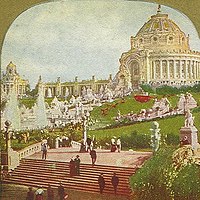
Ota Benga was one of these people. He and other members of his pygmy tribe were exhibited at the Louisiana Purchase Exposition in 1904 (the one of "Meet Me in St. Louis" fame). After that, he ended up at the Bronx Zoo—on display:

[Zoo director William Temple] Hornaday had his zookeepers urge Benga to play with the orangutan in its enclosure. Crowds gathered to watch. Next the zookeepers convinced Benga to use his bow and arrow to shoot targets, along with the occasional squirrel or rat. They also scattered some stray bones around the enclosure to foster the idea of Benga being a savage. Finally, they cajoled Benga into rushing the bars of the orangutan’s cage, and baring his sharp teeth at the patrons. Kids were terrified. Some adults were too, though more of them were just plain curious about Benga. “Is that a man?” one visitor asked.

This is a story of the times more than the individuals involved, but it reminds us that the times were anything but sensitive to otherness or the ubiquity of humanity: In 1906, the Bronx Zoo Put a Black Man on Display in the Monkey House.

Quick Take - Virtual Walt Disney World

Grinwout's knows little about Minecraft. These folks, on the other hand, seem to know an awful lot, enough to create Walt Disney World in Minecraft, with working rides.

Writing about love

That's an interesting problem. If we write about love, we have to navigate all sorts of shoals, including the insipid. It is hard to put emotions into words. I can write something that might scare you, that is, I might be able to arouse an emotion within the reader, but I would be much harder pressed to create a scene where a character is scared. The former is a matter of elementary narrative mechanics, the latter is a matter of artistic writing skills, which are much harder to master. A film analogy might be when we see the menace over the unexacting victim's shoulder or the lights go out or a door slams. Basic stuff.

Love scenes are similar. We could probably come up with the mechanics of characters falling in love without necessarily stooping to the pornographic, but how do we express the emotions? For that matter, if we want to discuss the art of love-making, can it be done without it being mechanical and predictable and pornographic? On the other hand, how do we separate the ephemeral—the beauty of being in love—from the mundane—trite expressions that simply relate that being in love must be beautiful?

Kurt Cornutt addresses some of this on the Oxford University Press blog in an article called The Love Songs of F. Scott Fitzgerald. Fitzgerald aspired to greatness in his novels, but meanwhile he pumped out a lot of short stories, simply for the money:

For Fitzgerald, the short story was a means to an end: it allowed him to finance his novel writing, which he considered the preeminent art form... He also resented the story market for enticing him to prostitute his talent. To command courtesan prices, he had to know how to his please his audience – and that meant recycling familiar themes, employing stock characters and scenarios, and tugging the heartstrings. What more artistically he might have accomplished, commentators lament, had he not been so dependent on this dirty money.

Cornutt examines some of Fitzgerald's love-story writing, and even compares it to Brian Wilson's love-song writing. I'm taken by the underlying question of portrayals of emotion, but I also have to admit, I liked learning about this side of Fitzgerald's career.

Daffy Duck

Daffy Duck made his first appearance on April 17. 1937. He predated Bugs Bunny, but comes across now as the alter-rabbit in many ways. Bugs, of course, was Warner Bros' big animated star, as emblematic to that studio as a certain mouse was to Disney. Bugs shone because he was the wise guy everyman that we rooted for because he always outwitted the world that was out to get him. Daffy, on the other hand, was wise guy who always seemed to outwit himself. When it comes to favorites, you can choose for yourself. Rabbit season? Or duck season?

There are those who claim that this is the best Daffy short. I won't argue with them:

Monday, April 16, 2012

This post is rated PG-13

Whatever that means.

The recent flap over Bully has brought the whole MPAA rating system under new scrutiny, but we'll bet anything that nothing will happen. The present rating system has been around since the 60s, with a handful of subsequent changes, most notably the addition of the PG-13 rating. Indiana Jones and the Temple of Doom was one of the real factors behind the addition. This movie, with beating hearts being ripped out of people's bodies, was rated PG, and parents who brought their little kids to see a fun Indy picture felt like they were having their own hearts ripped out. The creation of a teenage category, so to speak, was the solution.

There's a couple of problems with that. The biggest is that the group is a moving target. The teenager of the 1980s is not the same as the teenager of the 2010s, for one thing, and the definition of acceptability has changed. Violence and sex that were unheard of in movies for teens thirty years ago are now standard issue. Not that parents necessarily want this to be the case, but the world does revolve, no matter what we think about it. Add to that, a lot of parents don't seem to care all that much, and the ratings are decided not by a neutral group but by the film producers, who have a vested interest in money-making:

Stroll down any toy aisle and you’ll see a slew of licensed toys based on PG-13 movies, yet marketed towards very young children. Lego has a Pirates of the Caribbean set called “The Cannibal’s Escape” with a recommended age of 6-12. Fisher-Price sells a Green Lantern Jet that’s aimed at toddlers as young as 36 months. Both of these movies are rated PG-13, yet the licensed toys are marketed at much younger children. Similar examples are seemingly endless.

This is from a comprehensive Geek Dad post, Today’s MPAA Ratings Hold Little Value for Parents. One solution to the problem is a label like the one in the illustration above, with lots and lots of information, so that a parent will actually know what's in the movie, as compared to the more general information now. There is, of course, the other side of the coin, the relegation of the NC-17 to the no man's land of pornography. Going back as far as Siskel and Ebert, when those guys explained at length how there might perhaps be movies that deal with exclusively adult material might be not prurient but simply...adult, NC-17 has been the kiss of death. Which means that at least two of the ratings don't really work. But, as we say, we don't think much will happen, Bully notwithstanding. If the people making the money are the people calling the shots, there going to call them in the way that makes the most money. It's as simple as that.

Waiting to fly home

I just uploaded the results of the final round to Joy. My work here is done. Next year the event is in Nashville. I hope I'm invited to help out again; it's a fun tournament to run.

There's some explication in recent comments about cells; if you're curious, read CP's note.

One big difference between this tournament and the normal ones I run is that virtually everyone preffed. Granted there was a relative uniformity in the field, in that the majority is circuit-based, still, one does have one's preferences. I stuck to very strict assignments, and it was mutual probably for well over 90% of all the pairings. This doesn't mean it was all 1-1, because there were the occasional 3-3s, but if you're mostly getting your first or second choice of judge, that's not bad. One thing that always must be stressed is that the choice is mutual. You are not choosing the judge who will pick you up. You are choosing that judge that both you and your opponent rank identically. Big, big difference. What was amazing was that in the elims, we still had great mutuality, without a lot of hoo-ha. I mean, there was some hoo-ha, where you assign a judge here, and no one fits there, and you move that judge out of here and into there. It's a bit of a crap shoot, because you don't see in the main screen how the resulting ranking will work out. But it's do-able. And we did it. In the main, I'm quite satisfied with the tabbing. Nice work, if I do say so myself. And fun, as always, working with Kaz and Bietz, with occasional visits from Tim Mahoney and other special guest stars. I could have done with a little less "Great Moments in Star Trek Sound Effects" from O'C and the People's Champion, but I still liked hanging out with them.

More details to come. The biggest thing is that now, officially, my season is over. I will see one and all next year, starting at Yale.

I miss everybody already.

Except for some of them.

Full-scale version of the Starship Enterprise

Imagine a real life-sized version of the Enterprise. Where would you put it? Las Vegas, of course. Farfetched? Not at all. It almost happened.

The “big idea” was building the ship itself at full-scale. That was the main attraction. That being said, we also knew we would have to have some kind of “show” on board. So, conceptually, it was to be a “tour” of the ship, with all of the key rooms, chambers, decks, and corridors that we knew from the movie. There was to be the dining area for the ship’s crew (where you could dine in Star Fleet comfort), and other special features. There were also one or two interesting ride elements that we were considering including a high-speed travelator that would whisk you from deck to deck.

I had no idea that this was ever in the works. The Goddard Group designs all sorts of amusement attractions around the world. Rides, parades, museums, casinos, the whole gamut. Gary Goddard, the founder, previously worked at Landmark Entertainment Group, where he was responsible for Star Trek: The Experience, among others. He's responsible for the quote above. Get the whole story at the Goddard blog.

Via BoingBoing.

The Secret Garden

How often do writers really understand their own work? It's one thing if a writer puts out, say, three or four books in a lifetime. James Joyce wrote three novels and a bunch of short stories, and no doubt was fairly aware of the differences among them. They happen to progress in a straight line of modernism: you can read Portrait, you can struggle through Ulysses, and you can spend a week or two parsing the first page of Finnegan. Joyce had to realize that there weren't a lot of people who were going to think of Finnegans Wake as a good airplane read (or whatever constituted such in his day). So I would suggest that Joyce understood his own work.

What about Stephen King? He's written more books that he can probably remember. With that large an oeuvre, how can he possibly imagine which books will truly be his legacy? No matter what he happens to think, I'll bet he's wrong, simply because the odds are against him.

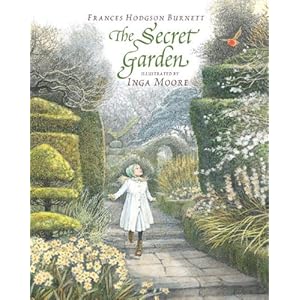
Look at Frances Hodgson Burnett. She wrote 52 novels and 13 plays. As primarily a writer for adults, no doubt she would be surprised to learn that she is now known for exactly one book, The Secret Garden. A Little Princess and Little Lord Fauntleroy may ring some bells among readers who like to go exceptionally deep, but that's about it. At the height of her quite extensive fame, Burnett moved into an estate in Kent:

Like her adolescent heroine, Burnett was led by a robin to the door hidden in the crumbling, ivy-covered garden wall; she executed a massive restoration project with the head gardener, expanding the view of the lawns, planting hundreds of flowers, and constructing a rose walkway. She settled into writing under a gazebo with her tame robin fluttering nearby. The book she worked on that first summer was not The Secret Garden, however, but one she had long labored over and was convinced would be her literary masterpiece, In Connection with the DeWilloughby Claim.

In Connection with the DeWilloughby Claim? Never heard of it. Burnett's story is an interesting one, especially if you're a fan of her work: Secret Gardens by Vanessa Blakeslee for the Paris Review.

Quick take - Bonnie Raitt

A survey of the performer's career, as she releases her latest album: Bonnie Raitt's Amazing, Omnivorous, Adult-Contemporary Career.

Audiobooks vs bookbooks

I've written on this subject in the past. Having a long commute by car, I've become an enormous fan of audiobooks, but that's not as simple as it sounds. The first question is, what books make sense as audiobooks, and which would you prefer to read as books? One touchpoint is when a book is read by someone who is really good at it. Audiobooks are a matter of performance as well as content, and a good performer adds a whole dimension to the book experience that is not there in one's own reading the page. Recently I acquired an old reading of The Wonderful Wizard of Oz. I wanted to throw it, and the reader, out the window. The performance gave new meaning to the words saccharine and ponderous, simultaneously. Meanwhile, Audible has just put out a performance of the book by Anne Hathaway. That one I'll try. If she can't do it, no one can.

Jenni Landman talks about the whole business of book in the Chicago Tribune, reading versus listening, in a reasoned fashion. And she interviews Audible founder/CEO Don Katz, who has his own worthy two cents to throw in. One problem with audiobooks that is acknowledged is that, presently, when you listen to an audiobook, you're sort of stuck on a conveyor belt. You keep going forward. And sometimes that's now exactly what you want:

If I read a book after listening to it, it's because I haven't gotten my fill of the language. I want to spend more time running the prose across my tongue, reveling in the writer's grace notes. This ability to savor is missing from the recorded books experience. Mp3 players don't accommodate thoughtful pauses. Scroll back to a review a passage, and you are suddenly three chapters off and now unable to find your place.

I hate losing my place, because it can drive you crazy trying to find it again. I hate being driven crazy while I'm driving!

If you like audiobooks, or wonder about them, read Audiobooks: Are they really the same as reading?

Saturday, April 14, 2012

Dept of Expication

From the comments: So the debaters are pre ranked and seeded in prelims? If so what is this based on?

You need to apply to qualify for NDCA; you get in by accumulating certain points during the year. It's complicated, but it's on their website. This provides a presumably neutral ranking of debaters across the country, despite where they debated (it doesn't necessarily have to be big bid tournaments). The resulting rankings are numerical, and we can list the entrants to the tournament in order as a result. Then you break them into 4 equal packages. And there you are.

More than 140 words

I'll try to keep up the tweets, as appropriate, but for those, follow the #NDCA2012 hashtag (and I"ll keep the widget with the tweets here for another couple of days, over on the right). It’s back to business here.

Anyhow, I’d forgotten the complications of pairing NDCA.

The original plan for Friday night had been to get together with O’C and The People’s Champion and the Emperor of Hamiltonia and go watch jousting, but at some point it occurred to me that I had a job to do and I probably should do it. Jousting with O’C would have to wait.

I got into the hotel in the afternoon and started playing with the data and setting up TRPC. The first thing one remembers is that we rank all the debaters and put them into cells. We create four levels, one through four descending, and we set it up so that none of the ones hit in random rounds. CP had the rankings and emailed them to me, and then I entered them, and Bietz showed me how to do the pairings, since I’ve only done it the once before, at last year’s NDCA. It does the presets for both the random rounds at the same time. This does make sense to me, and it also doesn’t. While not knocking out your top debaters by the top seeds hitting each other in the random pairings, it does sort of insure that the lower seeds will have rough draws. But then again, it is a championship. It’s supposed to be hard, and the competition is supposed to be designed so that the best competitors fight it out to the end. Sometimes I have trouble getting used to that.

Next, there’s the whole thing about judges not being in every round. Each judge has a certain number of rounds committed, and that’s it (although, apparently, we have a small purse of bribe money if things get a little too dicey). I went through and allocated to get enough judges for each round, so that we don’t use up people early on. Which meant that when we assigned the judges, if someone was available for round one but didn’t get placed, I removed their availability and put them in round two instead (I had set up that you were either one or the other). Of course, I had to move some twos into round one to get prefs. Then the couple of people who got nuttin’ got moved to three. It’s a pain in the butt, but if you don’t do it, the pain later is even stronger. I remember it from last year, when people would tell us they were no longer obligated, and they were right. I’m just not used to that. Normally you’re obligated for the whole shooting match. There’s some of this at Big Bronx, but the pool is so large it hardly matters, as long as you have a wealth of judges for round 3, where you have your first bubble at the down twos.

There’s four rounds today, with the longest lunch break known to man, so things should go swimmingly. We set up the Warm Room on my computer, so we’ll be doing that again. It looks like it’s working; I’ll post the first info as soon as I arrive on the UNLV campus.

Friday, April 13, 2012

What to read

"Read books. As often as you can. Mostly classics."

We posted Maura Kelly's slow books manifesto not long ago. She promoted the idea of reading the good stuff, and it makes sense. There is a lot of great literature out there, and an awful lot of it is simply wonderful to read. So, why not read it?

There's another side to this coin, however. Sure, I love Moby-Dick, but I have to admit, I also like James Bond novels. I have Melville and Fleming both on my Kindle. As a proselytizer for books and reading, I have to believe that any reading is a good thing, and that reading for pure entertainment is a perfectly acceptable activity. When I recommend books to teenagers, I always suggest books that I think they will enjoy, not books that I think will be good for them. James W. Hall, author of Hit Lit, makes this point at Speakeasy:

How can anyone who loves books not take heart in seeing so many new readers huddled up with a novel? Whether it’s “Harry Potter,” “The Hunger Games” or “Infinite Jest”—does it really matter? These days, when reading fiction seems like an endangered activity, why should we begrudge the success of any book, especially one that stirs such passion with younger readers?

We can't let an artificial line between so-called good books and books that will capture kids' imagination keep them away from reading in general. And, perhaps, the reading of what they want to read today make them eventual readers of those so-called good books tomorrow.

The weekend is here. Take a gander at Beware Literary Snobbery: Why We Should Read Bestsellers. And then go off and read a good book, however you define it.

Fernwood 2Night


According to Dangerous Minds, Fernwood 2Night shows are hard to come by. It's a shame, really, as this was one of the defining shows of 70s comedy, the sort of postmodern, everything so tongue-in-cheek that it was coming out their ear humor that followed the end of the straight vaudeville turns that we were so used to on television. At that time, a generation of old comics was passing, and a new generation was just beginning to come down the pike. Martin Mull was definitely part of that new generation; he always struck me as one of the funniest people around, no matter what he was doing. And this was the show that brought Fred Willard to the masses:

In a scene-stealing role that defined his entire career playing the clueless white guy—is there ANYONE more Caucasian that Fred Willard?—Willard portrays what is quite possibly the dumbest, most dense character in all of television history. I’ve always thought that Willard was a comedic genius—the obtuse angles of his observations, so off the cuff and spontaneous, so REAL—and he was never funnier than he is in this role.

The first clip in the article, with the race expert, shows Willard at his best. And I couldn't resist extracting the Tom Waits segment above; he's the perfect Fernwood guest. Anyhow, get the whole story, and more clips, at Fernwood 2Night: The Great Lost American Comedy.

Pinterest

When something new comes along that's really popular, we at Grinwout's feel an obligation to check it out and give it a try. So, we checked out Pinterest and gave it a try.

We didn't get it.

I mean, what exactly is the point of going online and finding a picture of something, and pinning it on your private bulletin board? Sure, there's a lot of pictures one might like, but making a virtual collection of them? Then again, Grinwout's doesn't collect anything in real life, either, aside from Disney pins when actually on a Disney property, and that's more a symptom of mass hysteria than a collecting interest.

Still, Pinterest is, at least for the moment, the site that is wowing them. We looked at Complex's The Top 10 Museums On Pinterest (and yes, it's a slide show, if you saw our remarks in the last post, but note that you don't switch pages, which makes it acceptable), and finally saw at least one use of the site that made sense. We especially liked what the Smithsonian and the Met were doing with the site. The thing is, if you have a collection of your own art, then Pinterest can provide a clever way to display it.

Then again, maybe you're a collector, and already use Pinterest like there's no tomorrow. In that case, have at it.

Lists

The top ten films of all time? The best films? The most popular films? The films you watch over and over again? How do you make those determinations? When people ask my favorite films, despite the fact that I consider myself something of a film buff, and I've seen a lot of movies and spent plenty of time seeking out classics, and I can name both American directors who wore eyepatches, and I really do think Citizen Kane is amazing, I am reluctant to offer an answer. It would take a lot of time to compose a list of my "favorite" films. What do I recommend? It depends on you. If you've seen a lot of movies, including the complete Ozu, I might suggest something different than if you've never even seen The Wizard of Oz.

Roger Ebert has his own take on lists:

Long-suffering readers will have read many times about my dislike of lists, especially lists of the best or worst movies in this or that category. For years they had value only in the minds of feature editors fretting that their movie critics had too much free time. ("For Thursday's food section, can you list the 10 funniest movies about pumpkin pie?") Now their value has shot way up with the use of slide shows, a diabolical time-waster designed to boost a web site's page visits.

I'm with him there. Lord, save us from slide shows! I've seldom made it to the end of one, even if I like the content, because I don't want to reward the greed of the webmaster who wants to artificially increase the number of "eyeballs." I mean, really. If Grinwout's touts a slideshow, it is an unusual event (and more often than not, slides on a page rather than multiple pages). I just don't like playing their silly game.

Ebert's remarks are from The best damned film list of them all, which is a good starting point for the business at hand, the top ten movies of all time. Sight & Sound publishes this list every decade, and Ebert is about to embark on submitting his picks for the 2012 list. He talks about the whys and wherefores, and that's interesting enough. But then you can go to S&S and take a look at all the different lists from 2002. This is the sort of thing to do with a group, because it will give you something to fight about.

Thursday, April 12, 2012

The Toy Fair

Illustrator/blogger Lisa Hanawalt and her boyfriend masquerade as chia seed employees to visit the Toy Fair at NYC's Javits Center, which is sort of an architectural Death Valley, without all the fun spots. It's the perfect place for a manufacturers' or any kind of sales convention. The toy show, of course, is absolutely limited to the trade—no kids running around here, thank you very much, despite what they happen to be offering. This is serious business, and Hanawalt is the perfect guide:

Do you remember your favorite toys as a child? And maybe you wondered why adults didn't seem as enchanted with your toys as you were? I used to swear I'd never lose interest in my figurines and dolls, I feared it would mean losing my entire sense of self. But of course I grew older and started leaving those beloved things behind. I can pick up a Breyer horse, admire the smooth plastic and artful details, but … that's it. I'm not going to sit on the floor with it for hours, making it talk to other toys, acting out my latest conflicts and fantasies, forming pretend relationships. I wish I could enjoy toys on that level again.

Sigh...

Breyer horses are at the show. And Legos. And this poor guy below selling bobble heads. Take the trip: The Toy Fair (via).

The guy who played Data

Whatever happened to Brent Spiner:


Fresh Hell is one of those web series that are popping up nowadays, and having just watched a couple of episodes, we can report that this is goofy, funny stuff. Whether or not the web is the source of all of tomorrow's entertainment, as some would suggest, remains to be seen, but there's good material out there beyond just clips. Vice.com (there's a URL for you) interviewed Spinter recently:

The part and the show was a gift and I am eternally grateful. I’m delighted that other people have opinions and affection for the character. The only thing that bothers me—and it happens all the time—is when people see me and shout, “DATA! DATA”! I’m fine with people recognizing me. I just wish they shouted, “Guy who played Data”!

Check out Off Hollywood - Brent Spiner, and follow his show, Fresh Hell.