Ah, yes. This was the future I was expecting. This ride famously demonstrated the machinery that could turn a rain forest into a paved road in seconds flat. It also makes you think that, if a hurricane hits, you still won't be out of power a week later.
[Via]... And he's right about the hats.

Showing posts with label world's fair. Show all posts
Showing posts with label world's fair. Show all posts
Monday, November 05, 2012


Friday, September 07, 2012
Riding off into the weekend: '64-65 World's Fair
Ground Zero for World's Fair buffs is probably the New York '39 fair, as one that most worked its way into the culture of the day and at the same time transcended that culture with its mix of modernism and hope on the eve of war. From the beginning of the era of big exhibitions, starting with the Crystal Palace in London in 1851, fairs were a really big deal, most of them doing their best to outdo the previous one. The creation of landmark objects became very important: the Eiffel Tower (originally 1889 Paris), the Ferris wheel (originally 1893 Chicago), the Atomium (1958 Belgium), the Trylon and Perisphere and the Unisphere (New York, 1939 and 64-5). Countries exhibited their wares, the world was made smaller, and ideas for future progress were presented.
There were a lot of fairs and expositions from the Crystal Palace on, but then they sort of petered out. For one thing, the need for international exchange wasn't what it used to be, and countries simply didn't want to spend the money in this sort of demonstration. Secondly, guessing the future is progressively more and more of a mug's game, and most people are flummoxed just guessing about the features of the next iPhone. They still have fairs and expositions, used mostly for the host countries to get support to build some much needed new infrastructure, and for developing countries to drum up business. They aren't the world destination they used to be.
New York '64-65 was one of the last of the really big ones (although it wasn't officially sanctioned by the governing body, as if promoter Robert Moses would care about that). The author of our little ride into the weekend today sums it up well: it came to town the same year as the Beatles, so for folks of a certain age, it was a game-changer. For me, it was less than an hour away via public transportation. I won't say I lived there, but I visited as often as I could.
So, return with us now to that golden couple of years: Promises Made: The 1964-65 World’s Fair
Oh, yeah. Did we mention that this particular World's Fair brought us this?
There were a lot of fairs and expositions from the Crystal Palace on, but then they sort of petered out. For one thing, the need for international exchange wasn't what it used to be, and countries simply didn't want to spend the money in this sort of demonstration. Secondly, guessing the future is progressively more and more of a mug's game, and most people are flummoxed just guessing about the features of the next iPhone. They still have fairs and expositions, used mostly for the host countries to get support to build some much needed new infrastructure, and for developing countries to drum up business. They aren't the world destination they used to be.
New York '64-65 was one of the last of the really big ones (although it wasn't officially sanctioned by the governing body, as if promoter Robert Moses would care about that). The author of our little ride into the weekend today sums it up well: it came to town the same year as the Beatles, so for folks of a certain age, it was a game-changer. For me, it was less than an hour away via public transportation. I won't say I lived there, but I visited as often as I could.
So, return with us now to that golden couple of years: Promises Made: The 1964-65 World’s Fair
Oh, yeah. Did we mention that this particular World's Fair brought us this?
Friday, May 11, 2012
Dali

Salvador Dali was born on May 11, 1904, and was active in all sorts of media, including the movie Un Chien Andalou with the ants and the eye (if you haven't seen it, and you're a movie fan, you have no choice but to go to YouTube and watch it now—we'll wait here for you), and the short for Disney, Destino, only recently completed and released. His most famous painting is "The Persistence of Memory," and some of his best work was for an illustrated Bible. But his masterpiece, without doubt, was his creation of Salvador Dali. He was born at the perfect time to capitalize on the nascent mass media of the 20th Century, and his fame, much of which was based (surrealistically) on his fame, put Andy Warhol to shame by that particular standard. Dali was one of the founding fathers of modernism and postmodernism both, and knew what he was doing every step of the way.
There's a fun little interview on Open Culture, with some further links if you want to dig deeper in general. Since Grinwout's is an acknowledged fan of World's Fairs, we'll just note that his sojourn in New York (around the time the photo above was taken) was well publicized, to put it mildly. He took the city by storm, above and beyond what he did at the fair. I'm not sure what fair promoters were expecting from Dream of Venus, but this is what they got. Racy? Well, the '39 Fair was racy, in its way. (Look it up, if you don't believe me.)
Dali left behind some remarkable art. We can probably now evaluate the work aside from the man, but since we have the man around if we want (thank God for film!), I don't know if we really should.
.
Tuesday, April 17, 2012
The wonders of the world
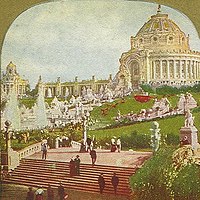 World's Fairs existed (and still exist) to exhibit our best products, to demonstrate the inventions that could change the future, and to bring disparate people together to learn about one another. At a fair today, that might mean that up-and-coming nations display their wares and tell the visitors how great it would be for them to move some of their corporations there, for mutual benefit. At fairs in the past, that might have meant that rounding up a group of natives from some undeveloped country and moving them lock, stock and yurt onto the fairgrounds so that the civilized world could gawk at them.
Ota Benga was one of these people. He and other members of his pygmy tribe were exhibited at the Louisiana Purchase Exposition in 1904 (the one of "Meet Me in St. Louis" fame). After that, he ended up at the Bronx Zoo—on display:
[Zoo director William Temple] Hornaday had his zookeepers urge Benga to play with the orangutan in its enclosure. Crowds gathered to watch. Next the zookeepers convinced Benga to use his bow and arrow to shoot targets, along with the occasional squirrel or rat. They also scattered some stray bones around the enclosure to foster the idea of Benga being a savage. Finally, they cajoled Benga into rushing the bars of the orangutan’s cage, and baring his sharp teeth at the patrons. Kids were terrified. Some adults were too, though more of them were just plain curious about Benga. “Is that a man?” one visitor asked.
This is a story of the times more than the individuals involved, but it reminds us that the times were anything but sensitive to otherness or the ubiquity of humanity: In 1906, the Bronx Zoo Put a Black Man on Display in the Monkey House.
Subscribe to:
Posts (Atom)