Monday, April 23, 2012

8 famous women writers in New York City

Dorothy Parker (pictured below), Zora Neale Thurston, Shirley Jackson, Gael Greene, Patti Smith, Susan Sontag, Tama Janowitz and Kate Christensen—eight writers of different times, of different styles, of different interests, of pretty much different everything. Brent Cox puts together an article explaining and comparing what it was like for them to live in New York City. Because, let's face it, if you want to be a writer, you have spend at least some time in Manhattan. Right?

Day jobs were needed as the women got their careers started, and some were writing-related, and some were real stinkers. The rent was murder, of course, and it still is. Just about everything is more expensive than anywhere else. Cox is especially concerned about the financial picture. Think about Dorothy Parker and company dining at the Algonquin:

Amidst the wisecracks and the bon mots hurtling back and forth, the room that held the Round Table was a restaurant, providing sustenance to the well-heeled clientele (and the Round Tablers). While Dorothy was more likely to rely on the charity of the hotel, happy to have a famous/notorious regular, the blue-plate special (half of a spring chicken, two veggies and French fries), was going for $1.65 in 1927, the height of the Round Table's fame. Convert that into 2012 dollars and you get $21.59... The bootleg Scotch that Dorothy's first husband would pick up to keep the couple lubricated in 1922 was going for $12 a quart (a princely $162.62 in current dollars).

Prohibition was expensive!

Check out What It Cost Eight Women Writers To Make It In New York.
.

Happy Birthday, Person Who Doesn't Exist!

A complete calendar of the birthdays of fictional characters? One can never for a moment doubt the usefulness of the internet. The folks at Flavorwire.com have done the heavy lifting of this one. This week, we'll be celebrating the birthday of Willis from Different Strokes, Monica from Friends and, today, Jin Kazama from Tekken (and yes, I have no idea who that is either). Want to know who shares your special day? Exclusive Infographics: Fictional Character Birthday Calendars. [Via Mental Floss.]
.

Hollywood's first great on-screen interracial couple

Shirley Temple, born April 23, 1928, is still alive and, one hopes, still kicking. Maybe not as she once did, but we'd understand that. She was one of the top box-office draws of the 30s, and was often paired with dancing partner Bill Robinson. This is one of their best:


They really were one of the movies' first interracial pairings, in a time when any but the most subservient of black faces were absent from the mainstream. One could say that a mature and polished performer like Robinson being matched up to a little kid is somehow off, but this was Shirley Temple we're talking about, and she was the big time. And the real deal. Not to mention that almost any excuse to capture the amazing Robinson on film is a good one, but the thing is, Temple was pretty amazing herself. She really could perform like a trouper, as her scenes with Robinson demonstrate: she's in there with him all the way. There were good reasons for her popularity.

As with most child stars, the fact that she aged gently slowly moved her out of motion pictures, but she never lost her charm and personality. She hosted a television anthology show in the 50s, and most famously proved that there was life after show business by being appointed US Ambassador first to Ghana and later to Czechoslovakia.

Happy Birthday, Shirley Temple, one of the last of the great movie legends.

Friday, April 20, 2012

I wouldn't want to judge a round that would want me as a judge

My favorite moment at NDCA was semis. The problem was, we were short a judge. If there’s one thing the group needs to do in the future, it’s insure that there’s a slue of neutrals for late outrounds. In the event, we only had two such floaters, and they were conflicted by their work with one of the teams.

Nails were bitten.

On Sunday night I planned the two semis panels based on hopes and dreams, essentially praying that a couple of people would be there who had no reason to be there. Unfortunately, because they had no reason to be there, they weren’t. At which point, choice of judges devolved to the warm bodies present. I had one backup, and he went right in. And then there was one more hole. The good news was that a judge who had been preffed was available; the bad news was, both teams had struck him. Well, at least it was mutual.

I could not overlook the fact that another potential judge was available. Yep. There was always me…

So I strolled into the round where the two debaters were waiting, and gave it to them straight. They could have the judge they both struck, who, in fact, was an expert policy judge, or they could have me. The benefits of the former, I explained, was that he might understand some of what they were saying. The benefits of the latter, as far as I could tell, were nonexistent. After a little consulting of paradigms, they chose the policy judge. A neutral party who observed this little interplay claimed that I did sort of use my innate persuasiveness to push them in that direction. But let’s face it. The very last time I judged an LD round was, mirabile dictu, the semis round at NDCA 2011. In that, to me, legendary contest, I awarded my ballot to the debater who uttered the most words that I understood—words, not sentences. If I remember correctly, I think the number was 16, but it could have been less. I mean, if you were on the $ircuit, would you want me for a judge if you could avoid it? I know I wouldn’t. I would argue till the cows come home that there is a role for judges like me, but not in a national semis round at this level. I don’t have the technical chops for it, and why should the debaters whose entire tournament has been based on their technical skills suddenly have to forego them?

Oh, yeah. I also managed to duck out of judging. This was not my specific goal, but no action is so horrible that some good doesn’t come out of it.

As I say, this needs to be avoided in the future, and the only way is either hire muchos judges or, as TOC does, set aside late-round panels in advance of the contest, so that people are there who need to be there.

NDCA: The Vegas side

I posted a bunch of updates via @jimmenick on Twitter, which I just removed from the right-hand column here; it seemed to conflict with the script for the Grinwout’s feed, for one thing, and I really don’t tweet much, for another, because it’s just not in my DNA yet. Anyhow, I wanted to talk more about Vegas.

I’ve been there before. The first time was 1955, the most recent in 2005, so although I’m hardly a habituĂ©, I’ve got some sense of the place, especially how it has changed over time. In the beginning, downtown was central, and one spread out a ways to the strip, where the more resort-like casinos existed. That was the Rat Pack era, when Vegas meant headliners or (usually naughty) variety shows. Nowadays the Strip is the center, and it’s headliners, extravaganzas, and naughty shows. There are seven Cirque de Soleil venues, for instance (including one that is naughty), enough presumably for every taste. At one point, the lure of the place was supposed to be family entertainment, and there were all sorts of rides and amusement park attractions, but that’s mostly gone now. The thing is, a family destination has to be family at its heart; Vegas merely added a subset of the familial, which wasn’t enough. Vegas, at it’s heart, is adult entertainment (in the non-naughty sense, although inclusive of the naughty), mostly stuff that adults do that children don’t. There’s a few things left now to entertain the young ’uns, but mostly there’s restaurants, shows, shopping and gambling, and those are aimed at the over-21 crowd. So be it.

After I arrived on Thursday and settled into my hotel, the Luxor, which is at the top (or bottom) of the Strip, I put on my feet and started walking. For the curious, there is a lot to see, running the gamut from genuine Monets to flea-bitten Mickey Mouse impersonators. I consider it best to accept them all, rather than seeking out one’s usual norm, because Vegas by definition is all of them, and excluding any of them misses the point. Let it all wash over you: that’s what Vegas is all about.

In the space of about five hours, I ranged from faux King Arthur, where they had a Spongebob Squarepants attraction (very Arthurian), New York New York with its taxicab roller coaster, a Henry Moore sculpture, “A girl in your room in 20 minutes” brochure hander-outers (all looking like Mexican immigrants), the Eiffel Tower, Venice complete with gondoliers, an Apple Store where I bought a connector for my iPod to the rental car aux plug, a son et lumiere of the history of Atlantis (which failed a few minutes after it started), a bar based on Coyote Ugly, a chichi mall where everything costs too much right across the street from a downscale mall where everything probably still costs too much but it’s all crap as compared to designer labels, Spiderman and Batman in need of losing a few pounds around the middle, twin Michael Jacksons, the MGM lion, and a parade of tourists that would amuse anyone absent all these other attractions. There’s no uniformity to the passing parade, unlike in, say, WDW, where everyone seems to be a fairly overweight British family. This is more like walking the streets of Manhattan, except marginally more English is spoken.

How can you not enjoy something like this? You don’t have to do anything except soak it in, and if you like, think about it. Wonder over the amount of noise that is generated in the casinos: I happened to read that there is statistical data that proves that people gamble more if there’s a racket going on, which surprised me, unlike the fact that if you’re gambling they will ply you with free liquor. That made sense; I do the same at my monthly poker games. (“Hey, Mike, you need another beer there, don’t you, buddy?”)

I didn’t do much more than my Thursday afternoon and Friday morning strolling, in terms of pure Vegasiana. That was enough. I like gambling but I’m too cheap to do much of it, and after I won a few bucks I stopped, and that was that. I did notice that there was no free wireless in my room at the Luxor. Is there really anyone physically in Vegas and also on Facebook? No one over the age of 21, and that’s a fact.

Go look at #ndca2012 if you want to see my Vegas pix, and comments as they happened.

Charlotte's Web

"Some pig..."

Of all the books I have read that were written for children, either as an adult or a child myself, many were very good. But only a few were, and are, special. Shockingly, to anyone who looks up at the logo for this site, the Alice books were among those special ones. I first read them as a teenager; I haven't stopped reading them yet. I don't think they're particularly satisfying when read aloud to younger children; it's hard to follow the logic and language unless you're reading them yourself. Maybe Victorian children were smarter than kids in my day. In any case, the impression the Alice books have had on innumerable writers and artists is undeniable. And they are, ostensibly, children's books.

Special in a different way is Charlotte's Web. I read this for the first time when I was reading it aloud to my daughter when she was quite young. I had read White material before that was intended for adults, but never his works for kids. I expected it to be good. I didn't expect it to be so affecting that I could barely speak the last words of the book because I was reacting so emotionally to them. It might have something to do with being something of a writer myself, on top of everything else. In any case, those last words have never left me.

Amazon's Omnivoracious, celebrating the 60th anniversary of the book, has brought forth the original catalog copy from 1952. If you're a Charlotte fan, it will give you a nice warm glow to read it. If you're not a Charlotte fan, you obviously have never read the book, and you need to drop everything and do so now.

David Sedaris

Most of us probably come to Sedaris first as an audio experience, maybe hearing him on This American Life, as likely as not with the Santaland Diaries. You immediately know that you want to hear more, so you seek out the audio versions of his books, and discover that the one or two stories you've heard before were not flukes. He is an expert performer of his own work, either cold in a studio or hot in front of an audience. He doesn't have the vocal chops of, say, James Earl Jones, but if Jones were reading Sedaris, it just wouldn't work right. Then again, Sedaris would have been a lousy voice actor for Darth Vader. But he's perfect for David Sedaris, and that's more than you can say for a lot of writers and their own work. His writing just happens to translate perfectly to his voice.

This wouldn't be terribly notable if it wasn't for the fact that Sedaris as a writer, absent his reading aloud his material, is very strong. You can read his stories without listening to them, and without even trying to imagine his voice in your mind if you already know it, and the stuff is really good. He's a good writer and a good (albeit limited) performer both. Pick whichever pleases you, but you won't go wrong either way.

If you're unfamiliar with Sedaris (how could that be?), you might want to start with a By the Book interview with him in the NY Times:

Boy, did I have a hard time with “Moby-Dick.” I read it for an assignment 10 years ago and realized after the first few pages that without some sort of a reward system I was never going to make any progress. I told myself that I couldn’t bathe, shave, brush my teeth or change my clothes until I had finished it. In the end, I stunk much more than the book did.

More Bond. James Bond.

James Bond goes on long after the passing of creator Ian Fleming (right) in 1964 (the year the film Goldfinger was released). Bond was iconic to begin with, or at least once Fleming got the hang of the character. In the first couple of novels the author seems to be finding his way, but by the time he got to Moonraker, he knew what he was doing. There is a combination of plot and explanatory detail that normally readers would find annoying, but with Bond, the explanatory detail is the liquor he consumes or the cities he visits or the cigarettes that he smokes, all of it relayed in a professorial matter-of-fact style that ultimately set the character as not real to anyone, but at the same time, more real than real. Hyper-real, in other words. There was never a spy anything remotely like the fictional James Bond, who became the quintessential version of what what we think of as a spy. How many other characters can you think of that have both outlasted their author and outlasted their fictional portrayers? In the movies Sean Connery was the quintessential Bond just as Bond was the quintessential spy, but that didn't stop Lazenby, Moore, Dalton, Brosnan or Craig. Nor will it probably stop the next fellow.

The novels too went on after the novelist died. Kingsley Amis, John Gardner and others have taken on the task of writing Bond novels, most recent among them being Jeffery Deaver with Carte Blanche, a reboot of sorts. Carte Blanche can be recommended to the most die-hard Flemingian Bond fan as a very good Bond novel, but at the same time, it is also a very good Jeffery Deaver novel. The author was obviously allowed to write his own book, rather than trying to imitate the original.

Next up to take on Bond will be William Boyd, a rather marvelous author in his own right, known for An Ice-Cream War and A Good Man in Africa, both Grinwout's recommendations. He comments himself on his license to write a William Boyd book, plus some other extremely interesting things, in a Telegraph interview: William Boyd on challenges of writing the latest James Bond novel. It's definitely a must for Bond fans.

Of course, the one character that does come to mind as comparable—actually, the one who probably sets the standard for outlasting creator and portrayers—is Sherlock Holmes, the quintessential detective to Bond's quintessential spy. There are some fun takes on the twists of the Holmes legacy at Sherlock Holmes’ Odder Fodder: Curious Books Featuring the Great Detective. Looking for the Holmes guide to self defense, for instance? This article will lead you to it.

It's been a while

Posting the latest Tale of True Debate Adventure reminded me that I have a whole slew of audio for those whose lives are lacking in Coachean entertainment. The list is a little funny in a way, because some of the really old stuff is totally outdated, but most of it is classic fiction that will never die (at least until I stop paying my annual hosting fees).

The link is http://www.jimmenick.com/podcasts/index.html

By the way, most of the material there is also available in written form. Especially note that there are more written than recorded Nostrums, if you get into the series and demand to find out what happens to everyone. Not that you ever will, but it will be better than nothing.

George Takei

Is George Takei the most interesting veteran of Star Trek? Today's birthday boy (4/20/37) was interned with his family during WWII, he was student body president of his LA junior high school, he was one of the first Japanese actors to build a career in post-war Hollywood, and eventually served as a Lieutenant on the Starship Enterprise on The Original Series. As true connoisseurs know, he was promoted to Captain after TOS ended:


Of course, his greatest fame was from TOS, where he worked with the only other contender for the most interesting Star Trek veteran, a relationship he describes here in his predictably gentlemanly fashion:


As a measure of cool, he's done voice work on everything from Archer to Scooby-Doo to Star Wars: The Clone Wars. Having served both masters, so to speak, he is the voice of reason in the ongoing war between Carrie Fisher and William Shatner on which Star X is best. And he's also a noted advocate of gay rights.

Did we mention he's also one of the funniest people in the universe:


Happy birthday, George Takei.

Thursday, April 19, 2012

Tales of True Debate Adventure!

This week's episode: "Bronx XXIII."

(This story is not exactly nonfiction. Facts have been rearranged, modified, and occasionally completely ignored in aid of providing a more satisfactory narrative.)

(Those who wonder why Cruz speaks with an Irish accent need to study the collected works of JM more carefully, or, preferably, get a life.)

RIP Levon Helm

Who would win?

Darth Vader vs. Voldemort. Sauron vs. Voldemort. Batman vs. Spiderman. Dracula vs. the Wolfman.

The adolescent imagination is filled with these sort of pairings. What would happen if you threw a hero or villain from one imaginary construct against an opponent from a different construct? The Grinwout has sat on long bus rides with high school debaters who can conduct a conversation along these lines for upwards of five hours. This is why the Grinwout has noice-reducing headphones.

But the idea of mixing and matching is not a new one. Universal Studios did all the early horror movies like Frankenstein and Dracula and The Invisible Man, and after they exhausted all the possibilities of return, revenge, son of, bride of, mother-in-law of, etc., they went to mixing them up against one another. The natural outcome of this was that teams of what were once collective nightmares found themselves in battle with Abbot and Costello, and losing. It was not a pretty sight. Then again, when I was in fifth grade, House of Dracula and House of Frankenstein, where the monsters were so numerous they had to take a number, were the hit of the playground.

The issue is the imaginary construct. As Stephen Padnick explains at Tor.com, some characters exist in their own singular construct, especially in movies:

Crossovers don’t really happen in films, outside the horror genre... The protagonists of long running film series rarely meet either. James Bond never hit on Sarah Conner to the disgust of her son. Indiana Jones did not team up with Rick Blaine to punch out Nazis while Marion Ravenwood drunkenly sang Marseilles, (though how cool would it be if they did?). Even superhero movies, which are almost as old as superhero comics, basically assume that their hero is the only superhero in the world, and their superhero origin is the only source of supernatural power.

This is not the case in comics, where all the characters exist in the same universe, and cross over all the time. Which is why we have the Justice League and the Avengers. In fact, each individual comic nowadays is simply one episode of the narrative that crosses all the comics of a particular publisher. I recently was checking out a Green Lantern narrative on my iPad that, if I were to have purchased it, would have covered dozens of comics across multiple venues, and it took about three spreadsheets and an extra can of Red Bull to even begin to figure it out.

Inspired by the upcoming Avengers movie, the first to provide celluloid crossover, Padnick parses it out in The Avengers, the Argonauts, and the History of the Team-Up.

The worst travelogue ever

Thank you, Dangerous Minds, for digging this one up. Apparently it's quite rare: It was screened before The Life of Brian, but only in theaters in Great Britain and Australia, where boring, groan-worthy travelogues were still being routinely shown prior to feature films. (More details are on the DM site.) I started watching it thinking it was just a bad travelogue, and then you start getting into it, and it gets really bad, and then... Watch it.


Tim Curry

April 19 being Mr. Curry's birthday, could we be amiss posting this?


Or this?


He's also had a rock career (without makeup):


The possessor of one of most mellifluous speaking voices around, he's done seemingly endless animated voices, originated the title role in Amadeus and the part of King Arthur in Spamalot on Broadway, and even done video games. The man does not seem to take a lot of days off.

Happy birthday, Tim Curry.

Wednesday, April 18, 2012

Robert Caro

The Power Broker is the best biography I have ever read. Let's get that out of the way first. And I've read, and loved, a lot of biographies. But never have I come away from a book with such a strong feeling of knowledge of its subject. Robert Moses was a most amazing figure, a strong-arm character, a conniver, a dreamer, very much the power broker as the title says. He built big, and often terribly wrong. I don't think I would have liked him as a human being. I've often wondered if author Robert Caro felt likewise.

After Robert Moses, Caro went on to Lyndon Baines Johnson, a similar figure in many ways, especially in the manipulation of power. I read the first volume, and I've been waiting for Caro to finish ever since, but every time a new volume comes out, it is not the last. I've given up. I'm going to get the ones that are out there on my Kindle and have done with it. By the time I'm finished with them, with any luck the final volume will be out. The (presumably) penultimate volume is coming out in a few weeks.

But, well, that Kindle... There's the rub. Publishing is changing these days, and the Grinwout is in the thick of it. Publishers don't really know where they're going with digital products, but they're going there a mile a minute. One fear is that we are creating a business of publishing—fast and electronic—that will no longer be able to support garganutan projects like Caro's LBJ biography. And the world will be a lesser place for it, if that is true.

[Knopf editor Sonny Mehta] pulls each of Caro's books off his shelf, The Power Broker and the first three Johnson volumes. He stacks them on his desk like blocks, resting his hand on top of the pile, saving a place for the next one. "I can't imagine this being done or even attempted by anyone else," Mehta says, almost to himself. "He's given over so much of his life to another guy." It's not just Caro's single-mindedness that makes repeating The Years of Lyndon Johnson a modern impossibility... Books like Caro's don't make corporate sense anymore, if they ever did. They require not just staggering investments of time but also of money, of jet fuel and paper and cloth. There will be five books now rather than four — and in the beginning, there were meant to be three — partly because they became victims of their own physical scale.

This is from a profile of Caro by Chris Jones in the May 2012 Esquire, The Big Book. It is required reading for anyone who cares about words, and how they are disseminated.

Just as an aside...

Finally something on VB that I not only understand, but agree with, Adam Torson's article on humility.

Everyone in debate should read this, and act accordingly. 'Nuff said.

Keith meets Mick

Mick is the greatest R&B singer this side of the Atlantic and I don't mean maybe. I play guitar (electric) Chuck style we got us a bass player and drummer and rhythm-guitar and we practice 2 or 3 nights a week. SWINGIN'.

Letter of Note printed Richards's letter to his aunt, He is called Mick Jagger, and as we ease into the 50th anniversary of the Rolling Stones, and various reports come and go about their touring again, or not, and recording again, and not, and for that matter, talking to one another civilly again, or not, it's fun to recollect that at some point in rock and roll there were no Rolling Stones. At one point in classical music there was no Bach or Beethoven either, so everything has to come from somewhere.

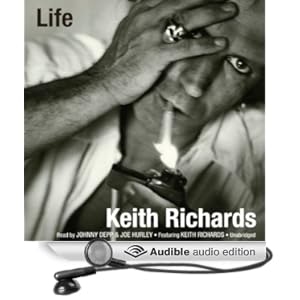
As Richards describes in Life, the group came together over classic R&B and some serious record collecting. In the early 60s, if you wanted music, you didn't bit torrent it when the spirit moved you. You had to haunt the record shops, and for the Brits, that meant scouring through not just records but imports to boot, and, for that matter, 45s, the one-song singles. Albums weren't the thing yet, although they did exist. Being a music fan was work, but it was worth it because it got you past the mainstream into where the action was. And, if you were lucky, it helped you create the Rolling Stones.

Richards's autobiography is highly recommended, but I would suggest you forego the paper version and acquire the audiobook, which he reads some of, along with Johnny Depp (and another narrator of less fame, but much ability). It's a worthwhile combination of performance and content, which as has been noted on earlier posts, is what audiobooks are all about.

The meaning of the Marshall amp

"If it's too loud, you're too old." And, by now, probably half deaf.

I have been to plenty of rock concerts. At some of them, you couldn't really hear the music, which does seem to lessen the quality of the experience. It wasn't that the music was too soft to hear: it was too loud. The recently deceased Jim Marshall, creator of the Marshall amp, can be directly tracked as the source of volume in stadium rock. Like most people, I knew that there was such a thing as a Marshall amp, so I marginally understood why his passing was noted. An article by William Weir explains it:

Marshall...had the fortune of having a 20-year-old Pete Townshend for a customer. Townshend told Marshall he wanted to hear himself over The Who's audience and rhythm section. Thus was born the first 100-watt amp. Add to that two cabinets, each bearing four speakers—together, the components came to be known as the Marshall stack—and Marshall secured himself a permanent spot on any history-of-loudness timeline... Townshend's wish to hear himself play over his bandmates and audience was certainly a reasonable one. But his discussing it with Marshall—who could actually do something about it—might be the moment arena rock was born, and the start of a widening divide between audience and performer.

In other words, it was the beginning of the battle of the bands versus the listeners' eardrums: How the Marshall Amp Changed Rock—and the Meaning of 'Loud'.

The book tour

If you're going to write a novel, which is an endeavor of great discipline, you're going to imagine a number of things. First of all, you're going to imagine that your book will be a bestseller, and you'll make enough money to give up your day job at the widget factory to spend the rest of your free time playing golf with Jame Patterson down in Palm Beach. Then you're going to have to believe that your great success means that your hungry fans want to meet you in the flesh and listen to you read from your future classic.

It is nice to dream.

A number of writers have finished their books, and with varying degrees of success (and I'm not sure how many rounds on the links with Mr. Patterson) gone on tour to promote their work. The results, as repaired in The Awl, have been mixed:

No one has heckled me yet, although I did have one guy at a reading come up to me and start asking me questions about the technology of the TM-31 and how it works and it took about five minutes for me to realize what was happening—it was about the time that I noticed how glassy his eyes were—and then he finally just came out and said it: he was a time traveler, too, and he wanted to know if I could do it anytime I wanted or had to use the machine the way I described in the book.

The title of the piece is self-explanatory. It's fun even if you don't have a bestseller in your personal oven: Nine Writers And Publicists Tell All About Readings And Book Tours.