Friday, July 05, 2013

How I Spent MSV #5, Special I See Dead People Edition

We did two cemeteries. The first, in Montmartre, we just popped into because we were passing by it.


The decidedly unique characteristic of the Parisian cemeteries is that they are packed to the gills, with ornate tombs seemingly placed willy-nilly beside one another.


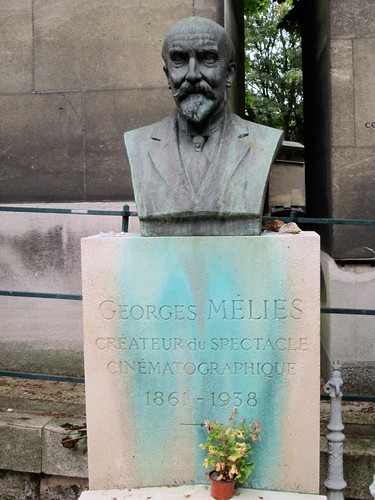
There were a number of famous people in Montmartre, but we had no guide to their whereabouts, and this was the only one I found:


Probably the most famous cemetary is Pere Lachaise, abounding with famous folk.


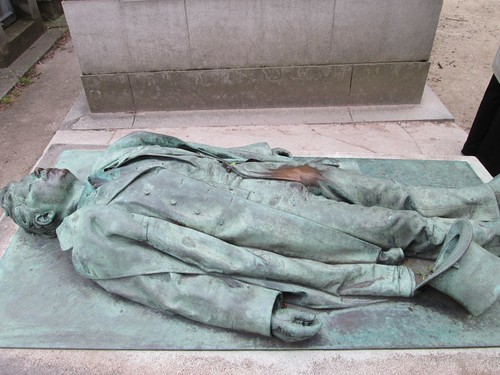
A lot of the famous folks have fresh flowers on their graves, placed by random admirers. In the one below, this guy was no one in particular, but I love how the memorial captures him as if he just keeled over:


If there's a particular practice associated with a grave, like kissing (note the lipstick stains that, apparently, corrode the stone), they'll block it off, or at least try to. This is Oscar Wilde's momument.


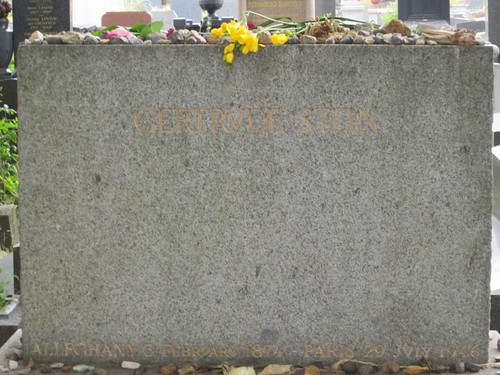
Same stone, front and back:


A whole section of the cemetery is devoted to the War and the Holocaust. This photo only hints at the emotional impact.


While there are those who say he's still alive (shopping at the 7-Eleven with Elvis?), here's old Jim, the second most popular musician in the place. It's a pretty nondescript grave, cordoned off, of course.


But even Mr. Mojo Risin can't match Chopin in pomp, flowers and impact.


Thursday, July 04, 2013

I stand corrected

Regarding my post on museums, says Claire:

LIES LIES LIES. There are THREE museums in Paris: Orsay, Louvre, and the Pompidou, which I love and I don't care what you think of me.

I have been to the Pompidou. I love that you can look out from the stairs, which are not inside the building, and see a lot of Paris. I'm rather taken by the idea of the machinery of a building being removed from its interior. And, well, they do have a lot of great stuff, although when I was there I unfortunately drifted into the area where it was all just piles of dirt with labels claiming that they were artworks. If one of the goals of art is to make you think, and I believe that it is, then Pompidou is a wild success. I just happen to be a philistine at heart. Even in NY, I go to the Met about ten times to every one visit to MOMA. What can I say?

Here's a video on their site:

http://www.centrepompidou.fr/cpv/ressource.action?param.id=FR_R-89fd49e847165bc78d564f6dbeb6777¶m.idSource=FR_E-2ab598d3369ad7a58ead7e6be32ba7b

Wednesday, July 03, 2013

How I Spent MSV #4

For most tourists, there are two museums in Paris, the Louvre and the Musée d'Orsay. The latter is a converted railway station, and is essentially the home to the Impressionists. People visit the Louvre because they feel that they have to; how many people can explain why the Mona Lisa is either important or a great piece of art? On the other hand, people visit the d’Orsay because Impressionist art (and all the other related schools of post-, pre- and anyone generally French and non-literal) has become pretty much the general favorite of just about everybody. The images stick in one’s brain, the painting styles intrigue even non-painters, and in a word, the stuff does at least part of what art is supposed to do, which is connect emotionally to the viewer. If beauty is supposed to be a part of art, and beauty is transcendent, then Impressionism is everybody’s most beautiful and most transcendent.

I’ve talked a lot about art over the years, what it is and how it can be defined. “Caveman,” of course, is the most detailed I’ve gotten, but I’ve thrown out other things over the years as well, often contradicting things I’ve said at other times. So it goes. Art, whatever it is, is always tied into a process of learning. With the passage of time I find not that my tastes change, necessarily, but that I start enjoying more and more stuff that previously had left me cold. Almost all of our major trips, and a lot of our day trips and short jaunts, include visits to art venues of one sort or another. It’s not just something we do because that’s what tourists are supposed to do; often it is the driving force of our trip in the first place. I mean, I strongly want to go back to Madrid, which I thought was a pretty bland city overall, solely because of the Prado and Thyssen museums (and, admittedly, a couple of really good restaurants).

We took a day for the Musée d'Orsay. Because of its contents, it is wildly popular. The main collection on the top floor fills up with people quickly, so if you really want to look at the paintings, you’ve got to be there when the doors open, otherwise you’ll be looking at other people looking at the paintings. Then you walk down the stairs to the decorative arts exhibits on the side, if you happen to be a fan of craftsman, nouveau and deco; they’ve got things you’ve never thought of, like Norwegian Viking-inspired art deco, plus the Viennese Secessionists and so forth. And then down on the first floor are the special exhibits, by which time you’ve probably exhausted your couple of hours of museum attention time, and need a break.

Tied into one’s d’Orsay ticket is admission to the Orangerie on the other side of the Seine, which wasn’t open the last time we were in Paris. After a long morning at the d'Orsay and a nice lunch break, you stroll over there, and you walk into a couple of elliptical rooms maybe a hundred yards long, on which are hung Monet water lily paintings stretching over the entire walls. These are a show stopper. Aside from architecture, there are few absolutely mammoth works of art, period, much less mammoth works of art that hit you in the gut and take your breath away and make believe for a while in humanity’s better nature. The Monets in the Orangerie are one of those magical places. The Sistine Chapel is another, if you want a comparison. You are awed by what one person can do beyond all imagining, a bravado artistic performance few would even attempt, much less at which they would succeed.

I can’t describe the experience of the Orangerie any better than that, and I’m certainly not going to post a picture of the paintings, which would give you no idea of what the experience is like. You simply have to go there. But be prepared. Plenty of people would storm into the room, look around, shrug and move on. Plenty of others were struck dumb and were sitting quietly in the middle just trying to absorb it all. You want to be one of the latter. These paintings are not just a tick on your list, another place you’ve been that you can talk about when you get home. These enormous canvasses, created by perhaps the most beloved painter ever as he was going blind in his old age, speak to something that cannot be articulated.

I obviously still have not recovered from the experience.

Yeah, it's an ad, but...

Tuesday, July 02, 2013

How I Spent MSV #3

Weather forecasting in Paris seems to be of the persuasion that, if you tell them it might rain, you’ve done your job. Every day the prediction hovered around 30 or 40 percent chance of rain. While once or twice we got sprinkled on, it never really hauled off and hit us with anything worth noticing. For that matter, even in London we only saw real wetness once, and then not for long. On the other hand, the weather was coolish in both places, mostly in the low 60s, which has to be one of the best possible scenarios for extended touring on foot. Very comfortable, in other words.

Still, at the beginning, before we learned that French weather predicting was an oxymoron, we figured that our first full day, where we had planned to explore outdoors down around the Bastille, would be better spent indoors at the Louvre, so we headed there instead. It was a little drizzly when we arrived, so this was probably a good idea. There was a line of about a hundred people, which took no time at all to move into the building; as you can see, at about noon,
the line stretched out of the picture.

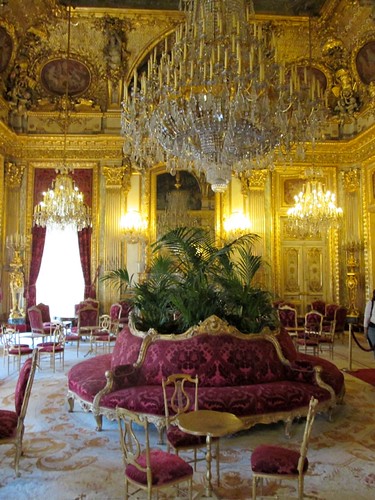
Of course, if you’ve never been to the Louvre, you pretty much have to hit the masterpieces like the Mona Lisa, but every tour group in the universe is doing likewise, making masterpiece stalking a decidedly unpleasant experience, unless I guess you’re the first person in the place. Having dispensed with the proverbial bucket list on our first trip some years ago, now we can visit seeking something else. This time we decided on French paintings of the 19th century (pre-Impressionism) and decorative arts, which includes some palace trappings. This is the sort of stuff that takes your breath away but you don’t have to fight the hordes to enjoy it, aside from the inevitable tourist who has to stand a relative in front of everything and take a photo to prove that they were there, and the other inevitable tourist who has to take a photograph of every painting, period, which is akin to whistling Wagner—it just doesn’t capture the essence. Oh, well. The French paintings are decidedly of the so-called academic variety, lots of history and education and moral illumination, the stuff the Impressionists didn't do when their time came along, which is why they couldn't get into the salons (they were refused, and they took great pride in being refusés). As for decorative arts stuff, well, they did have the odd king and/or emperor living here over the years; the Louvre after all is a former palace. Some pix below.

We put in our usual two or so hours, at which point museum overload always sets in, and we headed outdoors, where it had suddenly turned quite nice. We walked around, heading toward the (eastern) bottom of Ile St. Louis, which is the island next to the Ile de la Cite, which is the island with Notre Dame and the hunchback (the name escapes me but the face rings a bell, if you need a joke punch line to help you out here). St. Louis is quite charming, famous perhaps more than anything for Berthillon ice cream, which is proof that human nature is all too human. You can buy this ice cream at the counter at Berthillon, or at any of a number of other counters within a hundred foot radius. Exact same ice cream. Line at Berthillon? Endless. Line at Berthillon outlets? Virtually non-existent. Since we weren’t exactly in the mood for ice cream when we were there, we skipped it, and I felt that we were probably ruining the entire vacation by so doing and missing out on a world-famous treat, but we were nearby a few days later and made up for it then. It really was good.

We didn’t bother going into Notre Dame, which had yet another endless line, but then again, been there, done that, and there are plenty of other things to go into that don’t have endless lines, especially churches. A Catholic country that’s been in existence since the invention of Catholics tends to have a lot of churches worth visiting. Italy is, of course, the same thing. You can church yourself up endlessly, and if you happen to appreciate architecture, art and/or religion, you will be a happy tourist.

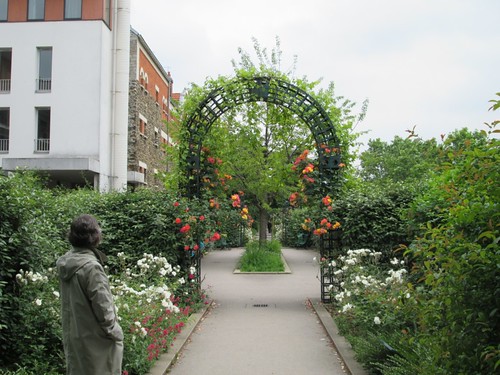
The next day we roamed the Bastille area. The prison itself is long gone, aside from a piece of rock here and there. Nearby is the area where the characters do some of their endless noodling in Before Sunset, the Promenade Plantée. It is, essentially, the Parisian High Line, with the distinction of predating the High Line by about 20 years. No one was filming us as we walked, however.

Following that, the next day we day-tripped out to Giverny. It seems pretty necessary to do a pilgrimage Chez Monet if you’re any sort of Impressionism fan, and if you do, you won’t be disappointed. The place really looks like his paintings. Just photographing the ponds, even when they’re overrun by tourists, looks like Monet’s lily paintings.

We had also planned a day trip to Chartres, which we’ve never seen, but the continuing bleak forecasts coupled with a surprise train strike—the French on strike? Quelle surprise arooni as the Frenchie say—put the kibosh on that one. We substituted a walking tour of the Left Bank.

Some selected pix:

The royal quarters in the Louvre:

That black dot in the top left section is a cannonball:

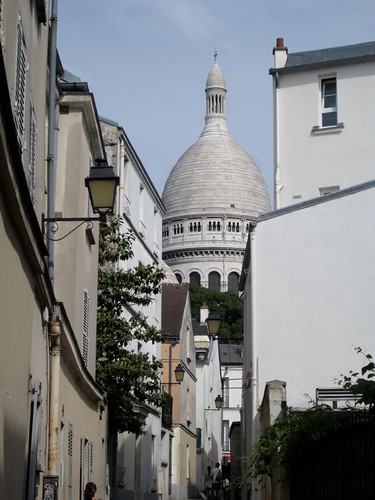
The city is filled with little courtyards:

Who says the French are a little on the ornate side?

The Parisian High Line:


The house at Giverny:

Nymphéas:

Poppies:

Monday, July 01, 2013

How I Spent MSV #2

I ended up traveling, techwise, with only an iPad and a tiny pocket camera. I have to admit, there were times when I wanted to pull an iPhone out of my pocket and figure out A) where the hell I was and B) where the hell the nearest metro station was, but other then that, there was something of an accumulating sense of freedom from not having the phone at hand. My need to read emails as they come in, especially when I’m on vacation, pretty much hovers between nil and not at all. There was the tiniest bit of debate business that needed to be attended to, but I was able to address that in the evenings or mornings when I had the iPad and wifi. The rest of the time, well, people could wait a few minutes. Of course, in addition to GPS duty, the iPhone can double as a camera, but I became quite enamored of the one I bought for the trip, a 16 megapixel Canon with a 5X optical zoom. It was so much better than doing heavyweight Sherpa duty lugging the SLR, which it cannot match in terms of control, balanced against exactly what sort of photos are being taken. If you’re going serious pix, then you need the SLR (or that new mirrorless generation of cameras that I gather remains pretty expensive). But I wasn’t expecting much more than souvenir snapshots. The Canon did the job.

I’ve been posting the full edited pix on Flickr (thanks for the memory, Yahoo: I had abandoned Flickr early on when I reached the limit), and selected shorts on Facebook, if you want to see the results. On Flickr, set 1, set 2, set 3.

On top of that, we used TripIt and TripAdvisor and of course Google Maps, and that was pretty much it for travel software. What else does one need?

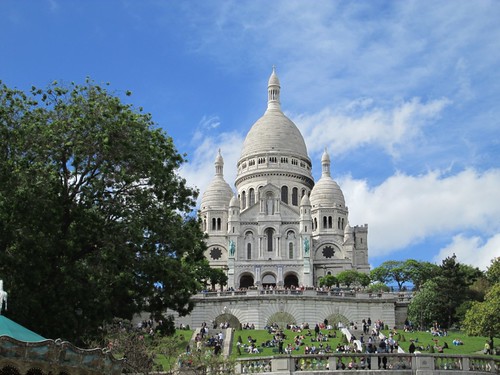
We rented an apartment in Montmartre, which is up the hill around Sacre Coeur.
Like a lot of Paris, it’s all tiny streets, many of them going one way, and when we were arriving, our driver found that most of them went the wrong way. The apartment belongs to one of my wife’s colleagues, and they rent it out when they aren’t there. Considering the price of Paris hotels, it was a steal, and it had a fully equipped kitchen, a living room, two bedrooms, and an enormous bathroom with a separate w.c. If you know Europe, you know that the phrase enormous bathroom sounds suspiciously bogus, but it was true. There were actually two showers, one in a stall and one in the tub, plus two sinks, if your whole group found itself so dirty it couldn’t wait and had to wash up as a team. The apartment itself was accessed past, first, a bland street entrance, then a hallway with the concierge’s apartment (like in the movies), then a sunny open courtyard, then into the next building, past the cat and up the stairs. It was absolutely perfect, and with the two bedrooms, perfect for families. And as I said, reasonable, another word you don’t hear much in Paris.

That’s the thing. Paris is the most ridiculously expensive city in the world, I’m sure. Everything is expensive. All the meals, all the shopping, the museums. The metro is reasonable enough, but if you want to go to the bathroom, that too will often cost you a euro or so. An ice cream cone? Okay, Berthillon on Ile St. Louis is allegedly the best ice cream in the world, but it’s about a buck a lick! On the other hand, that reasonable metro is also one of the best in the universe. Trains just keep on coming, they’re seldom overpacked, and if you don’t mind buskers, you’re golden. By the way, buskers nowadays are very twenty-first century, with portable backup systems over which they perform. It’s more like karaoke than street performing. The last time I was in Paris, if a guy was playing the concertina on your metro car, he was playing the concertina. Now he’s playing it with a hundred and one strings behind him, plus the vocal artistry of his cousin from Marseilles who also wants to get into the act. Jeesh. You can’t hear yourself think. Fortunately, you’re in the subway, and what’s there to think about in the subway other than not getting pickpocketed?

After we settled our stuff on the first day, we grabbed our book of walks and headed out to the neighborhood. We moseyed up to the top of the hill and the church, then threaded our way back down through the neighborhood. This is a hell of a crowded tourist area, but they tend to stick to the main thoroughfares, and the minute you hit a side street, you’re on your own. While going up the hill in front of the church is easy enough, there are some straight-on stairs that ascend without a break, and I don’t recommend those. You can also take a funicular, always fun, for the cost of a metro ticket.
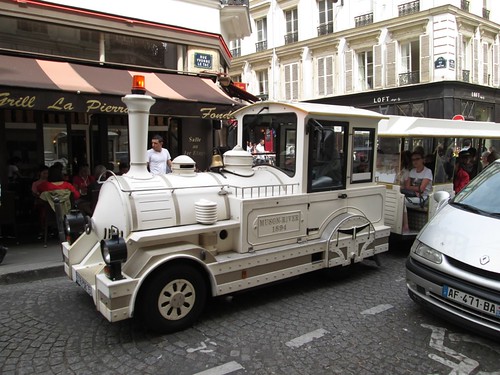
Or you can take this trolley pictured at the right, which will carry you around the neighborhood while at the same time making you look like such a total dork that if you are caught doing it no one cool will ever talk to you again.

After stretching our first day as long as we could, having a simple café dinner nearby, we hit the hay. Sunset was about 10:00 every night, meaning it’s just day most of the time during June. Gorgeous. And overall our weather, while cool, was seldom inclement. We lucked out.

Coachean Feed: No more racism, rights of foreigners, women in movies, homophobia and a Wilde treat.

More links of interest to the debate community.
  • Thanks to SCOTUS for explaining to us that racism is over. Meanwhile, Six Words: 'Black Babies Cost Less To Adopt'. This is some world we live in.
  • I've always been disappointed with people who have suggested, around various debate topics, ideas like the one that non-citizens should have the right to vote, because the inherent illogic demonstrates a pretty firm lack of understanding of the meaning of both citizenship and voting. Still, We Need to Protect the Rights of Foreigners, as this short think-starter piece explains.
  • Casting Call: Hollywood Needs More Women Movies are predominately male, no doubt for all the same reasons as just about every other industry, and this article catalogs the details. But I wonder why, down the street, so to speak, book publishing is predominately female, written by, edited by and read by. Go figure.
  • A single-slice article, Hollywood's refusal to stand up to Alec Baldwin is shameful does raise the issue that homophobia may have an acceptability, if you will, unlike racism or antisemitism.
  • Stephen Fry Reads Oscar Wilde’s Children’s Story “The Happy Prince” Well, that would seem to be self-explanatory. 20 minutes or so of pure joy? Fry's reading of Hitchhiker's Guide is spectacular and, of course, he narrates the British audios of the Harry Potter books. And he's Stephen Fry. 'Nuff said.

Friday, June 28, 2013

How I Spent MSV, #1

(More on resolutions later.)

Flying has to be the single worst part of traveling. At its best, if you have all the money in the world, you still have the hours of getting to the airport (a nightmare all its own in New York) and getting checked in and through security before you find your comfy chair on board a steel cylinder that weighs more than the average apartment building that is allegedly going to lift itself off the ground and fly across the globe at an altitude of about five miles above ground level. If you’re a normal traveler (which still means you have a lot of money, given the way airlines pile on the fees these days: any flight costs about twice the published price by the time all is said and done), you get all the pre-boarding hassles and on top of that, you’re squeezed into a seat that has been carefully engineered to allow the most number of seats across the fuselage and not the most amount of comfort for the seatees. I hear that the next generation of planes, about a foot wider than this generation, has two more seats across. Don’t even think about legroom.

Our flight to Paris from JFK was delayed over an hour because of bad weather. This doesn’t bother me, to tell you the truth. My theory is that one should leave as late at night as possible to encourage sleeping on the plane (or, more accurately, tossing and turning and drifting off on the plane achieving the partial illusion of sleep), so getting delayed a little bit isn’t so bad. We also spent a further hour of delay on the tarmac, which helped solve the other problem of arriving at your destination too early to check in. We had that one knocked before we even took off.

One curious thing: we had two seats of the three in our little patch of turf, and the third was vacant. This meant that we could marginally stretch out a bit, so to speak. I couldn’t believe our luck, and I kept waiting for that straggler to arrive just as the cabin doors closed, but it didn’t happen. We started away from the gate, and we still had the extra seat! Amazing. But, and this is even more amazing, about two hours into the flight, the stew came along with some guy and escorted him into the seat, waking and moving both of us in the process. I have no idea where this guy came from, and how he managed to board the plane 34,000 feet over Greenland. It was the neatest trick of the entire vacation. Maybe he was a variation on the famous William Shatner Twilight Zone gremlin.

I should also point out that while we were waiting to board, we were a little unsure of which gate was which. Then a woman in a wheelchair who was wearing a beret went to what we thought was our gate, which was a great relief, proving that we were at the right gate, as everyone knows that everyone in Paris does, indeed, wear a beret. At the DJ, back when we used to illustrate our stories, a French person without a beret was simply inconceivable. So it is, apparently in real life.

Of course, that was the last beret we saw for the next two weeks.

Anyhow, here’s the rule again: take the latest flight possible, get on board and spend all the time there trying to sleep. Don’t eat the food. Don’t watch a movie (they handed our loaded iPads on this flight, which was a new one on me). Don’t read Proust or listen to podcasts. No music. Sleep, period, with the eye mask they hand out (although I always bring my own, just in case) and noise-cancelling over-the-ear headphones. If you’re lucky, you’ll get three or four hours off and on, which is way way better than zero hours. I’ve tabbed some serious tournaments on way less sleep than that. (Maybe I shouldn't admit that.) And you’ll be as capable as possible when you finally arrive at your destination. To continue your war against jet lag, don’t nap. Get a good walk in the sun. Have a nice dinner. If you’re of age, drink a lot of wine with it, then go to sleep that night at a reasonably late hour on the local clock. The next morning you will then be ready for anything they can throw at you. Even if they’re French.

Wednesday, June 26, 2013

Christmas in June: The 2013-14 resolutions, part three, in which all good things, and some bad things, come to an end.

6. In the United States, the jurisdiction of a federally recognized tribal court ought to extend throughout the borders of the tribe’s reservation.

You know, I hate to admit it (and, for that matter, you know I hate to admit it, for those of you who understand the use of commas), but I have no idea what the point of this one is. The federal government has a special relationship with tribal governments, all of which is probably very interesting to learn about (in fact, I have in my day been quite a history buff in this area), but the underlying point of this one escapes me. The little bit of research I did online to clarify it didn’t help.

You can go here as a starting point: http://www.tribal-institute.org/lists/justice.htm

I would hope that further analysis would uncover an area of tribal rights vs federal hegemony or something, and more to the point, material that would lead to understanding the unique plight of the tribes in America. But the fact that I can’t see it straight on makes me believe I’m either dipping too much into the sauce lately or that this one is going to be a bit of a muddle. I’m inclined to believe the latter, given the steadiness of my hand as I type.

Rating out of a high of ten: ? I’ll reserve judgment until someone explains this to me.

7. Placing political conditions on humanitarian aid to foreign countries is unjust.

If I’m not mistaken, I saw that somebody on Facebook claimed that this was their camp topic. I’m not particularly surprised. This is the second of the three no-brainers.

As a general rule, humanitarian needs do indeed trump politics for the US. If Iran has an earthquake, for instance, we send in a bunch of help without limitations, and they accept it, and then hostilities are suspended until the situation is resolved, at which point we’re back to calling each other names. This strikes me as a good thing. (And note that US is not mentioned in the rez.) But the key word in analyzing the rez is “unjust,” meaning that it’s not necessarily about what is most moral action. Fairness/justice makes you stop and think about this. Of course, my example of disaster aid is only one kind of humanitarian assistance. What about cases of less immediate import?

Anyhow, I see this as meaty and, potentially, again, Jan-May. I don’t know if I prefer it to the DNA topic; I have only just noticed that that one too does not say US, which allows for discussion of tyrannical governments using the DNA, which I don’t like much because of the inherent evil thereof. Oh, well. They are what they are.

Rating out of a high of ten: 8. (And if I were so inclined, I’d go back and similarly rank DNA as an 8, due to the non-US-ness.)


9. The United States ought to prioritize the pursuit of national security objectives above the digital privacy of its citizens.

The last of the no-brainers, and probably the best of the bunch. It’s real, immediate and long term, public safety v. individual rights. Do I need to say more? My only fear is that, because it is so clean and clear, it might not have four months of legs.

Rating out of a high of ten: 9.

10. When in conflict, developing countries ought to prioritize environmental protection over resource extraction.

The dangling modifier aside, this would be a great topic (it’s a chestnut, at least used twice before, I think) if one side argued the environment and the other argued economic development (a better wording concept that resource extraction). That’s why they say, when in conflict. Unfortunately, too great a number of debaters evaluate the resolution, for the neg, not as that resource ext would have to be prioritized over environmental protection, but that the environment need not be prioritized over resource extraction. In other words, the aff must argue for the environment while the neg, not feeling restricted to one or another, gets to argue something else, to wit, sustainability. Duh. Of course sustainability is better than either of the two alternatives, but the resolution, ineptly unfortunately, wants you to choose one or the other. That’s where the WIC comes from. It’s hard to argue that the weasel sustainability neg is a misreading, because it really isn’t. But it is weaselly. I judged a bazillion rounds of this back in the 90s, if I recollect the dates correctly. It was horrible. I kept wanting to hit negs over the head for being weasels, and then I wanted to hit the affs over the head for letting them get away with it. I probably voted reluctant negs almost every time. If you have some way of always going neg, and you’re a weasel, this is the topic for you. At its core, as a matter of fact, it’s pretty fascinating. But LD never looks at the core of an idea if it can help it. Never has, as far as I can remember.

Rating out of a high of ten: 3

And, obviously out of numerical order, I’ve saved this one for last.

8. The atomic bombing of Hiroshima was immoral.

Everyone who looks at this one has, I think, the same reaction: That’s not an LD resolution, probably because, at first glance, it does not ask what we should do in a certain situation. It asks what should we have done. Secondly, although we’ve argued nuclear issues all over the place as long as I can remember, those issues have always included the ideas of MAD and proliferation and nuclear holocaust and the like, none of which are relevant in 1945. We’d have to throw out the nuclear playbook, in other words, to argue this one.

Which is exactly what we should do. If this topic isn’t fun, I don’t know what is. I certainly wouldn’t want to see it for the Jan-May long haul, but as a NatNat or Districts topic, or even Sept-Oct or Nov-Dec, I think it would be a hoot. At its core, it asks key questions about warfare, while allowing for educational benefits in teaching history.

Please, people. Vote for this one.

Rating out of a high of ten: 10 for any time slot other than Jan-Feb.

So, my feeling about the list overall? Honestly, about the same as always. There's some really good ones, there's a couple of confused ones, there's some stinkers. Given the way these things are developed, it's a pretty good job. I only wish that more time and thought went into the whole thing rather than relying on a handful of hours at one event. Countless thousands of hours will go into debating them. A few more hours should go into developing them. But of course, we've discussed that at length in various places, including TVFT. It is what it is, until the NFL makes it better. If you want them better and you're an NFL member, you know who to talk to.


Coachean Feed: Aff-Act, Chomsky on Zizek, racism is over (feh!) and Windsor explained

More links of interest to the debate community.
  • Finally! The Fisher decision in Plain English If the legal contusions of the affirmative action decision left you more than a little contused yourself, this is it in straightforward language. AA stands, but under scrutiny.
  • Chomsky on Zizek and Lacan This video is a little repetitive, as Mr. C dismisses Zizek and Derrida as posturers. Mostly he keeps saying, Where's the beef? Where's the material on which to base action? Sounds like me, if you ask me.
  • Despite what you might have heard to the contrary, racism is now over. Or maybe the south is just no more racist than the north. Or something. Try this nice batch of articles on the Voting Rights Act for aficionados of such trivia starting here.
  • And as far as SCOTUS's parting shot, here's a good summary of what really happened with gay rights: A home run but not a grand slam for gay-marriage advocates: In Plain English
That's two hits from ScotusBlog.com, by the way. It's a good resource.

Tuesday, June 25, 2013

Christmas in June: The 2013-14 resolutions, part two, the adolescent years

And so we continue.

3. Compulsory inclusion of non-felons’ DNA in any government database is just.

This is the first topic on the list that I think does what ought to be done. First of all, it’s a big issue for real. Secondly, it asks to weigh concerns of public safety versus concerns of individual privacy. Additionally, it forces us to understand exactly what it means, scientifically, to include DNA in a database. How does that compare to fingerprints? What can be done with this information other than tracking down perpetrators after a crime has been committed and DNA evidence discovered, which is presumably the reason for the db in the first place? Can we look at your DNA and see if you have some disease that will shorten your life, and somehow route that information to cause you harm? Is there a simple harm of invasion of privacy, period? What right does the government have at all to invade your body when you are not suspected of criminal activity? What’s the 4th Amendment in all of this?

In other words, you can argue this about twenty thousand different ways and the cows still won't be home yet. At first glance the wording doesn’t seem particularly problematic, although there may be some covert issues that will arise with deeper scrutiny. But why bother? The core content of the resolution is rich and full. Only those who refuse to argue the resolution at any cost will search elsewhere.

Rating out of a high of ten: 10. Good for literally any time period, and a contender for Jan-May (as the Jan-Feb topic is traditionally understood).

4. Hypersexualized representations by the media are immoral.

What?

My guess is that this is presumably an attempt at a resolution that will incorporate feminist concerns, but I could be wrong. Maybe it’s about the fact that the unlimited adjective-free “media” (which would be books, movies, television, radio, vinyl records, the internet, advertisers thereon, and a whole lot of et cetera) is oversexed. In other words, the poster for the US version of The Girl With the Dragon Tattoo would be immoral, and the content of the book The Girl With the Dragon Tattoo would also be immoral. Maybe it’s about pandering to our basest instincts, if we wish to include sex among base instincts.

If the point was feminism, how about a resolution that says something like, Women in the US are disadvantaged because of their gender? That way we could look at real feminist materials and get some great reading and education done. We could also examine in a classroom setting the mechanisms of sexism (which are akin to the mechanisms of every other —ism). I mean, if that’s what the point here is. Or if the point is really to address sexy advertising (which I have to admit was the way I read this on first blush), then say so very specifically, because the word media standing all on its own is every medium under the sun.

The more I think about this one, the less I like it. I obviously question what it’s talking about as vague beyond understandability; as a group, will LDers grok it in the same way? I guess it’s the equivalent of “Use of sexual images in aid of commerce is wrong.” Well, maybe it is and maybe it isn’t, but the basic arguments in favor of free speech which must needs allow unfortunate speech as well are pretty canonical and accepted, so I guess the debate here is about morality at its most undebatable level.

Rating out of a high of ten: 1.

I’d stop here, but the next one is a piece of cake:

5. In the United States criminal justice system, truth-seeking ought to take precedence over attorney-client privilege.

No.

At the point where my legal advocate is no longer my legal advocate, I have no legal advocate. At best there is an opportunity for learning here about the point of the justice system, but the legal system is what it is, and to suggest that we change it by eliminating privilege is to, essentially, kill all the lawyers, which is only a good idea if you happen not to need one. Look for 80% neg wins if this one passes (the 20% going into the random rounds where the top seeds hit first-years and eat them for breakfast).

Rating out of a high of ten: 1.

Monday, June 24, 2013

Christmas in June: The 2013-14 resolutions, part one, the early years

I just got back from vacation, and I’ll get around to talking about it sooner or later, or at least hitting the high points, but while I was gone the potential LD topics for next year were released, and I always like to bat these around while they’re still fresh. At least the ones that are fresh, that is. There’s usually a couple of chestnuts in the bunch, as there should be, if LD is going to remain even marginally true to its roots. The chestnuts (like no gov v. bad gov) tend to get chosen for NatNats, which is historically the most traditional of LD venues throughout the season. CatNats works in that same traditional arena with its unique judge panels, apparently chosen by scripture and geography or, perhaps, maybe not, but usually that venue is burdened with an impenetrable and unique resolution. Anyhow, resolutions determine the nature of the debate about them, at least to some extent, and it’s always fun to look at the possibilities and see what we can make of them.

1. A just society ought to presume consent for organ procurement from the deceased.

I saw that someone had gone into a complicated song-and-dance over the fact that we farm organs from the brain dead, who are perhaps classifiable as not deceased, but I don’t really think the issue here is whether one is merely dead versus really most sincerely dead, at least, not in any debate anybody wants to be involved in. Let’s just accept that what the rez is asking is whether society ought to be able to redistribute someone’s organs after that person is dead.

One problem I see with this is the exceptions for religion. At the point where we say that a just soc ought to presume unless the deceased’s religion says otherwise, we’re negating. The thing is, if we accept on the affirmative that there are limitations to what the society can do, we’re really not affirming. An aff has to say that society owns your body after you die, period, for any real clash. Of course, in our modern debate world of limited advocacies, I would imagine a lot of people getting away with loosey-goosey interpretations of this. In any case, religion trumps society by default, neg wins or no one wins. Not good.

Which brings us to the core. Let’s take it face on. Resolved: Society owns your body after you die, period. That’s what this rez is saying, and that’s the underlying position of the affirmative, and while I guess I could come up with some science fiction construct that justifies it, I wouldn’t really want to have to do so. Nor would I be sanguine about arguments regarding the difference between the individual alive and the individual dead. You do own your body when you’re alive, but not when you’re dead? Or you really don’t own your body ever, and it belongs to society as a whole? Since we obviously don’t believe that a just society has sovereignty over your body when you’re alive, any argument that says that it has sovereignty over it when you’re dead must needs lead to questions of whether it has sovereignty over it when you’re simply useless to society (e.g., serving a life sentence). How would these arguments not warrant harvesting organs from live imprisoned child molesters?

Honestly, I dislike this one more intuitively than intellectually. I just don’t see what it’s about, in a world where resolutions ought to be about something. Yes, there is more need for organs than there are organs available, but the main reason for this (I’m assuming) is the lack of available organs in the first place, since you’re mostly talking accidental deaths as the source. I don’t know of any great movement afoot of people protecting their organs after they’re dead, nor any great social movement afoot for getting those organs from the recalcitrant. This is not an issue of great social moment. So on the one hand, I don’t see any great educational benefit from the rez, and second, I don’t see any great ethical/moral dilemma leading to meaningful discussion. People probably could come up with arguments on this topic, but no one’s going to like it much.

Rating out of a high of ten: 3.5.

2. A progressive income tax is more just than a flat income tax.


Yes, it is, which is why it’s the standard pretty much worldwide, and even most flat taxes, as such, are modified by deductions that render them proportionate. What’s the point here? Aff gets to argue the de facto economic reality/necessity (which already biases those able to game it better, i.e., the rich) and the neg gets to argue that we should simply give it to the rich in the first place without forcing them to hire fancy lawyers and tax consultants?

I gather that flat taxes have the potential to raise more income, but that would not seem to be an issue of justice so much as an issue of fiscal (and perhaps totalitarian) management. I’m sure I'm missing something here, and there is a hidden wonderful basis for a round or two, but as I say, I’m missing it. With a resolution like this, going aff pretty much seems to guarantee victory (aside from the residual—inane—belief in neg presumption in LD). Feel free to explain why I’m wrong, but I fall asleep just thinking about this one. At least the one above had the potential for a Zombie K.

Rating out of a high of ten: 1

More to come tomorrow. Jet lag rules at the moment.

Friday, June 07, 2013

Official hiatus

I won't be posting for a while, and I wanted to point out it's not because I got run over by a bus and you missed the news on Twitter during the thirty-second interval when I was a trending hashtag. I shall return, the good Lord willin' and the creek don't rise. When I do, you will be the first to know.

Thursday, June 06, 2013

Coachean Feed: semiotics, pistol-packin' ER, supererogatory acts, cowboys and noise

More links of interest to the debate community.
  • Sometimes very small changes can make a very big difference. It's all in the semiotics. Revamped disability icons coming to New York City
  • A marvel: Eleanor Roosevelt’s pistol licence. Who wants to get shot by an ex-First Lady?
  • I used to use a cap E on my flows to refer to arguments in rounds about supererogatory acts, finding this a unique abbreviation as nothing else regularly used an E, and it also reminded me how to spell the word correctly. Supererogation, Repetition and the Experience of Morning Coffee is a nice little piece on Super E and its transformation via repetition. (Do Super E acts ever come up in LD rounds anymore?)
  • Bibliokept is one of my favorite sites, for cartoons like this one:

  • If you've always scratched your head at the line in "Isn't It a Pity" that goes "My nights were sour / filled with Schopenhauer," why not find out why Herr S was quite unlikely to attach a music player to his sound-cancelling headphones: On Noise. (And if you've never heard the song "Isn't It a Pity," well, that really is a pity.)

Tuesday, June 04, 2013

Have stuff, will travel

I am resolving conflicts about traveling and tech for my upcoming vacation. In the best of all possible worlds, I would have everything that I normally have available to me when I wanted it, but since that would mean either hiring a van to attach to the back of the plane or staying home, sacrifices must be made.

1. Must bring the iPad; this is a no-brainer. The iPad makes the plane trip zip by, for one thing. You can watch movies or play Civ or read books and magazines and listen to music. What else do you need? Once you arrive, you’ve got wifi for checking mail and plotting activities.
2. No phone. I thought about this long and hard, but since I won’t be getting a data plan, why bother? And I’m not getting a data plan because, first, I can use the iPad to check mail once a day, which is more than enough on vacation, and second, I can read a map, and I’m happy to get lost in Paris, so GPS will not be essential.
3. No DSLR because I’m tired of lugging around a big heavy camera (and often a second lens) on my vacations day in and day out. I’m using a little cheap point-and-shoot: 16 megapixel and 5X optical zoom makes little and cheap something fairly acceptable, I’d say.
4. Noise cancelling headphones. Don’t ride an airplane without them!
5. Obviously, no computer.
6. No Kindle, because there’s a Kindle app on the iPad. A fine collection of titles is already waiting for me, all of the vacation persuasion.
7. No iPods. The iPad will do the job, albeit with less choice. So I can live without some of the more obscure tunes for two weeks. It will be a sacrifice, but I think I can handle it.

This means, as far as I can see, traveling absolutely bare-bones. I’ve got only the iPad and a cheap carry-around camera. And some maps. And a hat to keep the sun off my bald head. I’ll probably also bring some pants and other items of a clothing nature.

And there you are.

Monday, June 03, 2013

Lean In - A sort of review

Discrimination has multiple aspects. And there are different kinds of discrimination. I wonder sometimes if, despite our presumed universal commitment to fighting discrimination in forensics, we are doing that good a job of it.

We always begin by thinking about things in terms of rights, this being a very elementary way to understand human entitlements. It’s built into our civics lessons from probably the first time we hear about US history in grammar school, that we are all endowed with certain unalienable rights; it’s a concept built into the value premise of the Declaration. It is an easy path from there to believing in civil rights for all. The Bill of Rights started it, and in our own educations we simply recapitulate it on a personal level. Legally we accept that everyone ought to be free to do and be whatever they want. So why, then, can’t everyone do and be whatever they want?

What we think, the very ideas in our head, do not arise there without context. Some of that context is our own experience. And a lot of that context is the social sphere in which we live. From the day we are born we are surrounded by information. That information, and how we process it, defines our selves. That information is, to wit, the culture in which we live.

Culture can be understood via meatballs. If you are born into a family from an Italian culture, your parents like meatballs. The day you are born, perhaps, your parents share a meatball sandwich while you’re taking your first nap. There are often meatballs cooking in your family’s kitchen, and in the kitchens of all of your relatives. Meatballs are taken for granted. They are a part of your culture. This doesn’t mean that they are always front and center, or that you personally like them or dislike them. It just means that they are there. Meatballs are an indisputable part of your existence.

All culture is meatballs. Religion? If your parents are observant, their religion surrounds you from day one. If your country is religious (e.g., you live in Pakistan), your country’s religion surrounds you from day one. Living in Pakistan doesn’t make you a Moslem, but you live in a space that’s Islamic. It’s a part of the information that surrounds you from birth. It and all the other aspects of culture, like language and art and climate and everything other thing you can think of, define the world that surrounds you; you as an individual are defined by how you act in and react to that world. If individuality itself is minimized by a culture, so be it. If individuality is maximized, so be that. It all varies, but the process is the same. The point is, all of us are products of our culture. Culture is the source of all information around us, including even the most natural of sensory data (we smell the meatballs). We can be separated from our culture, perhaps, but we cannot be separated from the fact that we as individuals are the end result of our responses to that culture. Most of it, we internalize our culture. That is, we accept it and it becomes part of us. Before you know it, we are sitting around eating meatballs with our own children.

One of the aspects of culture is perception of other people. This is not us as individuals reacting to others, but our culture actually defining the others. Obviously, if we are in a meatball-centric culture, cultures that are vegetarian are going to be radically different from our own. And our meatball-centric culture tells us what to think about vegetarians. Value judgments are made on a cultural level. Vegetarians are not as civilized as meatball eaters (or vice versa). We go on from there.

This is all basic stuff, Culture 101 if you will. And at the end of the course we understand that there are cultural prejudices that are built into us as individuals because we have been surrounded by them from Day One. And regardless of how enlightened we might be as individuals, stripping our selves of these prejudices on a personal level, the prejudices remain at a cultural level, unless we figure out a way to strip our entire culture of them.

The reason I think that we in forensics aren’t doing that great a job in this area, not simply of stripping prejudices from our selves but from our culture (the smaller culture of forensics and the larger culture of America as a whole), is that we look at it the wrong way. For one thing, and this is perhaps the biggest thing, we have some of the godawfulest literature to draw on. And worse, we aggressively use that literature in cases and in our self-education. We know just enough about, say, feminism, to think that what we need to do is read and cite Judith Butler. Even if we only look her up and just take a few shots off the bow of her impenetrable writing, we look to her, and others like her, as the source of our ideas. And we proceed accordingly, in an academic and ultimately jejune approach to a subject that is, frankly, neither academic nor jejune.

Sexual discrimination is real. Racial discrimination is real. LGBT discrimination is real. They are built into us as individuals and into our culture. We can establish as a goal the absorption of as much philosophical text as we can, in an attempt to understand it, or we can simply blink a few times and realize that there’s not much here to understand. For one reason or another, and yes, the histories here are different but the results are the same, people in positions of power often maintain that power by exercising it over others in a discriminatory way, often because they believe that their own position in society is more culturally “correct.” On the other side of the coin, the disempowered can be dispirited and, worse, even buy into the cultural biases themselves. The disempowered will alter their expectations based on the arbitrarily insignificant reasons for which they are disempowered (race, gender, sexual orientation).

There is need for two-pronged attacks against discrimination. On the one hand, we have to attack discrimination on the cultural level, removing it from the culture itself. I’ve always felt that education is one answer to this, and I would like to see lots of energy aimed in that direction. On the other hand, we have to attack discrimination on the personal level. And by this, I don’t mean that we have to not discriminate ourselves, although obviously that is a necessity, but those who are being discriminated against need to change themselves and not buy into their disempowerment.

All of which is prelude to my comments on Sandberg’s Lean In. I have to admit that I went into this book, having read the reviews, thinking that it might be a useful tool for debaters. I mean, since I started doing this job back in the Paleolithic Era, I have seen the culture of adolescents in general, and the role assignments that were being made, and the work that needed to be done to combat the bad stuff. (I’ve never particularly subscribed to the idea that debate is somehow worse than high school in general, aside from perhaps the idea that one would expect a little more enlightenment from tournament rats versus mall rats.) As I said above, I’m not a fan of the average sexual politics literature in the activity, so I was looking for something that would relate better to the average reader, something I could point out to a high school sophomore. Let’s face it: most of us couldn’t read Butler if we wanted to. How about something we could read? That was the goal.

Unfortunately, I was a little disappointed by the book. What I did like is the fact that she spends a lot of time talking to women directly, on how they have to change themselves and to combat the bad assumptions that is part of their enculturation. I think that is good stuff, and can be useful to young women, especially those starting out in careers. In other words, there’s some good stuff here for college students and young professionals. At the same time, there’s a certain hifalutin aspect to the book that keeps the reader from truly engaging. Sandberg’s personal story is so unusual, and her career is so high level, that sometimes it’s hard to push down the message she’s sending to a real level.

Probably it’s best that one take the book as a slogan and a concept more than, well, a book. It’s certainly an easy concept to understand; I’ll bet that watching Sandberg talk for half an hour would be more rewarding to almost anyone than reading the book, which ultimately just sort of slogs along. Still, in our little parochial world, where most of the literature is too old—feminism in 2013 is radically different from feminism in 1973, for instance, and Ms. magazine’s inaugural issue was closer to suffragist concerns than today’s, if you ask me—or too arcane, this may be the best book around to put in a young person’s hands, at least until the point is driven home. It won't hurt to take most of Sandberg's advice, and a lot of the facts and figures need to be seen. Just put aside that she was the top student in her Harvard class and after getting her MBA at Harvard Business she was a cabinet level chief of staff and VP at Google and COO at Facebook and that you, dear reader, are just another schmegeggie trying to find a place to park your bike out of the rain. She still has stuff to say to everyone; she just doesn't happen to be everyone.

Saturday, June 01, 2013

The Week in Facebook Poetry

Mechanical issue delay. Back to the gate.
THIS CANNOT BE REAL!
Why am I just realizing now that they changed the back of the penny?!?!

***

Afternoon on the river.
She goes all the way to Jordan and buys jewelry.
My cat snores should I be worried?

***

A hammock of a Memorial Day evening ...
Traffic!!!!!!!!! Not with it!
Are we there yet?

***

Why is the Flinstone's theme song rolling around in my head?
Are you wearing your overalls, too?
DFTBA

***

Bored
How certain smells can help you lose weight.
Yes, we brought the flabongo to the wedding.

***

In Munich!
Today, my hair has discovered the secret of anti-gravity.
Benghazi.

***

Chillin with vino.
Var föreställningen så bra som jag förespeglat?
The winner will be featured in Esquire.

***

Celebrating the new job with a good cigar.
Where are you these days?
I am the greatest conversationalist when talking to myself.

***