
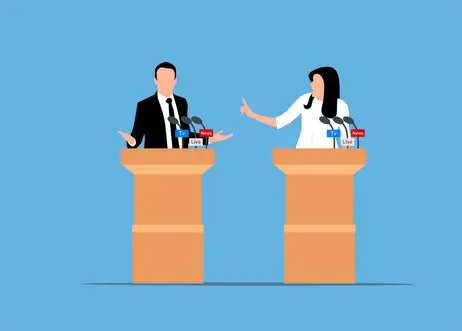
I debated for a year or so in high school. Back then, debate comprised two-person teams, arguing what we would today called Policy debate. It was the only debate available. There was one topic a year, which we studiously researched throughout the season until my partner Duncan and I had a whole shoebox filled with index cards. The topic was socialized medicine in the US. In the ensuing 60 years Policy went from shoeboxes to giant Rubbermaid file boxes to computers. The evidence grew, going from hundreds of facts (our index cards were all facts about something or other, discovered through The Reader's Guide to Periodical Literature and deep digging in the stacks of our local libraries) to fact-like items to general opinions to God-knows-what that would take up today's norm of a computer memory's thousands of "cards" — at least the designation remained the same. Curiously, the topic hasn't changed much either, insofar as government + medicine hasn't quite been resolved yet, sixty years later, and comes up regularly in one kind of debate or another.
As time passed, and the ability to amass information began to grow, things changed accordingly. Eventually what emerged were not a couple of schmeggies like me and Duncan, researching when we had a few spare moments, but machine-like team operations with dozens of students all researching regularly and pooling their resources. Big-time teams dominated, because they had the labor power to amass virtual Everests of evidence. Duncan and I would never have had a chance, even using the same modern tools. Giants ruled the earth.
There were also a lot of changes in the sense of what was going on in the rounds, with, shall we say, the hermeneutics of debate. For one thing, if you had a million pieces of evidence, you wanted to introduce as many of them as possible into your argument, so you had to talk fast. Really fast. Like a tobacco auctioneer (do they still have those?). So fast that only people trained in fast talking, e.g., other debaters and tobacco auctioneers, could have any idea what you were saying. And there was the introduction of the latest rhetoric theories and arguments from college debate, since as often as not college debaters were working with high school teams, and even more often than not judging their rounds. One of the most startling things I heard early on in my years as a coach was that a local debate coach with a national reputation, one of the leaders of the activity, considered himself unable to judge Policy.
A monster had been created.
Instead of trying to defeat the monster on its own ground, some teams, small and poorly financed—these monster teams by this point were traveling around the country almost every weekend to debate other monster teams—came up with the idea of not fighting the monsters but fighting monsterdom. They ran cases that were critiques of the situation, saying that the playing field was not level and arguing that not only should they not have to debate on an non-level playing field, but that they should be given wins because the situation was clearly demonstrating intrinsic unfairness. Some of this was based around race, and it almost became a cliche that if a Black team was running a racial critique, not voting for them for the win was an act of racism on the part of the judge. This was not exactly non-controversial. In any case, critiques became a common things, critiquing all sorts of aspects of the debate, as well as approaching topics from feminist, ageist, ableist, queer and other perspectives. They became known as kritiks, and ultimately Ks.
Meanwhile, the National Speech and Debate Association (called the National Forensic League back then, resulting in an obviously problematic acronym) started up a new kind of debate to make up for the growing esoteric nature of Policy (seen if nothing else as too fast for human ears). Lincoln-Douglas was born, comprising one-person teams and theoretically dedicated to what was called Values. The idea would be not that Socialized Medicine was a good thing because 63.92% of people in the Okefenokee Swamp would not catch the yaws but because Kant had demonstrated that people giving other people medicine was deontologically the right thing to do. One way or the other, deontology vs consequentiality became the underlying positions, and/or the individual versus society. Enlightenment philosophy was the coin of the realm.
LD, as it was quickly abbreviated, became very popular. The speed wasn't there, and the content was relatively accessible compared to what the Policy monsters were up to. Read a touch of Mill and Locke and Kant and you were on your way. And coincidentally, how many other high school students were reading such things, so you were now way ahead of the game simply in general albeit hifalutin knowledge. When you finally got to college, you would have philosophy 101 knocked.
The problems that eventually plagued LD were analogous to the ones plaguing Policy. The pedal kept getting closer to the metal and the speedometer just kept registering faster and faster. Then the blight of postmodernism struck. The college students who were coaching and judging high schoolers were themselves caught in the last gasps of PoMo in their college classes. At the point where most academics finally admitted that Derrida & company were mostly incomprehensible, college students were still knee-deep in the murk. Some of it was, indeed, fun (I enjoyed Baudrillard, for instance, one of whose ideas was that the best part of Disneyland was the parking lot) and some of it was materially useful (Foucault, definitely) but much of it was just impossible. I mean, where does one pull an ethical structure—remember, we were arguing right and wrong—from crazy old Nietzsche? (BTW, Policy in its own way wasn't immune to this sort of stuff.)
The next thing that happened to LD was that the topics, rather than concentrating on philosophical conundrums, started dealing with real world issues, the arguing of which required real world evidence, the sort of 63.92% of people in the Okefenokee stuff that Duncan and I had been dealing with, eventually evolving into the same God-knows-what of Policy. It was becoming for all intents and purposes one-person Policy. The whole K thing arrived at its doorstep as well. And I became that debate coach who couldn't judge his own activity.
So what we had in the debate universe was a two-person event dominated by powerhouse programs, arguing about hermeneutics and critical theory and obscure philosophy at rates of speed incomprehensible to normal humans, and a one-person event dominated by powerhouse programs (because LDers too were now regularly traveling around the country in what was called the national circuit) arguing about hermeneutics and critical theory and obscure philosophy at rates of speed incomprehensible to normal humans. As an aside, all this cost a lot of money for plane tickets and private coaching and hotels and registration fees, which, of course, becomes yet another subject for a K.
At around the turn of the millennium, NSDA wanted another type of debate aimed at solving the problems (if you want to call them that—many people don't) of Policy and LD. NSDA wanted an activity that wasn't esoteric. With the financial support of Ted Turner, they created Ted Turner Debate, quickly renamed Controversy, and subsequently quickly renamed Public Forum. The theoretical paradigm was that a general population lay audience would act as adjudicators. Certain people, essentially the "professional" college student type judges, were literally barred from judging the event. Among other things this would eliminate blazing speed as counterproductive. The topic would change every month, thus establishing a physical limit to the amount of research that could be done. And that topic would be something about current events, so that the debaters might actually learn something along the way other than how to debate. That is, by the way, the long and the short of it. What was the goal of debate educators? To learn about all sorts of content not covered in normal classroom, be it history or politics or morality or the like, or to learn how to debate in an academically rhetorical vacuum? Much of modern Policy and LD is the latter. The NSDA wanted the former.
What happened quickly in PF, which certainly had its growing pains, with various rule adjustments as time went on, was that it became the main general debate activity. It didn't require a coach to learn all sorts of esoteric skills like the ones that edged out me and that famous policy coach from being able to judge our own activities. The general content meant that almost any teacher could have a go at it. And best of all, your judges were free. You didn't have to hire college kids for a tournament: you turned instead to the parents of the debaters. After all, the event was intended for a general community audience. And you wouldn't have to pay parent judges, who could also act as chaperones if needed. Parents were promoted from handing out cold debate ziti at local tournaments to virtual partners in their children's extracurricular education.
Although PF started slowly, with lots of incumbents considering it second-rate debate, that bias eventually dissipated. While schools offering Policy and LD were dwindling, schools offering PF were beginning to boom. At tournaments, the Policy and LD fields were dwindling while PFers were breaking down the doors. (Not to put too fine a point on it, since PF was 2 people you could charge twice as much as LD while using the same space resources; all you had to do was put out another tray of debate ziti.) In my region of the northeast today, Policy is virtually dead, with only a handful of programs fielding any sorts of teams. LD, having taken the same road to esotericism, is also dying, but more slowly. When I started out in the mid-nineties, there were 6 schools within short driving distance doing LD and Policy. Only one of them still has a serious program, while only one new school has relatively recently started up an LD-only program. 4 high-level tournaments in the area have disappeared from the calendar, without any replacements. The numbers at surviving tournaments around the northeast tell the story. They're all PF teams up the wazoo, whereas it-is-what-it-is in LD and Policy (if Policy is even offered at all).
(And this does not cover leagues of inner-city schools and the like, which are mostly or entirely PF, and/or middle schools that have taken up debate as an educational sideline and who use PF as their medium. Because PF is accessible to kids, teachers and lay judges, it is booming beyond its old boundaries. Nice!)
One thing I haven't mentioned that plays into PF's growth, which is in most cases at the expense of Policy and LD, is student burnout. To be a competitive debater in those older activities requires that, in effect, debate becomes your life. When you're not researching, you're on the road attending high-level tournaments. Plus you have to keep up your schoolwork, presumably at the A+ level that makes you a competitive debater. That was how I lost some of my best debaters: they just didn't want to do it anymore. They wanted a life that wasn't limited to debating. I can't say as I blamed them. Meanwhile, if for no other reason than that the topics kept changing rapidly, PF didn't really reward or require giving up your life for it. There was no such thing as a longterm casual LDer or Polician, whereas a PFer could do other things with their time if they were so inclined. I consider that a positive.
In the end, it is the parent judging that has kept PF from going down the same road to extinction of LD and Policy. Some of the best PF people dislike the idea of parent judging. They can't do all the fancy stuff their colleagues in LD and Policy are doing. Of course, if a team gets assigned a college student judge up on all the latest, they can (and do) go to town. But the bread and butter of the activity is the parent judge. The debaters can't use extreme speed to load up evidence, and besides, the topics change too rapidly to amass that evidence in the first place. Ks are baffling to this audience, where Herman Uticks was a kid they vaguely remember from second grade. And since parents are cheap judging cannon fodder, they aren't going away any time soon. Most debate budgets have been slashed and slashed again over the years; the pandemic speeded up the process in many cases. The average public school doesn't have the money to employ high-level college student debate judges as ad hoc assistants or judges. The average public school has had to cut its participation because it can no longer afford bus transportation. Money, or lack of it, talks.
So, in this essay on present-day high school debate, we see Public Forum as the main event. And we see it staying relatively as it is. It is an event in which any school can start a program, at about as cheap as it can get. It's good for teachers, it's good for students, and it's good for parents, even if I haven't cited the benefits to them, chief among which is having a part, however small, in their teenagers' lives, which can be a difficult rarity at best. I'm sure PF will continue to evolve in some ways, but I don't think the underlying structure is going anywhere. Nor do I think there are many people who want to change that structure. They may have good reasons to want to do so, but can those reasons stand against the status quo?
You know what I think.
By the way, don't get me wrong. I do not dislike LD or Policy. Or Student Congress or Original Oratory or any forensics event. Each is valuable in its own way. And LD and Policy aren't going away completely. Large programs especially continue participating in those events, and there are certainly strong pockets of each around the country. In fact, we created the Online Debate League precisely to provide outlets for Policy (and later LD and PF) where there is no local tournament presence. I want every activity to live and thrive. I do think that LD and Policy are irretrievably lost in the doldrums, but they are not lost to the world at large and probably never will be. Hell, I'm on the team trying to save them. But I understand their problems and virtues, as I understand PF and its problems and virtues. At the core, I love high school debate for many, many reasons. If PF as it is practiced today is the most accessible and popular form of high school debate, and middle school debate, count me as all in on preserving it and, more importantly, keeping it growing.
And there you are. Thanks for reading this to the end. You may be the only one who has.


1 comment:
I doubt I'm the only one who read to the end (I've been following the blog for about 2 decades now, from back when I was a debater), but I'll admit the last few weeks of book and music reviews have made me reconsider hanging on. I'm here for the debate stuff.
Post a Comment